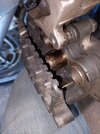
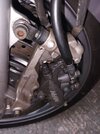
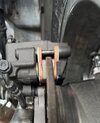
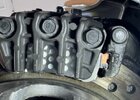
Rear brake binding

Yes I removed the SMC and placed it at a 15 Degree angle and placed piece of steel plate in place of the brake disk.
I was just an observation that when the SMC was pumped on its own, there is not enough force to reach the end of the clear tube.
 
There shouldn’t be.
If you bled the entire system, strap & weight the levers on overnight.
Then in the morning release them and you should have firm levers with no more the 1/2 of travel.
 
It really helps if you understand what is going on in the brake system.

For example - "you got to #3". That is the start of the process for the rear brake circuit using fluid from the rear reservoir. What you did for #1 and #2 was for the circuit operated directly by the front brake lever using fluid from the front brake lever reservoir. The two circuits are independent of each other.
If you have got something in the calipers to stop the pistons being pushed out, then you can do #1 and #2 as a cycle until they feel firm and then cycle round #3 to #7 without going back to #1 and #2 - until you get the brake pads in, the calipers bolted up and you do the final full bleed 1 to 7 after leaving the brake lever tied back and the brake pedal weighted overnight.

Read this - a lot of people have found it very helpful.


As far as the #3 to #7 sequence is concerned - the brake fluid goes in two directions from the brake pedal master cylinder: a) To the rear centre piston. And b) forward to the front centre pistons.

The line to the rear centre piston is easy to bleed - the brake line goes downhill to the caliper and can be filled with fluid very easily. But you cannot feel this at the pedal. until you have all of the air out of that line - the two halves are joined by a double banjo bolt - so they form part of the same circuit.

Then focus on the line going to the rear outer pistons. This line is complicated: it ends at the rear outer pistons - but it goes first to the front centre pistons. It splits on the front right fork leg above the mudguard (at the delay valve). Then over to the mudguard to front left centre piston. Get the fluid to the front right centre piston first.

From the front left centre piston it is a very short run - a couple of inches - to the inlet port of the SMC - so it really helps if you can get the air out from the hose that bends up behind the head lamp when you bleed the front left centre piston (lower bleed valve on the front left caliper). There are actually two hoses. So flex both of them at the same time - unless you want to work out which hose is which. The next bleed valve after that is back up the fork leg, across the mudguard, via the other flexible 'n' shaped hose to the headstock and then to the right hand side under the fuel tank - the PCV bleed valve. Once you get fluid coming out of that bleed valve you need to exercise the SMC to get rid of air any old fluid that is lurking in there. If you are not getting a good flow out of that bleed valve, it is worth carefully unscrewing the valve and pumping a few squirts of fluid. I've had gunge shoot out like a cork from that point. Put the bleed valve back extremely carefully - gently turn it anti-clockwise unti you feel it drop off the start thread and then gently turn it clockwise. Use fingers only until you reach the point at which it needs to be tightened.

The SMC needs to be tilted so the fluid is being pushed uphill, but you're not trying to shift the fluid with the SMC - you are really trying to clean the bore, and to help eject the old fluid behind inlet port between the SMC piston's two seals. It needs brake pedal pressure to push the fluid past the primary seal **. The fluid and air from the outlet port goes (eventually) to the PCV bleed valve. You might need help to keep the flow going while you exercise the SMC by having someone to press the brake lever. Get them to watch the reservoir level as well because while you are on the left side of the bike, the reservoir is quickly running out if fluid.

Then its down to the rear outer pistons and the rear most bleed valve to expel any air between the PCV bleed valve and the rear outer pistons.

This isn't a sequence start to end. It is a cycle. After doing #7, go back to #3. With more fluid in the system and less air the pumping becomes easier.

I use a vacuum pump to get the first cycle out of the way, but I hate using it. Its messy. So instead I often use the technique described in the manual. Close the bleed valve, pump the pedal / lever a few times. This builds up air pressure. Hold the pedal down or lever in, open the bleed valve and let the air pressure push the fluid through, close the bleed valve as the fluid flow slows down. Repeat.

After leaving overnight with lever tied back - gently release the lever. Push in the front outer pistons a fraction - air will have collected under the reservoir - this helps it through the tiny compensation port. Ditto with the brake pedal and the rear centre piston.

Once the levers are firming up you can start getting rid of trapped bubbles. Flexing hoses above the mudguard, tapping joints. etc.

Chase the air around the rear circuit. Do the rear centre first. Then chase to the front right centre, front left centre, pcv bleed valve, rear outer pistons. (That is slightly different from the sequence above, but you are chasing an imaginary bubble of air to the next bleed valve. That is different from filling the system from scratch.)

Read the pdf file. Watch the video. Study the pictures. None of this made any sense to me from the Honda manual until I decided to write this document. It was only by putting it together and trying to explain it - and researching and discussing with people like @Igofar and @Anna'sDad that it started to make sense.

It often takes me 3 or 4 circuits of the sequence #3 to #7 to get the brakes feeling as they should. I've just refurbished my one way bleed valves - so I can leave them attached while I do the rounds. The old hose was getting to tinted and stiff, but a length of windscreen washer hose is a good replacement. I don't know how long it lasts with brake fluid.

** Explanation of operation of master cylinders.


Note that all master cyclinders on the ST1300 operate in exactly the same way. Reservoir, piston, primary seal, secondary seal, compensation port, inlet port outlet ports.
The only real difference is the angle at which they operate. Clutch and brake lever - horizontal. Rear brake pedal - vertical with plunger facing down, outlet port at the top. SMC is at an angle with the plunger facing uphill and outlet port pointing 'downhill'.
 
Last edited:
It really helps if you understand what is going on in the brake system.

For example - "you got to #3". That is the start of the process for the rear brake circuit using fluid from the rear reservoir. What you did for #1 and #2 was for the circuit operated directly by the front brake lever using fluid from the front brake lever reservoir. The two circuits are independent of each other.

If you have got something in the calipers to stop the pistons being pushed out, then you can do #1 and #2 as a cycle until they feel firm and then cycle round #3 to #7 without going back to #1 and #2 - until you get the brake pads in, the calipers bolted up and you do the final full bleed 1 to 7 after leaving the brake lever tied back and the brake pedal weighted overnight.

Read this - a lot of people have found it very helpful.


As far as the #3 to #7 sequence is concerned - the brake fluid goes in two directions from the brake pedal master cylinder: a) To the rear centre piston. And b) forward to the front centre pistons.

The line to the rear centre piston is easy to bleed - the brake line goes downhill to the caliper and can be filled with fluid very easily. But you cannot feel this at the pedal. until you have all of the air out of that line - the two halves are joined by a double banjo bolt - so they form part of the same circuit.

Then focus on the line going to the rear outer pistons. This line is complicated: it ends at the rear outer pistons - but it goes first to the front centre pistons. It splits on the front right fork leg above the mudguard (at the delay valve). Get the fluid to the front right centre piston first. Then over the front left centre piston.

It is a very short run - acouple of inches - to the inlet port of the SMC. The next bleed valve after that is back up the fork leg, across the mudguard, a flexible 'n' shaped hose to the headstock ond then to the right hand side under the fuel tank - the pcv bleed valve. Once you get fluid coming out of that valve you need to exercise the pcv to get rid of air and old fluid that is lurking in there. If you are not getting a good flow out of that bleed valve, it is worth carefully unscrewing the valve and pumping a few squirts of fluid. I've had gunge shoot out like a cork from that point. Put the bleed vlave back extremely carefully - gently turn it anti-clockwise unti you feel it drop off the start thread and then gently trun it clockwise. Fingers only until you reach the point at which it needs to be tightened.

The SMC needs to be tilted so the fluid is being pushed uphill, but you're not trying to shift the fluid with the SMC, you are trying to clean the bore, and to help eject the old fluid behind inlet port between the piston's two seals. It needs brake pedal pressure to push the fluid past the primary seal **. The fluid and air from the outlet port goes (eventually) to the PCV bleed valve. You might need help to keep the flow going while you exercise the SMC by having someone to press the brake lever. Get them to watch the reservoir level as well because while you are on the left side of the bike, the reservoir is quickly running out if fluid.

Then its down to the rear outer pistons and the rear most bleed valve.

This isn't a sequence start to end. It is a cycle. After doing #7, go back to #3. With more fluid throughout the system the pumping becomes easier.

I use a vacuum pump to get the first cycle out of the way, but I hate using it. Its messy. Use the technique described in the manual. Close the valve, pump the pedal / lever a few times. This builds up air pressure. Hold the pedal down or lever in, open the bleed valve and let the air pressure push the fluid through, close the bleed valve as the fluid flow slows down. Repeat.

After leaving overnight with lever tied back - gently release the lever. Push in the front outer pistons a fraction - air will have collected under the reservoir - this helps it through the tiny compensation port. Ditto with the brake pedal and the rear centre piston.

Once the levers are firming up you can start getting rid of trapped bubbles. Flexing hoses above the mudguard, tapping joints. etc.

Chase the air around the rear circuit. Do the rear centre first. Then chase to the front right centre, front left centre, pcv bleed valve, rear outer pistons. (That is slightly different from the sequence above, but you are chasing an imaginary bubble of air to the next bleed valve. That is different from filling the system from scratch.)

Read the pdf file. Watch the video. Study the pictures. None of this made any sense to me from the Honda manual until I decided to write this document. It was only by putting it together and trying to explain it - and researching and discussing with people like @Igofar and @Anna'sDad that it started to make sense.

It often takes me 3 or 4 circuits of the sequence #3 to #7 to get the brakes feeling as they should. I've just refurbished my one way bleed valves - so I can leave them attached while I do the rounds. The old hose was getting to tinted and stiff, but a length of windscreen washer hose is a good replacement. I don't know how long it lasts with brake fluid.

** Explanation of operation of master cylinders.

I have bought some washer hose euro car parts £1.80 for exactly the same purpose.
I had a helper work the brake pedal/refil rear master whilst i worked the detached tilted SMC.

I have been using the bike and what i have noticed is before i start out the rear wheel will only spin half a turn.
After riding for 10 miles the wheel spins freely.
One thing i did notice after getting the tyr changed, i asked for the wheel bearings to checked and changed if necessary.
The shop only replaced one wheel bearing as it was a bit rough, they did not replace both as having only one in stock.

When reinstating the wheel the spindle pushed through much more easily than before.
Thanks again for taking the time to explain, I will have another cycle through.
 
I have bought some washer hose euro car parts £1.80 for exactly the same purpose.
I had a helper work the brake pedal/refil rear master whilst i worked the detached tilted SMC.

I have been using the bike and what i have noticed is before i start out the rear wheel will only spin half a turn.
After riding for 10 miles the wheel spins freely.
One thing i did notice after getting the tyr changed, i asked for the wheel bearings to checked and changed if necessary.
The shop only replaced one wheel bearing as it was a bit rough, they did not replace both as having only one in stock.

When reinstating the wheel the spindle pushed through much more easily than before.
Thanks again for taking the time to explain, I will have another cycle through.
Just an update.
I have gone through the bleeding sequence.
1, no air.
2, some air.
3, a lot of air came out.
4, no air.
5, a lot of air came out.
6, no air.
7, very small air bubbles.
I have taken the time to re read the thread and associated guides and understand a lot more how the brake system functions.
20250803_210710.jpg
I have the get the bike off the stand to rotate the rear wheel to check for binding.
 
After strapping the front and rear master cylinders overnight, i have gone through the bleeding procedure again.
1000006564.jpg
1, All ok no air.
2, Lots of air refilled master cylinder x 4 times.
3, Tiny bubbles.
4, All ok no air.
5, All ok no air.
6, All ok no air.
7, Small amount of air. However when operating the rear brake pedal and smc at the same time, the smc cannot be pushed in, pushed back out by operating rear brake peddle.

I have been unable to spin the rear wheel due to the design of hydraulic lift I have.
So I have taken the bike off the lift as I need to replace a leaking fork seal.
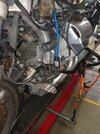
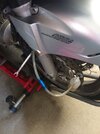
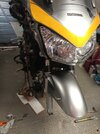
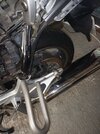
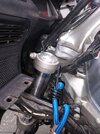
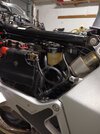
1000006571.jpg1000006573.jpg1000006572.jpg

The rear wheel is still dragging on the disk, about a quarter turn and the wheel stops.
 
Last edited:
Have you inspected the rear caliper mounting bracket?
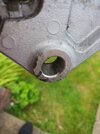
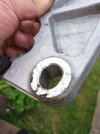
Are there flutes or spiral marks inside the home where the stopper plug rests?
Are you installing and tightening the rear wheel in the correct sequence?
Stopper plug MUST be tightened before the axle nut etc.
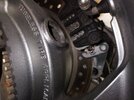
Take a picture of the rear caliper from the right side through the wheel so we can see the ledge that the pad retaining clip rests on, if it’s worn down this will cause an alignment issue and cause issues.
 
Have you inspected the rear caliper mounting bracket?
Are there flutes or spiral marks inside the home where the stopper plug rests?
Are you installing and tightening the rear wheel in the correct sequence?
Stopper plug MUST be tightened before the axle nut etc.
Take a picture of the rear caliper from the right side through the wheel so we can see the ledge that the pad retaining clip rests on, if it’s worn down this will cause an alignment issue and cause issues.
Hi
I have sent the front forks off to replace fork seals.
When the front wheel is back on, I will take the back wheel off to inspect.

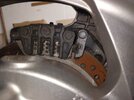
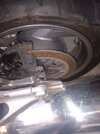
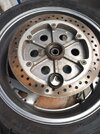
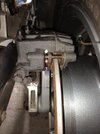
Below us a photo of the rear caliper, the caliper bracket was replaced recently.
20250810_202547.jpg
 
While I can see it clearly with the small picture on my phone, the rear rotor sure caught my eye! I’m not so much concerned about the rust on the forward side in the picture, but with the witness marks on the rear side of the rotor (looks like two grooves) looks like the caliper/bracket/pads are misaligned?
 
The forks are back from All bike engineering London. After the stanchions and fork seals being replaced.
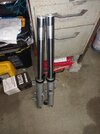
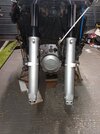
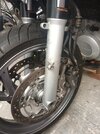
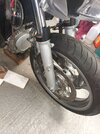
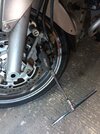
20250821_204115.jpg20250821_211953.jpg20250821_212042.jpg
Will continue tomorrow.
 
I have attached the front wheel following the Haynes manual and JF Heath.
20250823_155757.jpg20250823_155808.jpg20250823_185157.jpg
When I pumped the front brakes after refitting the front calipers and taking off the center stand. It took two pumps to give a firm lever.
I then operated the front smc whilst lying down and rotating the rear wheel. There is hardly any movement required of the smc maybe 1 to 2mm to activate the rear brake.
However the rear wheel becomes harder to turn at one point.
20250823_185215.jpg
I also observed whilst reattaching the front brake calipers, uneven wear of the pads.
20250823_161432.jpg20250823_155424.jpg
 
I have removed the back wheel, checked the rear wheel bearings all seems fine.
Remove the rear disc to check if seated correctly, there was some corrosion which I have cleaned off.
1000006680.jpg1000006684.jpg
The caliper bracket was next inspected. I have a new spare which I will install.
1000006688.jpg1000006693.jpg1000006694.jpg
Will clean the pistons in the rear caliper tomorrow.
1000006697.jpg1000006696.jpg
 
The rear wheel is reattached brake pads fitted properly. The caliper bracket stopper bolt torqed first. New caliper bracket. Still a bit of pads rubbin the disc.
Will go on a test run tomorrow.
20250825_152539.jpg20250825_152556.jpg20250825_152612.jpg20250825_152621.jpg20250825_152646.jpg
 
Last edited:
I started the bike on the center stand and spun the rear wheel.
The wheel is still dragging, I tried the rear brake and the dragging is still there.
20250827_184612.jpg
It is like the pistons in the caliper will not back off.
 
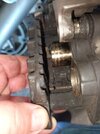
The pistons in the photo from Sunday looked rather messy. Some of it was muck which would probably clean off. Some of it looked like corrosion near to the seals.
The boot on the slider pin is torn. So the slider pin would not be very clean. But you've repalced the bracket now, so hopefully that should be good.

I don't know exactly what you have done, but presented with that situation I'd want to carry out a few tests.

1. Are the front brakes binding - particularly the front left ?

2a. Rear reservoir. Take the lid off (I have to dismount my reservoir to remove the lid). Is it brim full ? It should have an air space above the top line marked on the side. If it is brim full, you need to take some fluid out before doing the next bit.

2b. Front Left caliper. Remove the pads. Remove the caliper from the fork legs. Press the rear brake pedal slightly - careful - you don't want to eject the centre piston entirely. Just move it out a little bit. Then using thumb pressure on the front left centre piston, (having made sure that the piston itself is clean and shiny), push it in to its bore. It should move in easily.
Purpose - to find out whether the rear master cylinder near to the rear reservoir is allowing fluid to return to the reservoir. If it isn't then we have one probably reason. That relief port - the compensation port in the rear master cylinder needs to be clear otherwise the rear brakes will lock up.
2c. Replace the front left caliper and pads - loosely for now - to avoid accidentally ejecting fluid and pistons all over the garage floor.

3. Add a bleed tube to the front left caliper, lower bleed valve. A vertical tube is good enough.

Go to the rear caliper. Remove pads, Remove bracket. Open up the front left lower bleed valve and pump a little fluid into the tube so that you can see the level of fluid in the tube.
Using thumb pressure, push in the rearmost piston in the rear caliper. The front piston should move out easily. Now push in the front piston - the rear piston should move easily. Now push in both together. They will move not as easily - and you should see the fluid in the bleed tube on the front left lower bleed valve go up.
If it does, close the bleed valve. Refit bracket loosely.
Purpose. The rear caliper fluid must be able to escape through the compensation port in the SMC. Normally it flows out to the lines to the rear master cyclinder - but it does that by going past the front left centre piston. You have been checking whether or not fluid is getting through the SMC and the compensation port. The results of this may determine whether a new SMC is required.
4. With the rear caliper bracket in place, and no pads installed. Bracket held firmly enough by the axle - grab hold of the caliper by its top and move it across so the the pistons touch the brake disk surface. (You may want to protect your disks from oil/grease with a paper towel). It should move all the way very easily. Let go of the caliper. It should stay put.
Then pull it all the way towards you until the other side of the caliper meets the disk. Again - very little resistance, easy movement and when you let go, it should not move back by itself.

Purpose. You are checking that the caliper is able to move easily on its slider pins. If it doesn't move the full range, then suspect that the slider pins are not parallel. If it moves by itself when you let go, then suspect that the slider pin is fighting against too much grease or air pressure.
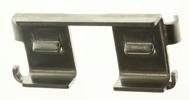
1756394256535.png5. Return to the front left caliper. All brackets have a chrome retainer clip. Like the one on the right. This one is for the rear caliper bracket - it has section punched upwards across the middle of the face on each side of the slot for the brake disc. The front retainer clip does not have this 'ridge'. If you accidentally put the clip for the rear caliper into the front caliper, then the front pads will not be able to move away from the disc surface and the brakes will continue to be applied- enough to operate the SMC and apply the rear brakes. You are not likely to see this behaviour in the garage, but ti will certainly exist on the road.
** If you use EBC pads, then this would not be a problem. All pads have the notch in the pad backing plate. But EBC pads have their won problems.
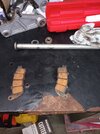
I suspect your rear pads may be EBCs - you said that they were new. New Honda pads would not allow you to see that much of the pistons. The rear pads are much thicker.

6. Finally (for now). I had a fellow UK member come to see me about a locking front brake. We started at the brakes pad end and worked our way back. Toward the end of the day it emerged that he had fitted a new service kit for the front brake lever. Stupid of me - I should have asked where from. No it wasn't Honda OEM. It turned out that the push rod was a fraction too long, which prevented the master cyclinder piston from returning properly - which prevented the excess fluid in the brake line from escaping through the compensation port. Resulting in locked brakes afer the first application.

So it might help to think about what you have replaced and when it started happening.
 
1. Are the front brakes binding - particularly the front left ?
The front brakes are binding not to the extent of the rear, spins half a turn. Cannot tell if left or right binding.

2a. Rear reservoir. Take the lid off (I have to dismount my reservoir to remove the lid). Is it brim full ? It should have an air space above the top line marked on the side. If it is brim full, you need to take some fluid out before doing the next bit.
The rear reservoir has air space as pictured.
1000006765.jpg
I have replaced the pistons, seals, pads, pad pin, bracket in the rear caliper, all are genuine Honda parts from Fowlers Bristol. The front SMC has been replaced genuine part from fowlers Bristol.
The pads in the front are as I had the bike.
I will check my invoice from fowlers to confirm the right pads are in the rear.
1000006766.jpg1000006767.jpg
2b. Front Left caliper. Remove the pads. Remove the caliper from the fork legs. Press the rear brake pedal slightly - careful - you don't want to eject the centre piston entirely. Just move it out a little bit. Then using thumb pressure on the front left centre piston, (having made sure that the piston itself is clean and shiny), push it in to its bore. It should move in easily.
Purpose - to find out whether the rear master cylinder near to the rear reservoir is allowing fluid to return to the reservoir. If it isn't then we have one probably reason. That relief port - the compensation port in the rear master cylinder needs to be clear otherwise the rear brakes will lock up.
2c. Replace the front left caliper and pads - loosely for now - to avoid accidentally ejecting fluid and pistons all over the garage floor.
1000006774.jpg1000006776.jpg1000006777.jpg1000006779.jpg1000006780.jpg1000006781.jpg1000006787.jpg
I have followed this procedure and the piston pumped out and then pushed back into the caliper. Then replaced the pads.
A new set of rear pads have been ordered from Fowlers after telling them the Vin number to avoid receiving the wrong part.
Will continue tomorrow.
 
Last edited:
New Honda pads would not allow you to see that much of the pistons. The rear pads are much thicker.

Fresh OEM instal, The wheel spun 2 times around with no pads and pads 1.5 with a drag.* They have always felt like this when fresh. They loosen up in a few miles for me (this may not be ideal). But here the pictures for reference.

IMG_1822.jpeg
IMG_1824.jpeg

* Edit for accuracy.
 
Last edited:
I have posted a reply below i have A8 pads fitted instead of A6 (my bike).
I sent the order back except the pads.
I have looked on fowlers website and the part numbers appear to be the same.
1756418113645.png
The 2008 is below.
1756418570827.png
I have the wrong pads in the rea caliper willsmotorcycle illustrated this. Not sure how to order these.
 
Fresh OEM instal, The wheel spun 2 times around with no pads and pads 1.5 with a drag.* They have always felt like this when fresh. They loosen up in a few miles for me (this may not be ideal). But here the pictures for reference.

IMG_1822.jpeg
IMG_1824.jpeg

* Edit for accuracy.
My pads are not like this, thanks for taking the time to photogragh.
 
For future reference, the rear caliper on the ST1300A8 and the ST1300A6 are the same. The front brake system, calipers, SMC etc on the A8 and later models are definitely not the same as the A6.
 
Back
Top Bottom