Make easy bleeder location for fitting behind fairing?

I have toyed with that very idea too. The only thing holding me back is how big and exactly where to make that hole - after all, there's only 1 chance at getting it right.
An easy way to locate an exact place to drill like that is to set up a laser pointer or the crosshairs of a laser level to point directly at the point of your part you wish to match a hole with. I mount my laser level on a tripod. Without moving the bike. Put the piece back on ( in this case, the fairing) and wherever that laser is pointing go ahead and drill. I have used this method around the house and the shop for different things and it works perfectly.
 
I would be more than happy to have hydraulically adjusted valves on my ST1300. I had hydraulically adjusted valves on my Honda Shadow 1100CC and I never had to touch the valves once in over 240,000 KM, 150,000 miles. I never even removed the valve covers during that whole time. That is a much more desireable advantage to me on a sport-touring or touring motorcycle that is intended for long distances.

Shadow redline is about 6500 as I remember, ST1300 redlines about 8,000. Hydraulic lifters could/might pump up or bleed down at rpm's over 6500-7000.
 
Shadow redline is about 6500 as I remember, ST1300 redlines about 8,000. Hydraulic lifters could/might pump up or bleed down at rpm's over 6500-7000.
The rev limiter on the 1300 kicks in at 9250 rpm. The tach does show the red zone somewhere before that. I rarely got up there though, preferring to surf the torque wave between 5500 and 6500 rpm.
 
Shadow redline is about 6500 as I remember, ST1300 redlines about 8,000. Hydraulic lifters could/might pump up or bleed down at rpm's over 6500-7000.
No they won't and again, if that is the level at which someone wants to constantly run their ST1300 they bought the wrong motorcycle.
 
The CB650SC had a redline of 10K RPM. I rode one on a few occasions and never felt the need to take it that high. Getting on a highway saw maybe 8000-8500. That was brisk enough. I don't ever recall hearing about problems with its hydraulic valves. Some electrical stuff I think.

I'm sure if you kept the needle at 10K there would probably be an issue. Like the man said if someone wanted to live in that territory they bought the wrong bike.
 
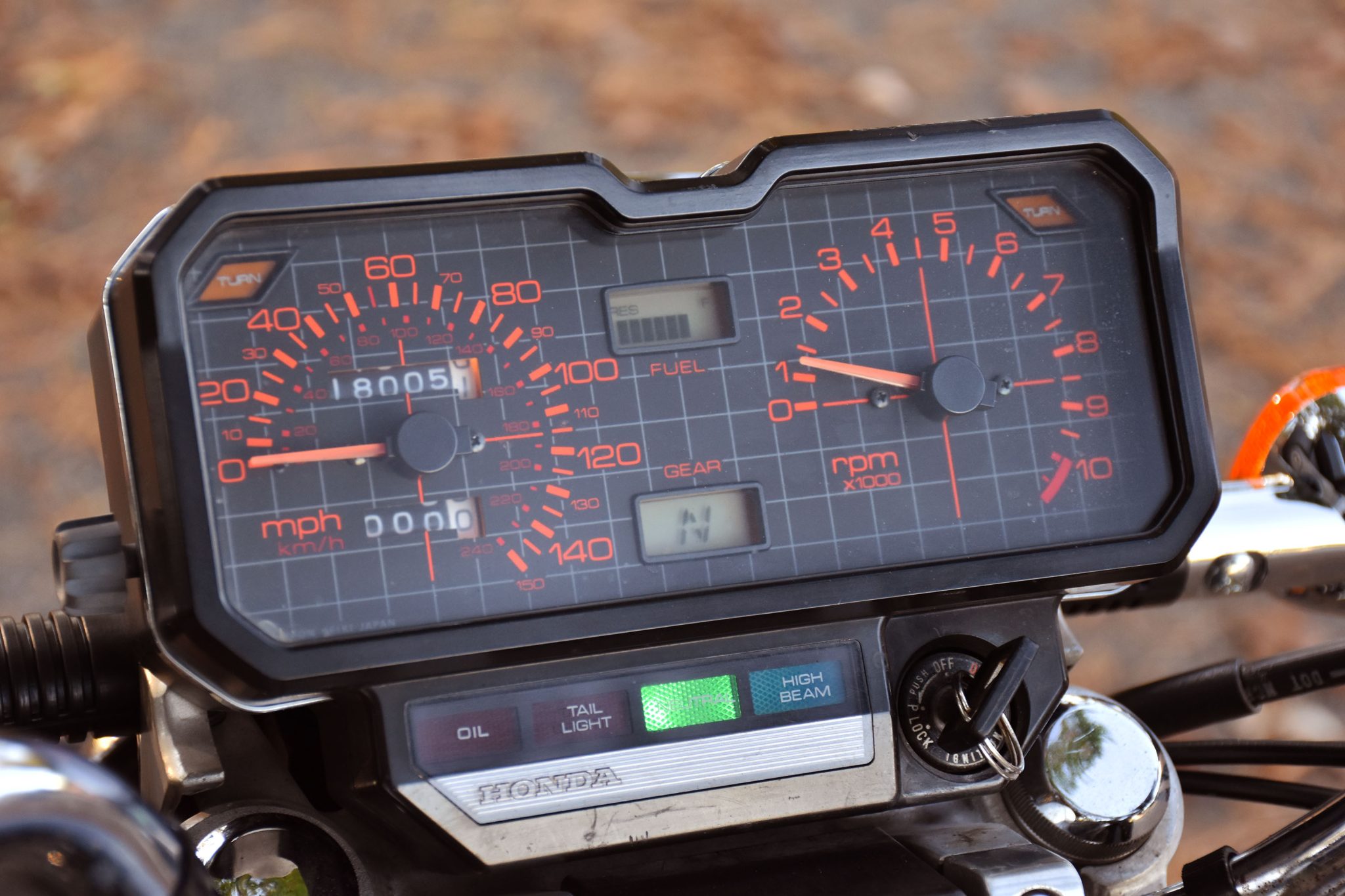
One last bit of straying — one of Honda's best bikes IMNSHO was the 650 Nighthawk/CB650SC.

8ed1d6203c167d6ecbee0d2b460ee4b7b1da33b7.jpg


rejuvenated-1983-honda-cb650sc-nighthawk-is-the-personification-of-the-eighties_11.jpg


Inline 4
Hydraulic valves <— FTW!
6-speed
air cooled
Shaft drive
Fuel gauge
Gear indicator
Beautiful

This bike had it all. A terrific UJM. Or UM even. This would have been a great stablemate to my V65 Sabre. I like the styling of the V45 a bit better but – hydraulic valves!
“Faster than a speeding ticket” was the add Honda used….they just didn’t tell you about all the oil leaks they could never stop in the top end.
 
Had a guy bring me his ST1300 that the Honda shop had modified by drilling a 3/4 inch hole in the side of his $700 dollar fairing piece so you could look straight in and see the PCV Bleeder! They then figured out that there was no way to get a wrench on the bleeder to open and close it :rofl1:
How much you wanna bet they didn't order a new fairing for free and install it on his bike?
 
I didn't write that I want hydraulic lifters in my ST1300, I wrote that I would be happy if it had them. Two completely different conditions. I bought, and have, exactly the motorcycle that I want.
You also wrote "No they won't" referring pump up/bleed down and at just 7,000 rpm that lifter goes up and down 58 times a second enough to cause a problem without constant running at speed.
 
Had a guy bring me his ST1300 that the Honda shop had modified by drilling a 3/4 inch hole in the side of his $700 dollar fairing piece so you could look straight in and see the PCV Bleeder! They then figured out that there was no way to get a wrench on the bleeder to open and close it :rofl1:

So it's not possible to access the bleed valve through the fairing with a hole?
 
How much you wanna bet they didn't order a new fairing for free and install it on his bike?
Doesn't it depend on whether the owner requested the hole or not? I'd think if the mechanic did that on his own, the owner has a slam dunk small claims case. Well, nothing involving lawyers and courts is slam dunk....

So it's not possible to access the bleed valve through the fairing with a hole?
About all we learned from Larry's post was you cannot get a wrench on the bleeder through a 3/4" hole. Come on, the original suggestion/idea was to drill a hole and cover it with a plug and the Honda logo. If the round 'winged' logo is 2" in diameter, then surely one can get both a wrench and hose on the bleeder nipple. With a little creative energy, said logo can be enlarged and printed on say a 2 1/2" or 3" puck that would fit in a larger hole.
 
Doesn't it depend on whether the owner requested the hole or not? I'd think if the mechanic did that on his own, the owner has a slam dunk small claims case. Well, nothing involving lawyers and courts is slam dunk....


About all we learned from Larry's post was you cannot get a wrench on the bleeder through a 3/4" hole. Come on, the original suggestion/idea was to drill a hole and cover it with a plug and the Honda logo. If the round 'winged' logo is 2" in diameter, then surely one can get both a wrench and hose on the bleeder nipple. With a little creative energy, said logo can be enlarged and printed on say a 2 1/2" or 3" puck that would fit in a larger hole.
Sure you can get a wrench on the bleeder through a small hole but you wouldn’t be able to swing it.
 
You also wrote "No they won't" referring pump up/bleed down and at just 7,000 rpm that lifter goes up and down 58 times a second enough to cause a problem without constant running at speed.
I did write that, and they will if cheap poorly designed hydraulic lifters and valve train parts are installed, which I didn't do, so they didn't. That was on older engine designs so I guess that I just got lucky several times over. Hydraulic lifters on a modern design overhead cam engine is capable of even higher RPM's.
 
Last edited:
Average owner OR Honda dealership mechanics. It's been my understanding that shim under bucket is the most reliable and long lasting way to set valve clearance.

I disagree. That maybe the case insofar as mechanically adjusted valves go but with a mechanical valve train the adjustment changes over time as parts wear. This is why regularly scheduled checks are called for and why re-adjustment is required. The most reliable way to keep valves in proper adjustment over the long term is with hydraulically adjusted valves. Wear to any of the parts in the valve train is automatically compensated for on a continual and on-going basis in real time resulting in the valves always being in proper adjustment without the need for any intervenention.

Manufacturers use mechanically adjusted valves for a host of reasons such as fewer parts (less cost to them), less complex engine design and manufacturing (less cost for them), less valve train weight which not only allows for higher RPM's but it also allows the engine to rev up faster, more horsepower, etc.. None of these are significant advantages on a sport-touring or touring motorcycle in my opinion. Most of these advantages would not even be noticed by most riders. If a person is seeking top tier sport-bike like performance, including the little extra oomph that mechanical valves might offer, they should not be expecting to find it in a sport-touring or touring motorcycle, they should be looking at a sport-bike.

I would be more than happy to have hydraulically adjusted valves on my ST1300. I had hydraulically adjusted valves on my Honda Shadow 1100CC and I never had to touch the valves once in over 240,000 KM, 150,000 miles. I never even removed the valve covers during that whole time. That is a much more desireable advantage to me on a sport-touring or touring motorcycle that is intended for long distances.
I have owned several (7) 1100. I checked the valves a few times and blew off doing it again. They were all in spec. On one of the bikes, at 104K miles, all 8 valves were within factory specs.
 
Sure you can get a wrench on the bleeder through a small hole but you wouldn’t be able to swing it.

Something like this would work:

But thinking about it a bit more, I think it would need to connected to vacuum to keep air out of the system since the bleed hose isn't directly connected.

bleed valve wrench.jpg
 
Last edited:
There are bleeder screws that are inches long.....And bleeder screws with a check valve...and I know some folks go wild at the mere suggestion of tampering with brakes....fittings, fluids..pads etc.... Anyway.... ddemair....cool tool.
 
This afternoon I bled the brake system. The previous owner had done it recently, but the rear pedal was spongy. There was a lot of air in the system when I bled the upper section under the tank. Everything works fine now. It was the first time I'd removed the fairing, and it wasn't that complicated compared to my Africa Twin CRF1000. For a disassembly every two years, it's not that much of a hassle, and it's a good opportunity to clean any hidden, potentially rusty parts.
 
Back
Top Bottom