Rider RSS The Roof of Italy—Stelvio Pass

Joined
Oct 25, 2026
Messages
46
Stelvio Pass is one of those bucket-list roads you dream about riding long before you imagine ever actually going there. It is so iconic that motorcycles have been named after it and photographs of its seemingly endless switchbacks have become shorthand for great motorcycle roads. But no photograph quite prepares you for the experience of riding it.

At 9,045 feet, Stelvio is the highest paved mountain pass in Italy. The SS38 climbs from the town of Prato Allo Stelvio in South Tyrol, while another approach comes from Bormio in Lombardy. Both sides are spectacular, but the South Tyrol approach is the one that delivers the famous wall of switchbacks that makes Stelvio instantly recognizable.
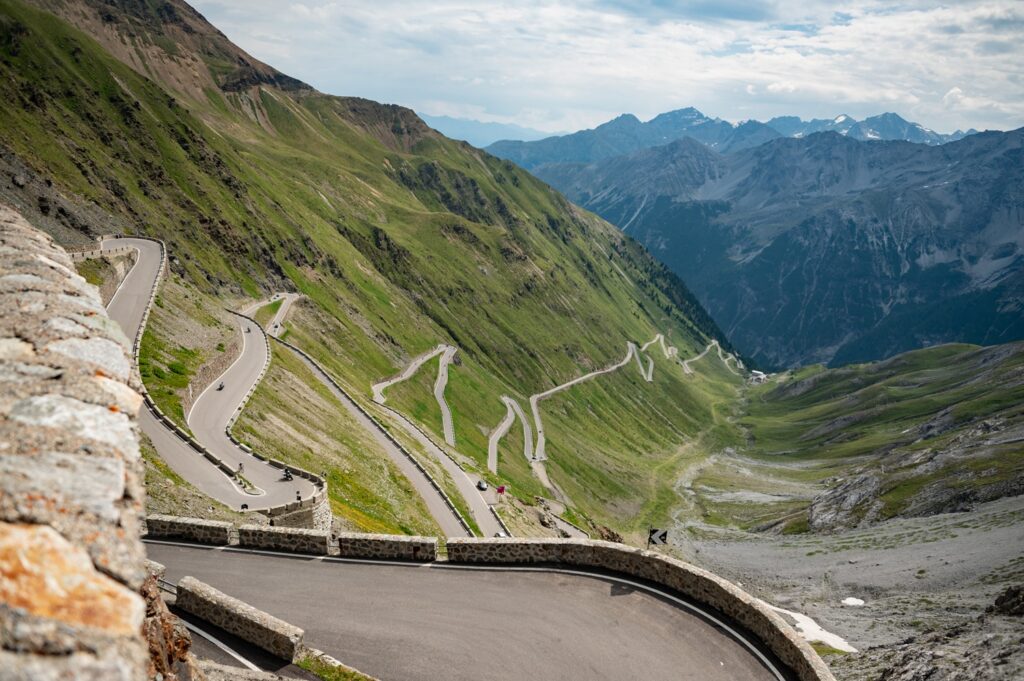

A legendary road through the Italian Alps, Stelvio Pass climbs through 48 hairpin turns and is one of Europe’s highest paved mountain passes. Photos by: Marisa McInturff

At a Glance​


Location: Lombardy and South Tyrol, Italy
Road: SS38, Passo dello Stelvio
Distance: 28 miles from Bormio to Prato Allo Stelvio
Summit: 9,045 ft
Best Direction to Ride: The Prato Allo Stelvio approach provides the iconic uphill 48-hairpin experience
Ride Time: Half day
Skill Level: Advanced mountain riding
Best Bike Type: Sport-touring, standard, ADV, touring


Once the road begins climbing in earnest, the scenery changes quickly. Forest surrounds the lower sections, but the higher you climb, the more the mountain opens up. Then comes the first switchback.

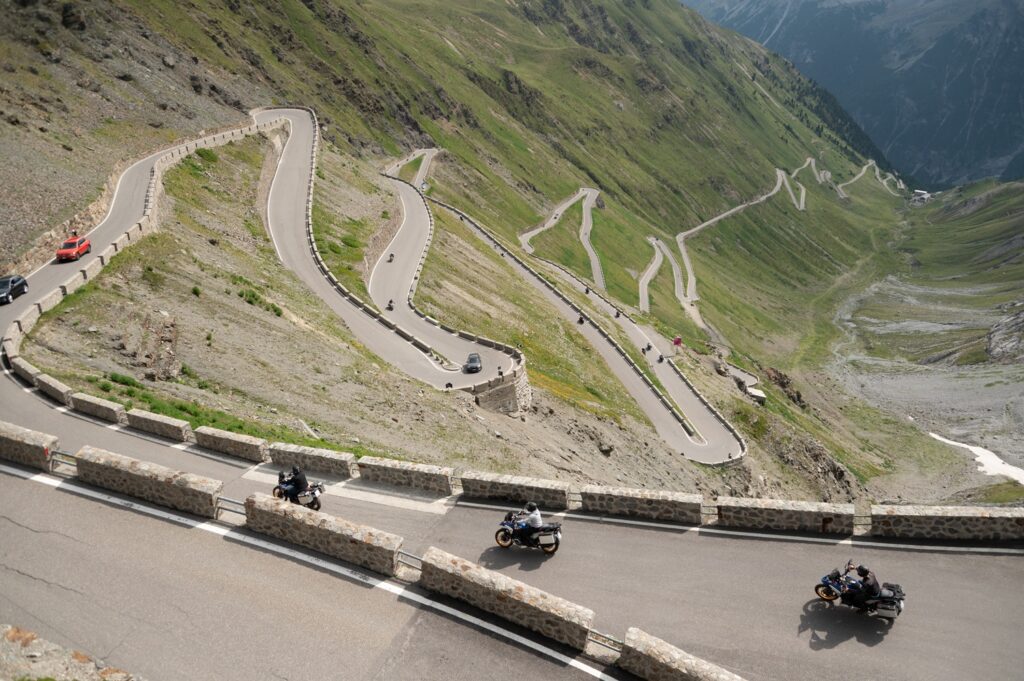
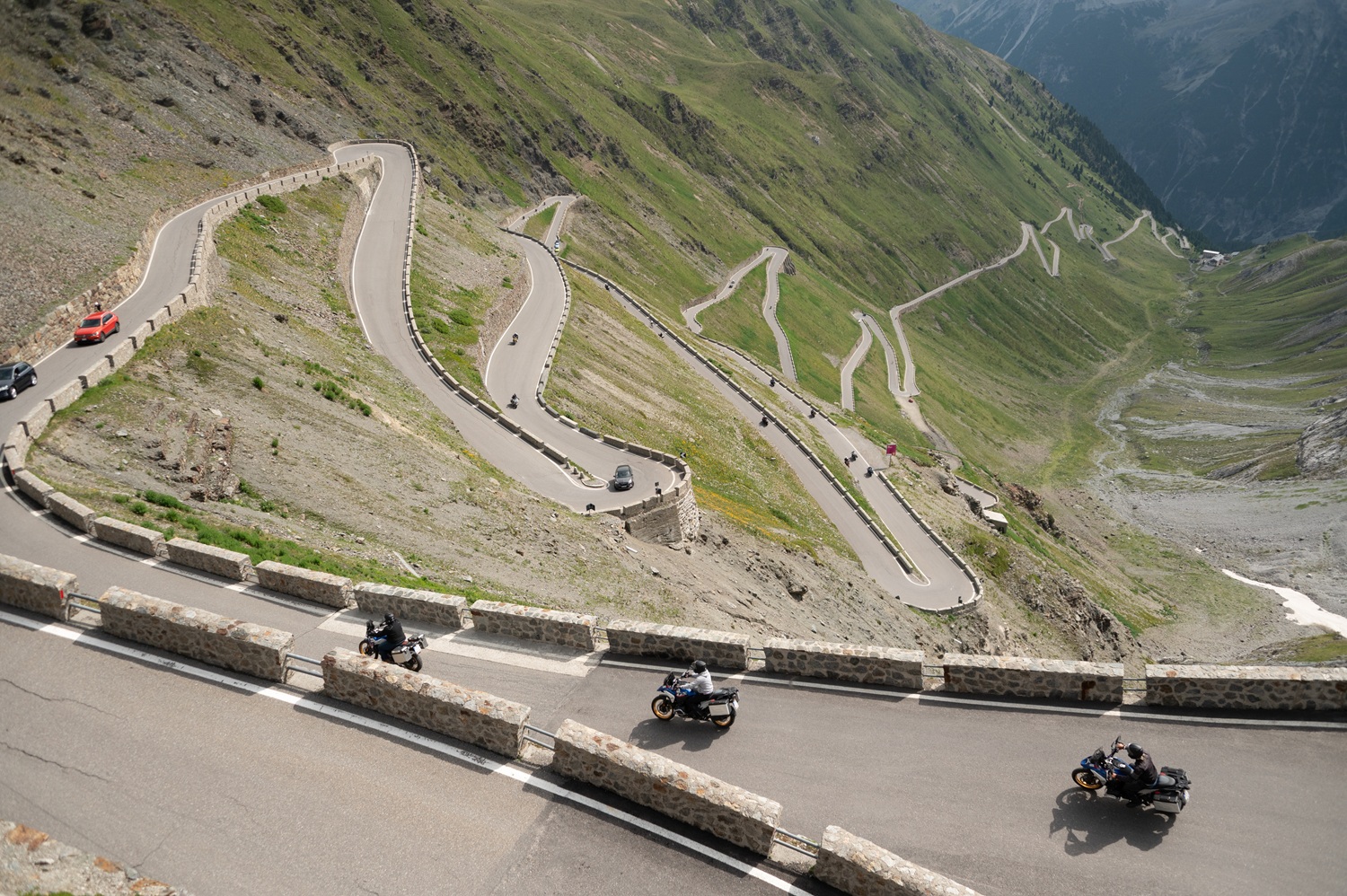
The famous Stelvio switchbacks seem to stack one on top of another as the road ascends the mountainside. There are 48 hairpins on the South Tyrol side, and riding them is a physical experience. Corner after corner requires concentration, precise lines, and a smooth throttle. Before long, I could feel tension building in my shoulders, and I had to remind myself to relax my grip and let the motorcycle work.

One particularly steep hairpin has become something of a celebrity in its own right. Its combination of grade and tight radius has made it a notorious spot for motorcycle tip-overs, and videos of riders losing their balance there have become popular online. Seeing the clips is funny from the comfort of your couch. Sitting on a motorcycle at the bottom of that corner is another matter entirely.

Top of the World​


The pass is more than a point on a map. At the top, you’ll find restaurants, food stands, and souvenir shops selling patches, stickers, T-shirts, and other Stelvio memorabilia. On a busy day, the summit becomes a gathering place for motorcyclists, bicyclists, and tourists from around the world.

From here, the road splits. To the right, you have Umbrail Pass, which takes you immediately into Switzerland following ridgelines. This route is generally less traveled and spits you out in Val Müstair. If you stay to the left, however, you can continue to follow SS38, “Passo dello Stelvio,” all the way to Bormio.

Descending toward Bormio, the road dives through a series of tunnels carved into the mountainside, emerging into views of rugged Alpine peaks and cascading waterfalls. After concentrating so intensely on the switchbacks during the climb, the descent felt like a chance to take in the landscape. The tunnels add another dimension to the ride, between alternating darkness and bright Alpine sunlight as the road works its way down the mountain. Take caution in these tunnels, as many have turns within them that can be hard to see while your eyes are adjusting.

Just remember that Stelvio is a high-mountain road, and conditions can change quickly. The pass is closed during the winter and may not open until late spring or early summer depending on snowfall. Even when the valleys are warm, temperatures at the summit can be dramatically cooler. Check road conditions and weather before heading up, and don’t assume that a clear morning in the valley means clear conditions at 9,000 feet.
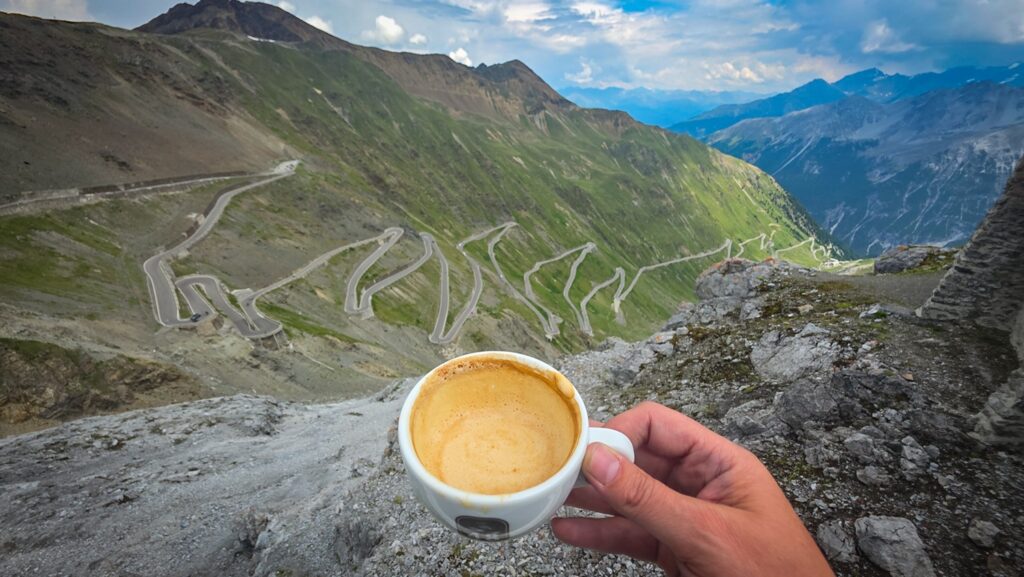

I can’t think of a better way to celebrate conquering Stelvio Pass than by sipping a cappuccino at the top!

When we returned to the summit after exploring the nearby roads, the quiet mountain we’d experienced earlier was already coming alive. The smell of roasting sausages filled the air, motorcycles crowded the parking areas, and the souvenir shops were open for business.

We found a restaurant, ordered cappuccinos and spaghetti Bolognese, and watched the traffic crawl across the mountain. When in Italy, right?

Stelvio is famous because of how it looks, but riding it reveals why it has earned its reputation. The road is demanding, dramatic, and occasionally intimidating. It takes you from green valleys into an Alpine world, then sends you back down the other side through tunnels, waterfalls, and some of the most spectacular scenery in the Alps.


Travel Resources​

Map & Route​


Click to view the route on REVERhttps://go.rever.co/voNQqL6kC4b
Click here to download the GPS files

Road Conditions​


The Stelvio Pass road is paved but narrow in places, with numerous tight hairpins, limited sight lines, and significant elevation changes. Expect motorcycles, bicycles, cars, and buses, particularly during peak summer periods. The road can be wet, cold, or foggy at higher elevations even when conditions are pleasant in the valleys. Check current road conditions before departure.

When to Travel​


Stelvio is a seasonal high-mountain road, and snow can close the pass outside the summer riding season. The best riding window is generally from early summer through early fall, depending on snow and weather conditions. July and August offer the most reliable access but also bring the greatest traffic. Early morning riding can provide cooler temperatures and lighter traffic.

Road Food​


The villages of Bormio and Prato allo Stelvio offer the widest selection of restaurants, cafes, bakeries, and markets. There are also places to eat near the summit, making Stelvio an easy road for riders who want to stop for lunch with a view. You can’t go wrong with a spaghetti and coffee at the top, though those smoked sausages smelled delicious as well.

Where to Stay​


Bormio is an excellent base for exploring Stelvio and surrounding passes, with hotels, restaurants, fuel, and other rider necessities. Prato allo Stelvio and other communities in the Venosta Valley provide additional lodging options. Riders planning a larger loop can also stay in Switzerland or in smaller Alpine villages along the route.

Points of Interest​

  • Stelvio Pass summit
  • Stelvio National Park
  • Bormio
  • Prato allo Stelvio
  • Trafoi and the Venosta Valley
  • Gavia Pass
  • Umbrail Pass
  • Swiss Münstair Valley

If You Have More Time​


Use Stelvio as the centerpiece of a larger Alpine tour. From Bormio, ride Gavia Pass before returning toward Stelvio, or cross Stelvio and continue over Umbrail Pass into Switzerland. The surrounding roads provide enough variety for several days of riding. This area of the Alps is truly motorcycle heaven.


The post The Roof of Italy—Stelvio Pass appeared first on Rider Magazine.

Continue reading...
 
If you want to watch different riders/ tourists (and some really sexy Euro- luxury sports cars) from around the world attempt to ride these hairpin, you absolutely MUST watch @Kanyarfoto on farcebook.
He is a photographer and uses video too, think of Killboy's photo station on the Dragon / Hwy 129 in TN / NC.
He's funny, but very helpful helping goofballs pick up their dropped bikes, usually at what he calls Turn 10.
Many epic fails, some predictable falls and tipoversand lots of entertaining fodder demonstrating how NOT to ride a motorcycle.
 
Here is a section from my End of Season Newsletter that I send out to my Alps-Tours mailing list. It is by Kanyarfoto and is about the final day of Stelvio Pass this season where he talks to the last to bikers to ride the pass. It's pretty funny.

END OF SEASON ON THE STELVIO PASS - A KANYARFOTO VIDEO​

We rode over the Stelvio Pass twice this season, once in June when it was snowing at the top (we did not stop) and again in September when the weather was good and we stayed for an hour.

In good weather it is like a carnival at the top with hotels, souvenir shops, sausage stands, summer skiing on the glacier and loads of people, cars, motorcycles, bicycles and sometimes buses. Its fame comes from its height (3rd highest paved pass in the Alps at 2,760 meters/9,055 feet), its approx. 50 switchbacks per side (dozens of which are visible as you ride up or down), its tight, steep, cambered turns and the fact that the road itself is an engineering marvel with a long history.

It is the only pass that Tour Members seem to know about in advance and ask to visit. As noted above, there are lots of videos online which contribute to its popularity. Kanyarfoto has made a name for himself by posting videos, often daily, of the things he sees while setup at switchback #10 taking pictures (like Killboy on the Tail of the Dragon) for sale. Turn #10 is a tight switchback with a steep inside camber famous for people stalling or braking in the steep camber part knocking them off balance so they fall over gently. Noone seems to get hurt and his videos can be funny at times. Many of my Tour Members have seen his videos.

Kanyarfoto posted a video on November 11, 2026, the last day before the pass was officially closed. It shows the top all closed and boarded up for winter, some recent snow on the ground and him walking around by himself for a final season ending look, when he unexpectantly sees 2 bikers. The two riders were nearing the end of an extended tour (23 countries, 26,000 kms) and didn't realize they had lucked out to ride the pass on the final day before closing. The exchange between all 3 of them is fun and touching to watch. It is also interesting to see the top all closed up and empty, especially if you have seen it in summer brimming with activity and full of life (see the photo above the Moto Musings heading). It seemed like a fitting end of season video.


Having ridden it several times, I find the "poor cousin" Bormio side to be a bit better than the more famous side if for nothing more than there is usually less traffice. Not to say the famous side isn't nice to ride but it can get busy, even in the off season.

Bormio side
IMG_2968 (Small).JPG
 
I look at Stelvio as something to put a checkmark on. Something which each biker must do ones. Maybe like Mt. Washington on the East Coast but on a lessor scale and minus the commercial part.
Ride it ones and don't come back.
Stelvio is probably the most commercial of all passes with overpriced coffee.
After 10-15 switchbacks it becomes work. Let alone in high traffic season. Yes, the views are rewarding.

I much prefer Galibier in France, Gavia in Italy, Furka - Susten loop in Switzerland and maybe the Manghen pass in Italy although it can be a challenge climbing up the tight/narrow hairpins w/passenger on a loaded bike, on the northern side going southbound. But the German sausage with hot sauerkraut and polenta is an unforgettable reward. And yes - the stunning views from atop are always there...

1794970336460.png
 
Stelvio is probably the most commercial of all passes with overpriced coffee.
After 10-15 switchbacks it becomes work. Let alone in high traffic season. Yes, the views are rewarding.
With what I've read about it, I'd probably get to that switchback #10, find that someone dumped their bike in the road and the other lane has a tour bus coming so I'd have nowhere to go.

Last summer I went on a rally in California named aptly The Sierra Sidewinder. Three days of one curve or switchback after another. Fun.

Chris
 
With what I've read about it, I'd probably get to that switchback #10, find that someone dumped their bike in the road and the other lane has a tour bus coming so I'd have nowhere to go.
LOL
Go there in June or September. Not much traffic.
Don't really know why Stelvio is special. There are plenty of passes less crowded and as good or better. Maybe it's just a hype.
 
Don't really know why Stelvio is special.
I think the visual is a big part of it. Just like the "Dragon". There are lots of places in the US where the locals dub their road the "Little Dragon". They are all fun.

While I totally enjoyed the last ride on that rally where we had one switchback after another, I love high speed sweepers. To each his own.

Chris
 
While I totally enjoyed the last ride on that rally where we had one switchback after another, I love high speed sweepers. To each his own.

No reason not to enjoy both. Sweepers are less intense to enjoy the scenery IMO, highly technical riding, for me, doesn't give much time to take in that fabulous view. And now, being older, I'm tired after thrashing a steed about for several hours.
Not saying I don't enjoy it though. Wish I would have had the chance to enjoy some of those Euro passes in my youth, but the photos are great! (sigh).
 
... on weekends during holiday season: total gridlock... :rolleyes:

I mentioned in my Newsletter that the Alps, like many other beautiful and interesting places, have gotten noticeably more crowded, especially since COVID. I made the mistake of going over Stelvio on a sunny June weekend day in 2025 and it was slow going. Even the bikers weren't passing as they normally do on the passes because there was nowhere to go. We went over it 2 months ago on a sunny day mid-September, mid-week and very little traffic.

I now plan my tour rides (and personal rides) to avoid the bigger, better-known passes on the weekends. Social media, YouTube, Instagram, etc. have all played a part in making unique photographic locations way more crowded. The Dolomites have become very crowded. I watched a YouTube video (of course) with a hiker visiting some of the more popular treks, which were loaded with other walkers. He asked a variety of people why they came - 9 out 10 said they saw it on YouTube or Instagram.

I'm very lucky that I have been able to ride the Alps for 40+ years, way back before it got crowded. I've probably been over Stelvio 50 - 60 times during those years in all kinds of weather during various months of its open season. There were times when I had it all to myself on sunny days until I got to the top where there was activity. Same for most of the Alps. I still love the Alps, which is why I keep going year after year, I just do more planning now around the weekends.

I personally think Stelvio is a fantastic road to behold, but not a particularly great road to ride. It's not in my top 5. Passo Gavia on the southeast side of Bormio is one of my top 5 favorites - nearly as high, wild and rugged and less crowded (usually).
 
OK, been reading this a while and decided to chime in with a question.

I've driven a few of the pass roads in the Alps, and on a scenery scale they rate 10/10. But, on the driving/riding excitement scale, I find the US mountain roads to be more fun to ride. The US mountain roads have more of a "rhythm" when riding them. Speed stays relatively consistent, lots of repetitive leans to the left and right as the road follows the contours of the mountain. The Alps switchbacks are a long stretch of straight, slam on the brakes, go around a 180° turn (slowly) and then accelerate again down another long straight section. I find that to be a less interesting road layout while riding or driving.

Beartooth Pass in Montana is the one US mountain road that I've ridden that is paved in a style of switchbacks similar to the Alps, and I felt the same way riding it. Great scenery, but the rhythm of the road wasn't all that exciting.

Anyone else feel the same way?
 
I think many of the older roads are on paths that were originally taken by horse drawn wagons. And those probably followed game trails. It's a function of what is the easiest way to go up a hillside.

That said, you would've liked the road I was on that last morning at the rally. Probably 15 mph tops. It was just a beautiful rhythm. Fling the bike way over to the left, straighten for a couple seconds, then fling it over to the other side. Straighten. Repeat. A wonderful feeling.

Chris
 
OK, been reading this a while and decided to chime in with a question.

I've driven a few of the pass roads in the Alps, and on a scenery scale they rate 10/10. But, on the driving/riding excitement scale, I find the US mountain roads to be more fun to ride. The US mountain roads have more of a "rhythm" when riding them. Speed stays relatively consistent, lots of repetitive leans to the left and right as the road follows the contours of the mountain. The Alps switchbacks are a long stretch of straight, slam on the brakes, go around a 180° turn (slowly) and then accelerate again down another long straight section. I find that to be a less interesting road layout while riding or driving.

Beartooth Pass in Montana is the one US mountain road that I've ridden that is paved in a style of switchbacks similar to the Alps, and I felt the same way riding it. Great scenery, but the rhythm of the road wasn't all that exciting.

Anyone else feel the same way?

Well, besides the switchback roads in the Alps, there are plenty of the S-type roads you're talking about. These are on a lower altitude. And there're plenty of those. They're not only in the Alps per se, but many in Pyrenees (as Pyrenees are lower) and all thru Europe in the mountainous areas from Portugal to Romania.
The advantage over the US good roads is that you don't have to ride for 1000 miles from one good riding area to another. They're almost next to each other. Start in Portugal to Spain to France, Italy, Slovenia, and on, you can always have fun until you tired and welcoming some straights for a change before getting back on the twisties.
American roads like that are far from each other as in the US many are built to go around the mountain rather than over the mountain.

Also, most of them have broken passing lines to allow passing when in US most of the time is a double yellow and you schlep behind a slow-pock or breaking the law hoping no police car is near (happened many times).
Drivers are friendlier to bikes and the food is better. :)
agreed, but the topic of this thread was Stelvio pass and its numerous switchbacks, thus my reply was specifically aimed at those types of roads, not European roads in general.

I'd disagree that you have to ride for 1000 miles from one good riding area to another in the US. I've ridden in all the western states and while there are some parts where the roads get less interesting, there are far more other routes that can be taken where the scenery and roads stay interesting for the majority of the time.
 
I find switchbacks boring especially with one after another for how far?

Come east (US) and ride NC, Va or WV. We ride 200 miles a day of curvy hilly roads, for 3-4 days, with very little if any repeats or divided highways. That's with none of the "named" roads that get all the hype and crazy traffic! Or come half way and ride in Arkansas. We don't even care if you trailer. ;)
 
Last edited:
Stelvio Pass is one of those bucket-list roads you dream about riding long before you imagine ever actually going there. It is so iconic that motorcycles have been named after it and photographs of its seemingly endless switchbacks have become shorthand for great motorcycle roads. But no photograph quite prepares you for the experience of riding it.

At 9,045 feet, Stelvio is the highest paved mountain pass in Italy. The SS38 climbs from the town of Prato Allo Stelvio in South Tyrol, while another approach comes from Bormio in Lombardy. Both sides are spectacular, but the South Tyrol approach is the one that delivers the famous wall of switchbacks that makes Stelvio instantly recognizable.
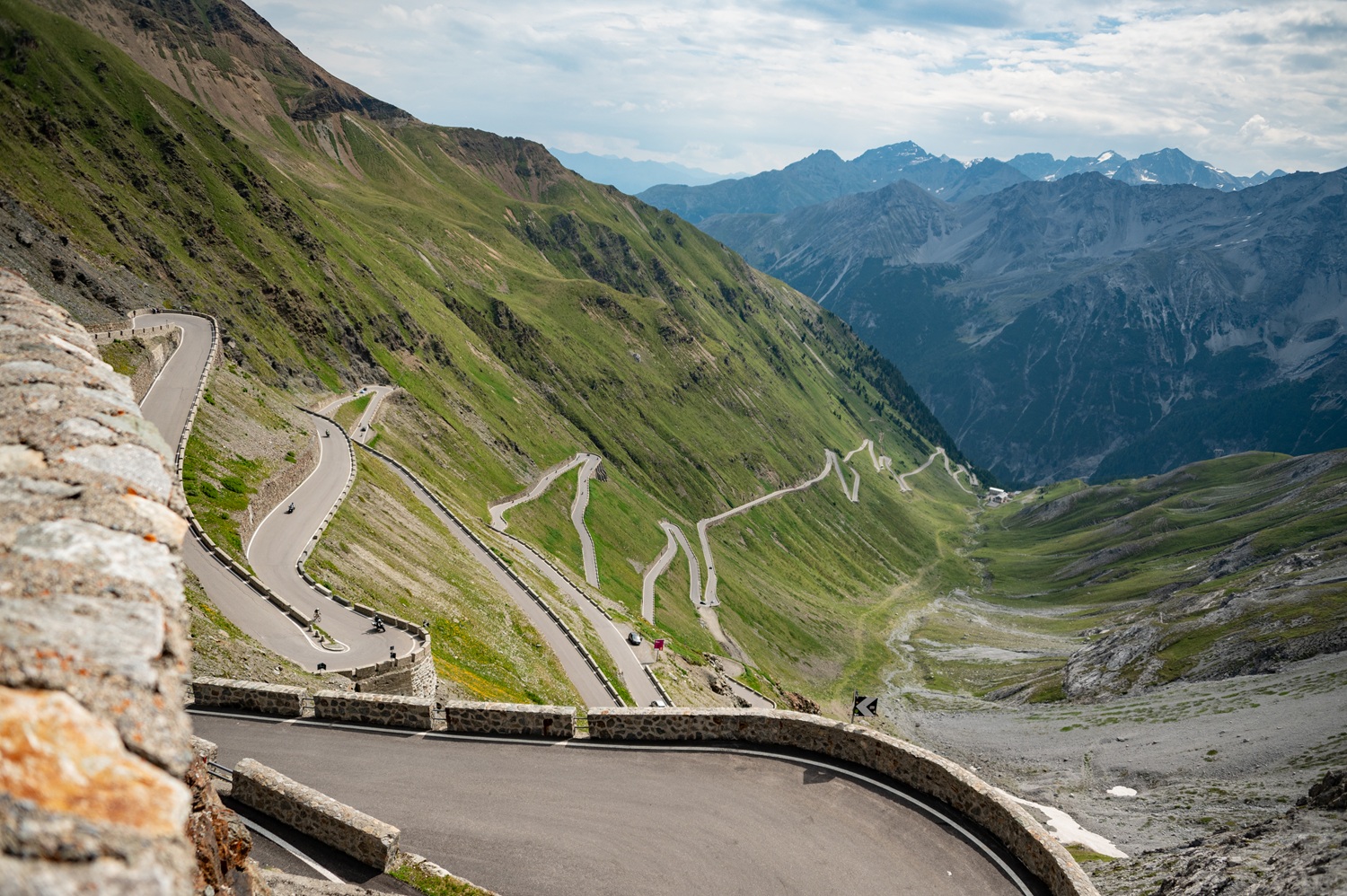

A legendary road through the Italian Alps, Stelvio Pass climbs through 48 hairpin turns and is one of Europe’s highest paved mountain passes. Photos by: Marisa McInturff

At a Glance​


Location: Lombardy and South Tyrol, Italy
Road: SS38, Passo dello Stelvio
Distance: 28 miles from Bormio to Prato Allo Stelvio
Summit: 9,045 ft
Best Direction to Ride: The Prato Allo Stelvio approach provides the iconic uphill 48-hairpin experience
Ride Time: Half day
Skill Level: Advanced mountain riding
Best Bike Type: Sport-touring, standard, ADV, touring


Once the road begins climbing in earnest, the scenery changes quickly. Forest surrounds the lower sections, but the higher you climb, the more the mountain opens up. Then comes the first switchback.

The famous Stelvio switchbacks seem to stack one on top of another as the road ascends the mountainside. There are 48 hairpins on the South Tyrol side, and riding them is a physical experience. Corner after corner requires concentration, precise lines, and a smooth throttle. Before long, I could feel tension building in my shoulders, and I had to remind myself to relax my grip and let the motorcycle work.

One particularly steep hairpin has become something of a celebrity in its own right. Its combination of grade and tight radius has made it a notorious spot for motorcycle tip-overs, and videos of riders losing their balance there have become popular online. Seeing the clips is funny from the comfort of your couch. Sitting on a motorcycle at the bottom of that corner is another matter entirely.

Top of the World​


The pass is more than a point on a map. At the top, you’ll find restaurants, food stands, and souvenir shops selling patches, stickers, T-shirts, and other Stelvio memorabilia. On a busy day, the summit becomes a gathering place for motorcyclists, bicyclists, and tourists from around the world.

From here, the road splits. To the right, you have Umbrail Pass, which takes you immediately into Switzerland following ridgelines. This route is generally less traveled and spits you out in Val Müstair. If you stay to the left, however, you can continue to follow SS38, “Passo dello Stelvio,” all the way to Bormio.

Descending toward Bormio, the road dives through a series of tunnels carved into the mountainside, emerging into views of rugged Alpine peaks and cascading waterfalls. After concentrating so intensely on the switchbacks during the climb, the descent felt like a chance to take in the landscape. The tunnels add another dimension to the ride, between alternating darkness and bright Alpine sunlight as the road works its way down the mountain. Take caution in these tunnels, as many have turns within them that can be hard to see while your eyes are adjusting.

Just remember that Stelvio is a high-mountain road, and conditions can change quickly. The pass is closed during the winter and may not open until late spring or early summer depending on snowfall. Even when the valleys are warm, temperatures at the summit can be dramatically cooler. Check road conditions and weather before heading up, and don’t assume that a clear morning in the valley means clear conditions at 9,000 feet.
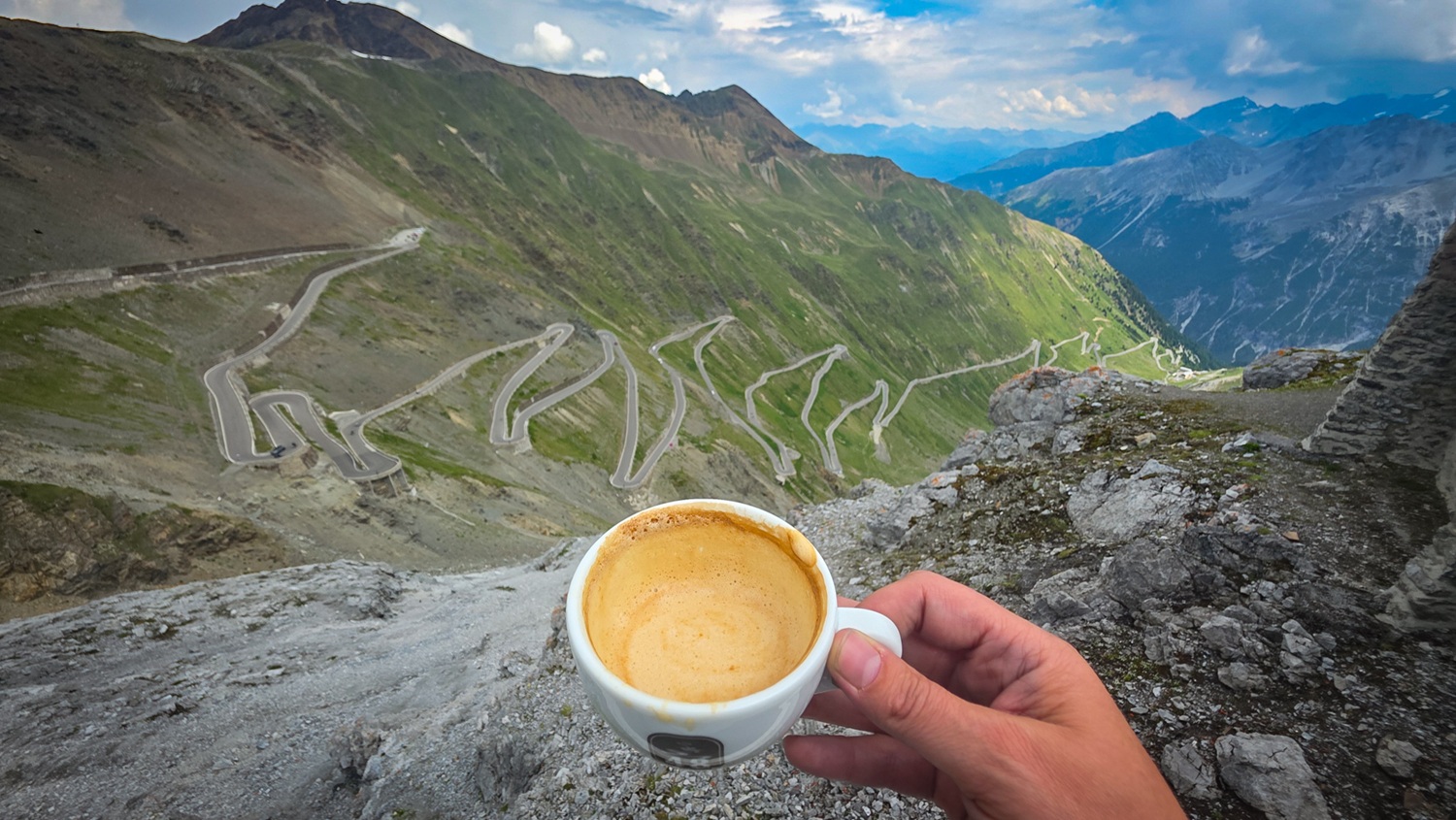

I can’t think of a better way to celebrate conquering Stelvio Pass than by sipping a cappuccino at the top!

When we returned to the summit after exploring the nearby roads, the quiet mountain we’d experienced earlier was already coming alive. The smell of roasting sausages filled the air, motorcycles crowded the parking areas, and the souvenir shops were open for business.

We found a restaurant, ordered cappuccinos and spaghetti Bolognese, and watched the traffic crawl across the mountain. When in Italy, right?

Stelvio is famous because of how it looks, but riding it reveals why it has earned its reputation. The road is demanding, dramatic, and occasionally intimidating. It takes you from green valleys into an Alpine world, then sends you back down the other side through tunnels, waterfalls, and some of the most spectacular scenery in the Alps.


Travel Resources​

Map & Route​


Click to view the route on REVERhttps://go.rever.co/voNQqL6kC4b
Click here to download the GPS files

Road Conditions​


The Stelvio Pass road is paved but narrow in places, with numerous tight hairpins, limited sight lines, and significant elevation changes. Expect motorcycles, bicycles, cars, and buses, particularly during peak summer periods. The road can be wet, cold, or foggy at higher elevations even when conditions are pleasant in the valleys. Check current road conditions before departure.

When to Travel​


Stelvio is a seasonal high-mountain road, and snow can close the pass outside the summer riding season. The best riding window is generally from early summer through early fall, depending on snow and weather conditions. July and August offer the most reliable access but also bring the greatest traffic. Early morning riding can provide cooler temperatures and lighter traffic.

Road Food​


The villages of Bormio and Prato allo Stelvio offer the widest selection of restaurants, cafes, bakeries, and markets. There are also places to eat near the summit, making Stelvio an easy road for riders who want to stop for lunch with a view. You can’t go wrong with a spaghetti and coffee at the top, though those smoked sausages smelled delicious as well.

Where to Stay​


Bormio is an excellent base for exploring Stelvio and surrounding passes, with hotels, restaurants, fuel, and other rider necessities. Prato allo Stelvio and other communities in the Venosta Valley provide additional lodging options. Riders planning a larger loop can also stay in Switzerland or in smaller Alpine villages along the route.

Points of Interest​

  • Stelvio Pass summit
  • Stelvio National Park
  • Bormio
  • Prato allo Stelvio
  • Trafoi and the Venosta Valley
  • Gavia Pass
  • Umbrail Pass
  • Swiss Münstair Valley

If You Have More Time​


Use Stelvio as the centerpiece of a larger Alpine tour. From Bormio, ride Gavia Pass before returning toward Stelvio, or cross Stelvio and continue over Umbrail Pass into Switzerland. The surrounding roads provide enough variety for several days of riding. This area of the Alps is truly motorcycle heaven.


The post The Roof of Italy—Stelvio Pass appeared first on Rider Magazine.

Continue reading...
Congrats on fulfilling one of your bucket list items. Excellent adventure but can get very crowded; time of year and time of day can affect enjoyment.
I did in 2015. Decsending to Bormio was equally fun.
 
Back
Top Bottom