Fuel leak around the fuel sending unit

Joined
Apr 15, 2022
Messages
11
Age
68
Location
Wisconsin
Bike
1994 Honda ST1100
Morning all, wanted to check and see if and am sure some one has dealt with a fuel leak stemming around the fuel sending unit. I had the tank out and installed new fuel sending unit o-ring with new lock ring using the Honda loc-ring tool and new fuel cap that the vent acutally works. Oddly, after installing the new items and 3 weeks later I seem to have the same fuel leak.

My question, has anyone dealt with this persistant issue, I am stumped. Thank you in advance for any input

The Kid!
 
I only had the fuel pumps out...

Considering the age I'd recommend to check the rim on the tank for any signs of corrosion/peeling paint flakes, causing uneven surface the packing now fails to seal on...

When installing mentioned fuel pump, I used a new flange seal and applied a slight smear of silicone grease on the rubber (actually some soft plastic) helping it to slip and snuggle into place...
maybe same aids proper seating of the packing ring?
 
Appreciate the insight, surface is clean. Am thinking of applying Honda Bond 4 (gas resistant). Got to pull the tank and re - inspect.

Thank you!
 
The leak is from the side of the tank? I've replaced 2 of those over the years and haven't had a problem.

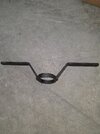
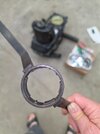
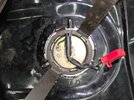
Can you post a picture of the tool?
 
The leak is from the side of the tank? I've replaced 2 of those over the years and haven't had a problem.

Can you post a picture of the tool?
Pulled the tank and removed sending unit o-ring. Cleaned the o-ring and noticed the o-rinfmg needed to fitted into the sending unit ring. If installed correctly when you turn the sending unit over the o-ring does not fall off. Believe my problem was self - inflicted because I sat o-ring onto the tank (wrong!).

Here is the pic of the sending unit tool.
 

Attachments

  • 20260624_061932.jpg
    20260624_061932.jpg
    172 KB · Views: 24
  • 20260624_061940.jpg
    20260624_061940.jpg
    64.8 KB · Views: 24
  • 20260624_062004.jpg
    20260624_062004.jpg
    138.6 KB · Views: 23
Thanks for the picture of the tool. I can't imagine why someone would design such a convoluted method for loosening and tightening an item.

I used an old screwdriver like a punch to R & R mine. I bought the screwdriver in the late 60's at a flea market. It was old and abused back then. It's about 14" long with a tip about 3/16" thick when I "bought" it for 25¢.
 
I can't imagine why someone would design such a convoluted method for loosening and tightening an item.
This is a case of design theory vs real world reality. Design is based on theory, not necessarily on what happens in practice.

Removing, and in particular installing, a locking ring with a punch only applies pressure in one specific location at a time. This can force the locking ring tightly against one side of its receptacle before it begins to turn. It also applies pressure unevenly to the sealing ring. This can damage any one of these parts and also has the potential to distort the sealing ring causing a leak. I understand that the chances of these problems happening is a case of those one in a million type things, especially in this case where we are dealing with relatively strong metal surfaces. Such sturdy material is not always the case however. Designers design based on theory. In theory a rotating locking ring should have force applied to it evenly around its entire circumference in a manner that also allows it to remain centered. This reduces the possibility that the locking ring, the sealing ring, or the receptacle, can be distorted or damaged due to the application of uneven pressure. This tool allows for that to be done. Whether the proper tool is required in any particular application to accomplish the task is a different matter all together, as any of us who repair things well knows as we can't buy every special tool that there is.
 
I was mainly referring to tangs on the cover. Why not have them equally spaced with 2 or 4 or 6 tangs so lever or a square tube or a sheet metal socket like plumbers use or something easily fabricated at home? I would say that you would be hard pressed to find 10 of those in US Honda dealerships now or even back when the 1100 was in production.

I understand what you're saying. I used an improper tool to do the job. Two times on different bikes. Neither of mine leaked, maybe because of my general knowledge and experience, maybe luck. I'm still riding one. Don't know about the other as I sold it about 10K miles later. I threaded it snug, by hand, then tapped it 2 or 3 times. All done, easy peasy. And isn't "not leaking" the point Not many of us can afford or justify all the special tools "needed" to work on bikes.

I spent over 40 years in shops designing, manufacturing, assembling, installing and maintaining electro/mechanical equipment. We had to deal with a lot of crap designed and manufactured machines the company bought. The general saying was somewhere there is a college that needs to repo one of their degrees.
 
Last edited:
Why not have them equally spaced with 2 or 4 or 6 tangs so lever or a square tube or a sheet metal socket like plumbers use or something easily fabricated at home?
Likely to prevent unqualified tempering... :unsure:
I see a safety relevance, like fuel leaks... which this thread is about... ;)
I see me getting one of those, or a suitable adjustable/universal (3 leg) tool in the future...
 
I was mainly referring to tangs on the cover.
In that case my response is of no help, so disregard it. Both of your posts were asking about the special tool so I gathered that this is what you were questioning the design of.

As for the cover- I haven't the foggiest notion as to the actual reason why it was designed the way that it was. If I was to hazard a guess there are only two things that immediately come to mind. One is it is an attempt to thwart not using the proper tool because they see it as necessary. The second is that it might be a simple matter of satisfying some need in the manufacturing or assembly process that we are not aware of.
 
Appreciate the insight, surface is clean. Am thinking of applying Honda Bond 4 (gas resistant). Got to pull the tank and re - inspect.

Thank you!
Are you sure the seepage isn't coming thru the screw or where the wires go through the cover. Those o rings on the cover are used in almost all cars and are pretty bullet proof.
 
Back
Top Bottom