


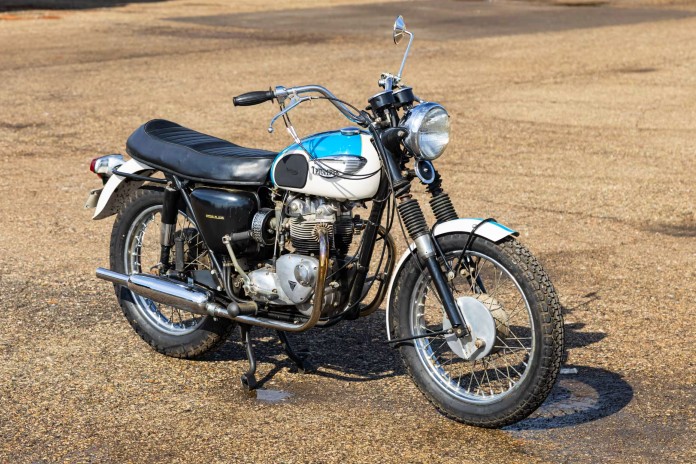
This 1967 Triumph Daytona (Lot L7) is one of many desirable motorcycles that will cross the block at the Mecum Indy auction May 8-16 at the Indiana State Fairgrounds.
We’re less than a month away from Dana Mecum’s 39 Annual Spring Classic, known as the Indy auction, which takes place May 8-16 at the Indiana State Fairgrounds in Indianapolis. As of today (April 7), there are 98 motorcycles listed on the Mecum website that are up for sale at the Indy auction, and more are being added each week.
In our previous posts, we highlighted classic Harley-Davidsons and classic Japanese bikes. Today we’re taking a closer look at British bikes.
1936 New Imperial Model 30
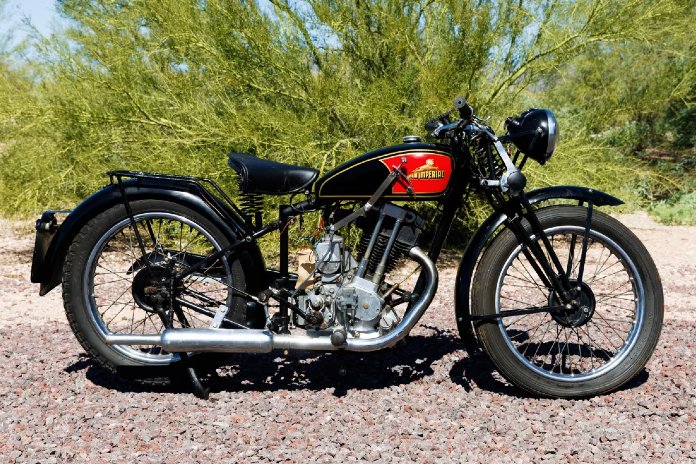
1936 New Imperial Model 30 (Lot G10)
(Lot G10): New Imperial is one of the lesser known British motorcycle manufacturers. As in the U.S., there were hundreds of companies in Europe producing motorcycles during the first few decades of the 20th century. Most did not survive, and some of those that did (like Royal Enfield and Triumph) are still around today. New Imperial was founded by Norman Downes in Birmingham around 1900, and it built innovative motorcycles employing unit construction and sprung hub frames long before these design features became commonplace. This Model 30 from 1936 has a 247cc single-cylinder engine, a tank-shift 4-speed gearbox, a girder fork, a sprung solo saddle, and a black paint scheme with red panels and gold pinstriping on the tank. It’s being sold with no reserve.
1949 Norton Trials (500T)
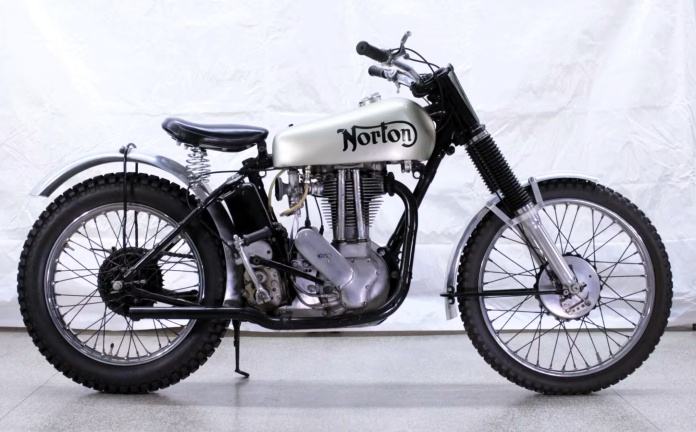
1949 Norton 500T Trials (Lot G210)
(Lot G210): In 1948, a Norton 500T won the Team Prize at the prestigious 70-km Scott Trial off-road competition in the United Kingdom. This example is one of the factory-built racebikes produced from 1948 to 1954, and it has a 490cc Single with a 4-speed gearbox. It was purchased from a private collection and then put on display at Rocky’s Great Outdoors of Burton, Michigan, for 17 years. It is now being sold as part of the Paul “Rocky” Roll Estate Collection, and it is offered with no reserve.
1951 Triumph Thunderbird
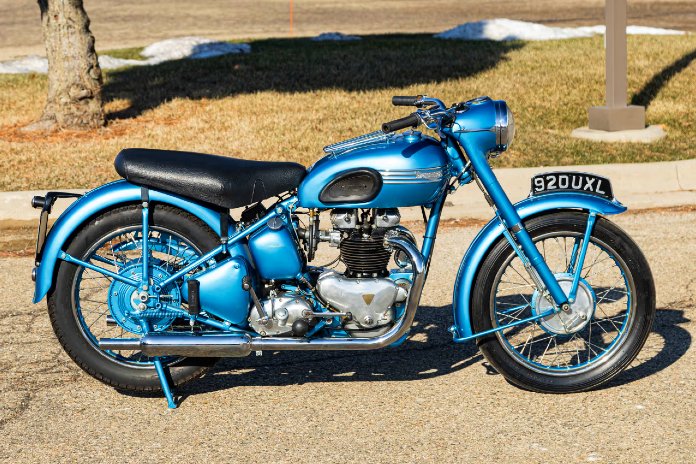
1951 Triumph Thunderbird (Lot N24)
(Lot N24): Produced from 1949-1966, the Triumph 6T Thunderbird was aimed at the U.S. market. Legendary Triumph designer Edward Turner came up with the idea to create a larger version of the 2-cylinder engine from the Speed Twin, bored out from 500cc to 650cc to satisfy horsepower-hungry American riders. He also thought of the “Thunderbird” name and created its paper dart logo. This example, painted from stem to stern in Thunder Blue, is being offered with no reserve.
1957 Ariel Square Four
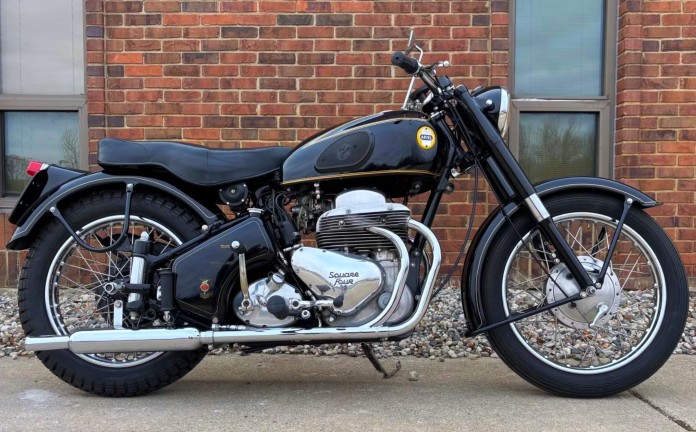
1957 Ariel Square Four (Lot N278)
(Lot N278): Edward Turner (yep, the same one who later worked for Triumph) devised the square-Four engine configuration in 1928. It is essentially two vertical-Twin engines sandwiched together, with two transverse crankshafts, a 4-cylinder block, and a single head. The Square Four motorcycle, which had an air-cooled 995cc OHV 4-cylinder engine, was produced by Ariel between 1931 and 1959. This 1957 example underwent an extensive restoration by Johnson Motors in Los Angeles, California. It has been kept in a climate-controlled environment and maintained in running condition.
1963 Triumph 6T Thunderbird
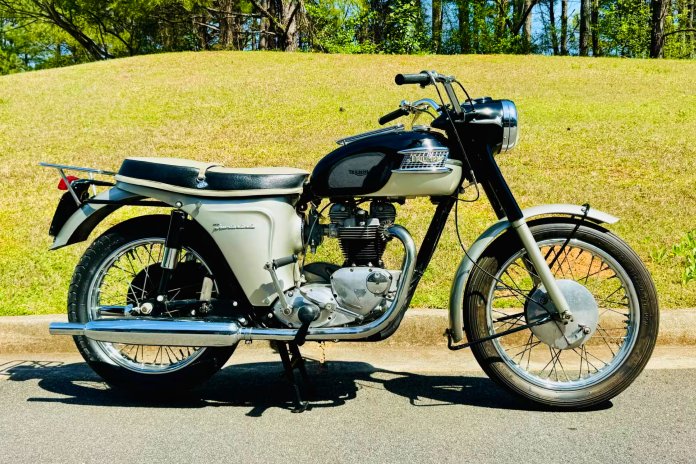
1963 Triumph 6T Thunderbird (Lot L184)
(Lot L184): We’ve all seen Marlon Brando play the rebellious Johnny in the 1953 film The Wild One. Brando rode a 1950 Triumph 6T Thunderbird in the movie, and Triumph’s U.S. importers wrote a letter to the producers objecting to the bike being used in a film about rowdy motorcycle gangs. This later example features a rear fairing nicknamed the “bathtub” due to its shape. Apparently, the fairing was unpopular in the U.S. market and quickly dropped, making this a rare example. This 6T Thunderbird is part of the Hendricks Collection.
1965 Matchless G12
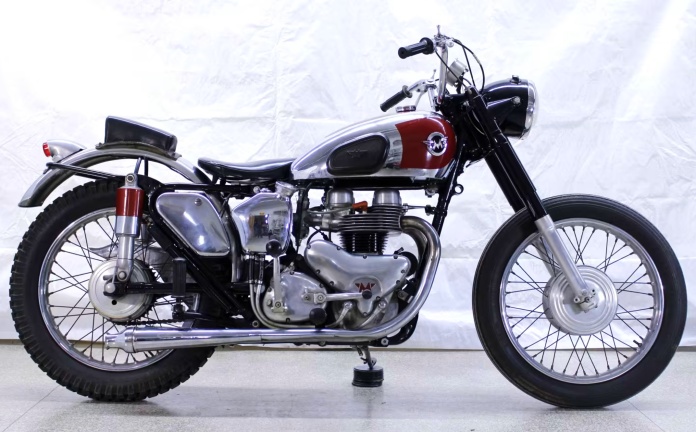
1965 Matchless G12 (Lot V49)
(Lot V49): Produced by Associated Motor Cycles, the Matchless G12 is another British motorcycle created for the U.S. market. One of the last motorcycles designed under the Matchless name, the G12 was also sold as the AJS Model 31. It is powered by an air-cooled 646cc parallel-Twin good for 35 hp. This example, which has a red/chrome paint scheme, is being sold as part of the Paul “Rocky” Roll Estate Collection with no reserve.
1967 Triumph Daytona
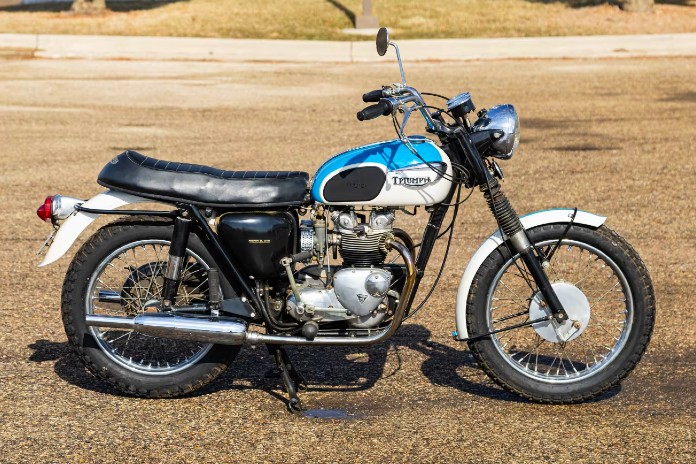
1967 Triumph Daytona (Lot L7)
(Lot L7): The Bonneville is, hands down, the most iconic motorcycle produced by Triumph. The first Bonneville T120 emerged in 1959, named after the salt flats in Utah where a Triumph-powered streamliner set land speed records in the 1950s. The T120 stood for “Twin” (it had an air-cooled 650cc parallel-Twin engine) and the bike’s claimed top speed. Triumph also produced a 500cc version called the T100. After “a smiling, soft spoken, and extremely smooth-riding Texan named Buddy Elmore” (Cycle World) won the 1966 Daytona 200 on a 500cc Triumph Twin, the T100 was rechristened the Daytona for 1967. This example, with a rebuilt engine and a blue-and-white paint scheme, is being offered with no reserve.
1969 BSA Rocket 3
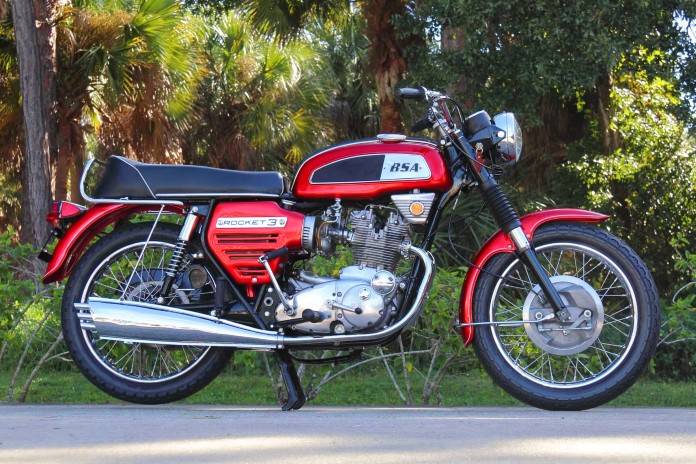
1969 BSA Rocket 3 (Lot G11)
(Lot G11): In the late ’60s, BSA and Triumph were both owned by the Birmingham Small Arms Company. This model, powered by an air-cooled 740cc OHV Triple, was simultaneously badged and sold as a BSA Rocket 3 and a Triumph Trident. It has the original Ogle Design slab-sided styling and raygun silencers, before it was given a more classic look with a teardrop tank in an attempt to revive sales against the Honda CB750.
To see all of the motorcycles up for auction in Indianapolis, go to Mecum.com, click on the Buy drop-down menu at the top, select Motorcycles, and click on “View Lots.”
A Mecum auction is a must-attend event for any gearhead, but if you can’t be there in person, you can bid online or by phone – just fill out the registration form on the Mecum website.
The post 2026 Mecum Indy Auction Preview: British Beauties appeared first on Rider Magazine.
Continue reading...