


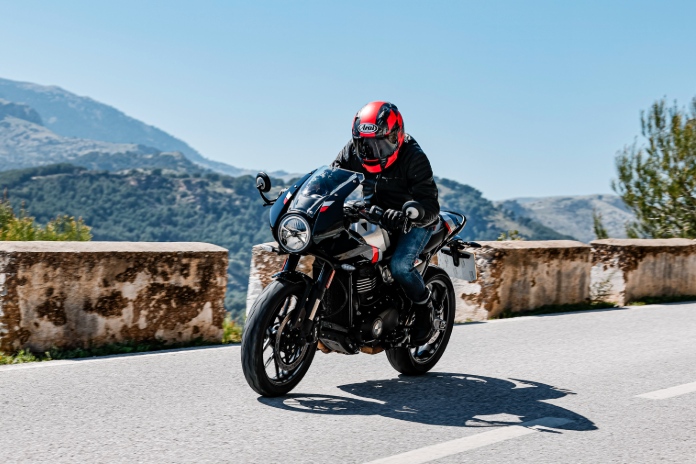
The Thruxton 400 rolls into Triumph’s lineup as the sportiest version of the entry-level 400s. To my eyes, it’s also the best looking of the bunch. (Photos courtesy Triumph)
In 2024, we tested Triumph’s then-new entry-level motorcycles, the Speed 400 and Scrambler 400 X, on the backroads of southern Spain. They were and remain the least expensive bikes in the brand’s lineup, attainable choices for those who had, up to that point, been priced out of Triumph ownership. The low price didn’t result in a cheap riding experience; the bikes were good fun and felt like quality-made machines.
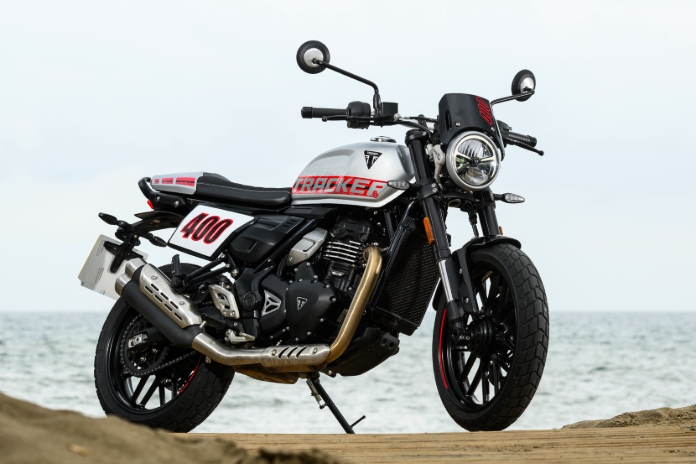
The Tracker 400 will be available in Aluminum Silver Gloss (shown), Racing Yellow, or Phantom Black.
Triumph’s strategy with the 400 class was twofold. While the lower price meant that the profit margin per bike was lower than with other models in the lineup, Triumph has been able to make a lot of them through its partnership with Bajaj Auto in India. In 2025, 50,000 out of 110,000 Triumphs sold globally were the 400s. They sell well in the U.S. too: In the past two years, 7,000 of 30,000 Triumphs sold in the states were the 400s. The second piece to the puzzle was customer retention: Get new riders into the Triumph brand and keep them there as those riders decide to upgrade machines.
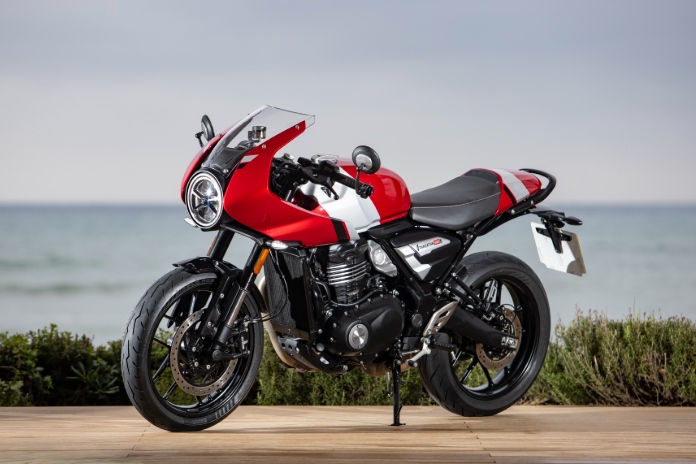
Unfortunately, this striking red color option on the Thruxton 400 is not coming to the states. U.S. customers will have a choice between Phantom Black and Aluminum, Pearl Metallic White and Storm Gray, or Metallic Racing Yellow with Aluminum Silver.
Given those sales figures, it should come as no surprise that Triumph has expanded the 400 lineup. In 2025, it added the Scrambler 400 XC, which added a few accessories and extra off-road details to the Scrambler 400 X but was not a new bike overall. For the current and next model year, Triumph has added two new models to the family: the Tracker 400 and the Thruxton 400.
Triumph once again chose Spain’s coastal and mountainous terrain as the location for us to test the new 400s.
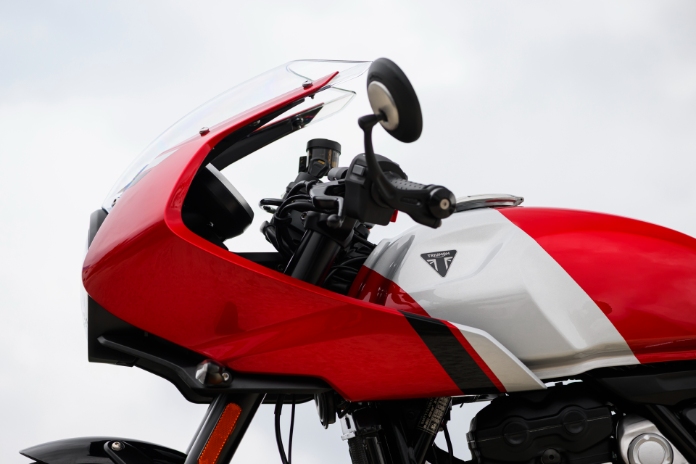
The Thruxton’s fairing and tank lean into its cafe-racer look while incorporating more modern lines than previous Thruxtons.
Instead of revamping the bodywork and calling it a day, Triumph engineers decided on a more full-scale changeup for the new 400s: new frames, new chassis components, new ergonomics, and an engine upgrade. That means that those shopping for a Triumph 400 will have more to consider than just styling.
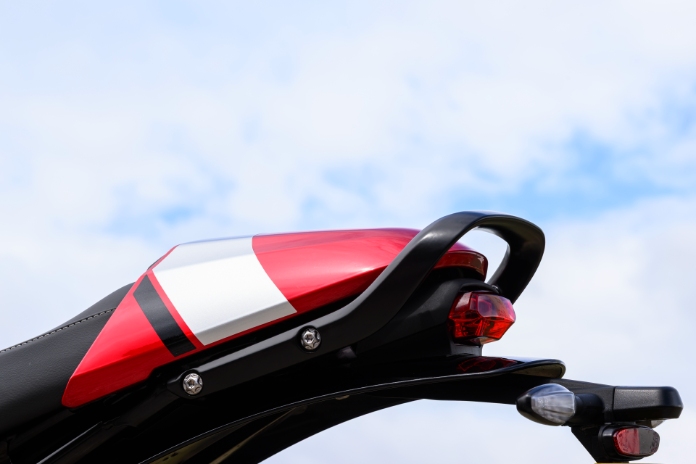
A rear cowl covers the passenger seat.
But since their styling is a clue to their riding characteristics, let’s start there. The Tracker 400 is designed to look like a flat-track machine, with a wide and flat handlebar, a “400” number plate that’s visible from a mile away, an upswept dual silencer, and knobby-looking (but road-focused) Pirelli MT60 RS tires. It would look right at home on any American Flat Track circuit, although it’s made for the pavement.
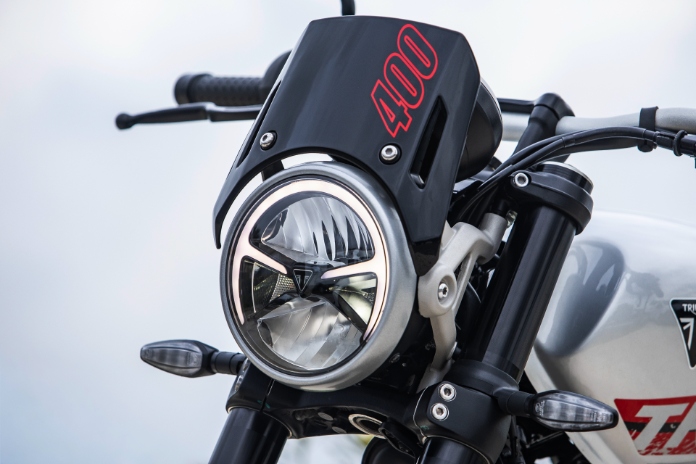
A flyscreen with “400” on it comes standard on the Tracker.
The Thruxton’s sporty styling has a different flavor. It adopts an iconic name from Triumph’s lineup and leans into its cafe-racer heritage with a fairing, low clip-on bars, and bar-end mirrors. The name “Thruxton” was first used by Triumph lineup in the mid-1960s for a limited-edition racebike. It’s seen several iterations since, up to the Thruxton Final Edition of 2025. The Thruxton 400 is an obvious echo of previous Thruxtons but is a bit more modern in its lines.
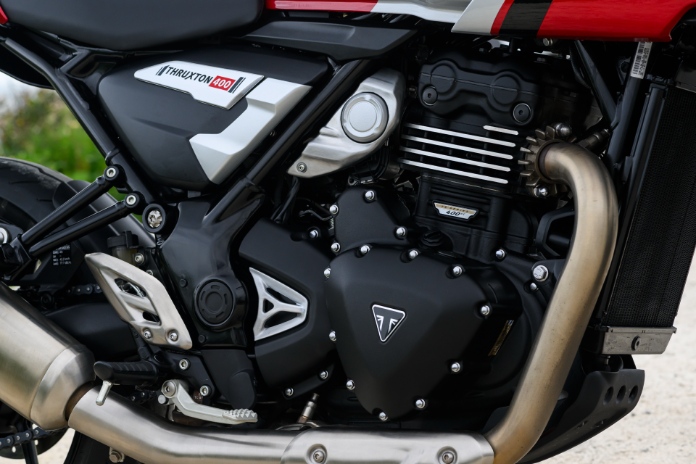
The Thruxton and Tracker make good use out of the upgraded TR-Series single-cylinder engine.
Befitting these sporty looks, the liquid-cooled 398cc TR-Series single-cylinder engine is beefed up for use in the Tracker and Thruxton. Now producing 5% more peak power that arrives 1,000 rpm later in the rev range, the engine received a revised camshaft profile and a retune, resulting in 41.4 hp at 9,000 rpm. Torque remains the same at 27.7 lb-ft but arrives 1,000 rpm later at 7,500 rpm. Redline is also increased. This all means that this new version of the TR-Series engine rewards riders who like to get the revs up. When asked if the new version of the engine would be used in the Speed and Scrambler, Triumph reps said no. The more aggressive nature of the revised mill intentionally complements the sporty attitudes of the Tracker and Thruxton, while the Speed and Scrambler are more laid-back by comparison.
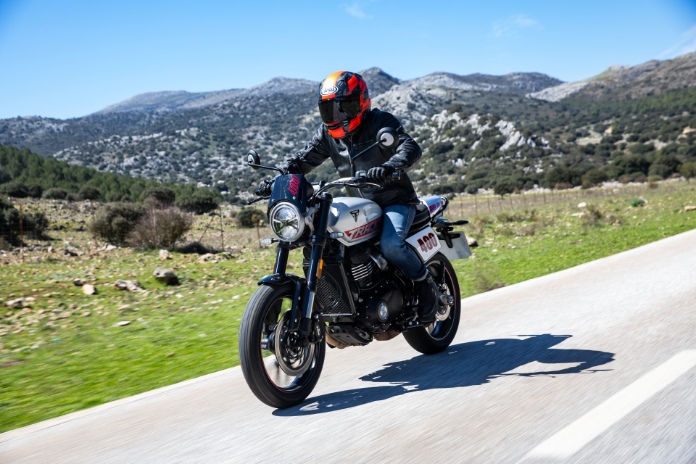
While the Tracker and Thruxton will arrive to dealerships around the same time, the Thruxton is listed as a 2026 model and the Tracker as a 2027 model. Triumph reps told us this was due to their production dates.
GEAR UP
- Helmet: Arai Regent-X
- Jacket: Cortech Hoyden Ladies Leather
- Airbag Vest: Alpinestars Tech-Air 5
- Gloves: Pando Moto Onyx Black 02
- Pants: Rev’It Marley Ladies SK Jeans
- Boots: Pando Moto Apex Sneakers
That bump up in power was noticeable and appreciated during our day of test riding, but it wasn’t the first thing that set these bikes apart from the earlier 400s for me. It was their ergonomics.
To start off our sunny day in southern Spain, I saddled up on the Tracker. Compared to the Speed, the Tracker’s handlebar is 0.9 inch wider and 5.3 inches lower, and the footpegs are 3.4 inches farther back and 1 inch higher. These changes created a noticeable difference in how it felt to sit on and ride the Tracker. Riding along small streets on our way north into the mountains, the commanding position had me excited for more to come.
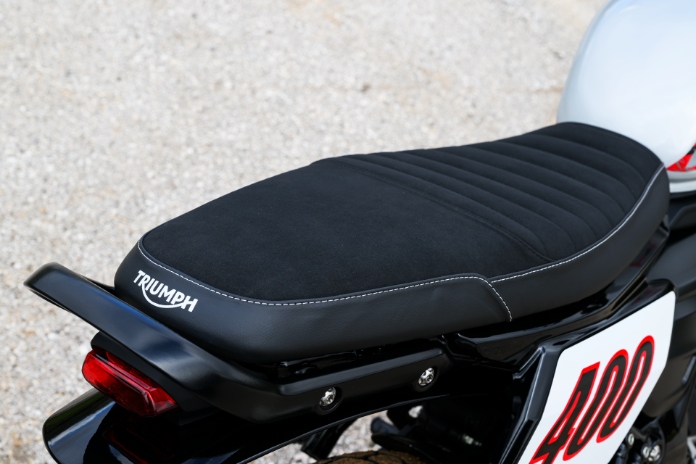
The Tracker’s seat offers plenty of space to move around. Removing the rear cowl reveals a passenger seat.
Once we got away from the traffic and were able to let loose, I fully appreciated everything the Triumph engineers had done to make the Tracker distinct from the other 400s. The wider handlebar provided extra leverage for steering, and the repositioned footpegs allowed for a sporty stance. The seat is also fairly flat and roomy, giving plenty of space to move around as needed. The rear cowl conceals a passenger seat on both the Tracker and Thruxton, and both come with passenger pegs as well.
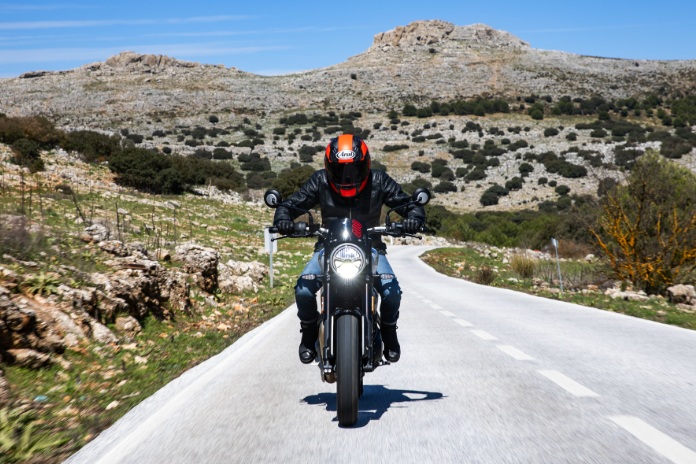
The round LED headlight looks just right on the Tracker. Both machines are slim and easy to maneuver into tight parking spots.
The revised TR-Series engine felt comfortable and familiar on our way toward open roads, producing controllable and predictable power for trouble-free urban riding, just as I had experienced on the Speed and Scrambler. When the road opened up and those in front of me started pulling away toward the next turn, I twisted the throttle and enjoyed the extra power in the upper rev range. The bike surged forward, eager to not be left behind. Passing slower-moving vehicles was effortless.
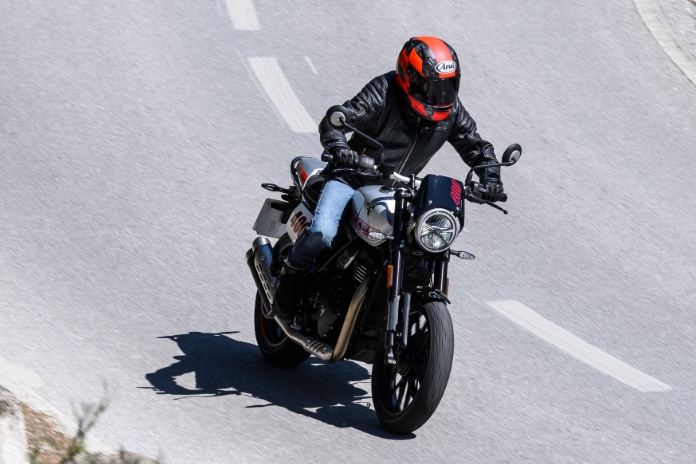
The Tracker’s wide, flat handlebar provides extra leverage and an elbows-out riding position.
Between the more engaged riding position and the extra oomph of the engine, the Tracker is a clear step up from the Speed 400. Some shoppers might not be as drawn to the flat-track styling and might prefer the Speed’s roadster aesthetic; I admit I’m one of them, but the riding experience provided enough extra pizzaz to win me over.
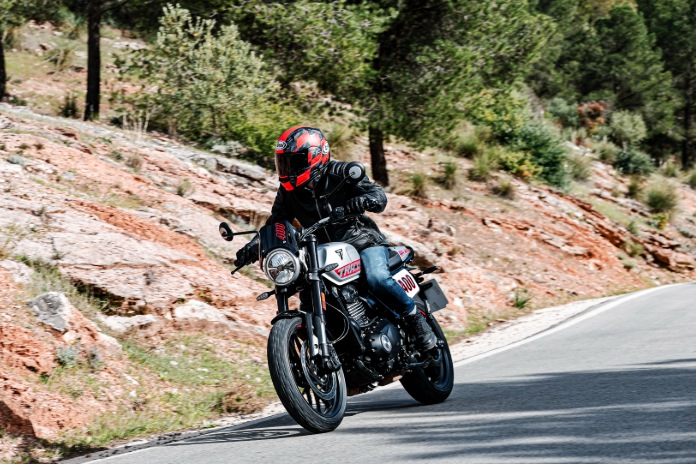
For less than $6K, you can get a fun-loving machine that suits both daily riding and weekend jaunts to the twisties.
After a too-big lunch in El Burgo, it was time to swap to the Thruxton. If I thought a 5.3-inch difference in the handlebar position between the Speed and Tracker was significant, I wasn’t prepared for the Thruxton’s clip-ons being a full 9.7 inches lower than the Speed’s bar. They’re also 1.6 inches narrower. The footpegs are positioned 3.4 inches farther back and 1.1 inches higher, putting them about equal to the Tracker’s footpegs. With the waist as the pivoting position, my upper half rotated forward to grasp the bars and positioned me into a leaned-forward stance.
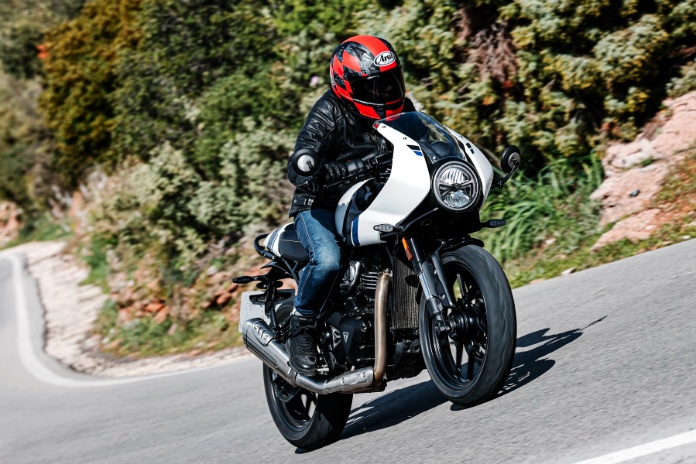
The Thruxton’s Pearl Metallic White and Storm Gray color option with blue details is a beauty.
The engine provided the same exhilaration as I’d experienced on the Tracker, but the Thruxton’s riding position allowed me to make the most of it. Ducking behind the fairing, I flipped the Thruxton from side to side around bend after bend and had a blast. On straighter roads and riding at highway speeds, both bikes were more than capable of moving around traffic, but a flaw revealed itself. The mirrors vibrated so much to be nearly useless. Those vibrations carried into the feel at the bars some as well.
The Thruxton’s Pirelli Diablo Rosso IV tires provided confidence, just as the Tracker’s Pirelli MT60RS tires had done, although I wanted better feel from their shared brakes. Up front is a 4-piston radial caliper pinching a 300mm disc, and in the rear is a 1-piston floating caliper paired with a 230mm disc. They got the job done, but their lack of feedback took a bit of the wind out of my sails – not so surprising for entry-level machines. Both bikes come with switchable ABS and switchable traction control.
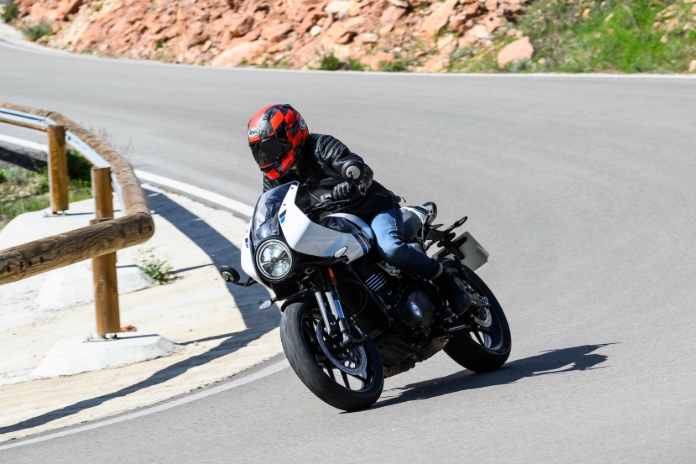
More aggressive ergonomics makes a rider want to take full advantage of the Thruxton’s 5% boost in power compared to the earlier 400s.
The Tracker and Thruxton both get a new hybrid spine/perimeter frame made of tubular steel, and their bolt-on subframes are unique to account for different mounting points for the bodywork. The Tracker’s wheelbase is a bit longer than the Thruxton’s, giving the Tracker a more planted feel and allowing the Thruxton to more easily dip into turns.
Both bikes also share suspension components, although the fork is a bit stiffer on the Thruxton. A 43mm inverted big-piston fork provides 5.5 inches of travel on the Tracker and 5.3 inches on the Thruxton, and the rear monoshock offers 5.1 inches of travel on both, as well as preload adjustment. I found the suspension suited the bikes’ sporty natures just right, with the Tracker offering a more comfortable ride and the Thruxton’s slightly stiffer fork creating more confidence in the corners.
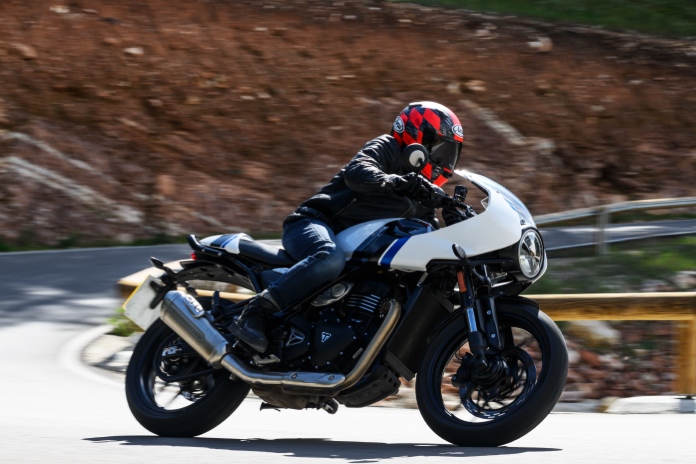
The Thruxton’s 31.3-inch seat height is easier to manage for a short rider like me than the Tracker’s 31.7 inches. The Thruxton also feels quite narrow between the knees.
The instrumentation on these bikes is pretty basic, but it provides everything you need and looks well-designed. I’m fond of an analog speedometer, and the 400s have one, with black background and white numbers and dial. Off to the right side of the speedometer is an LCD display that shows rpm, gear position, a clock, fuel level, trip meters, and some other info.
For machines priced around $6K, the Tracker and Thruxton are exciting additions to Triumph’s 400 line. While they don’t offer a lot of bells and whistles in terms of ride modes, adjustability, and extra features, they feel like well-sorted, well-made motorcycles that were thoughtfully designed, which is not always the case for entry-level bikes. I’d be proud to own either of them, but it would be difficult to choose a favorite.
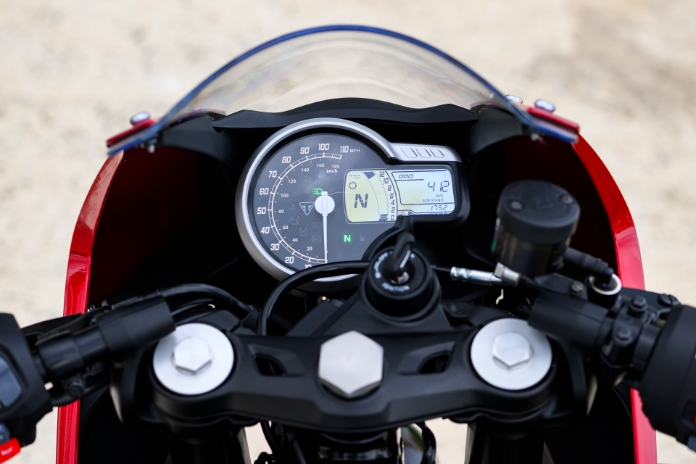
Everything you need and nothing that you don’t. The dash features a classic analog gauge mated with an LCD screen.
The Thruxton is a beauty, and it doesn’t compete with the Tracker in its grin factor on curvy roads. It’s an engaging ride and encourages the rider to live up to its cafe-racer appearance. If I’d only ridden each one for about an hour, I’d have said my heart lies with the Thruxton. But after a full day of riding, the Tracker has the strongest pull for me. It’s the more versatile of the two, and I could ride it more comfortably for longer periods of time while still enjoying a sportier ride than the Speed or Scrambler offer.
If you don’t agree with my choice, there’s good news for you! All five of Triumph’s 400s offer their own unique flavor, alongside their shared attributes like their simplicity and ease of use, their quality construction and feel, and their attainable price point. Pick whichever one speaks to you, and you’ll have made the right choice.
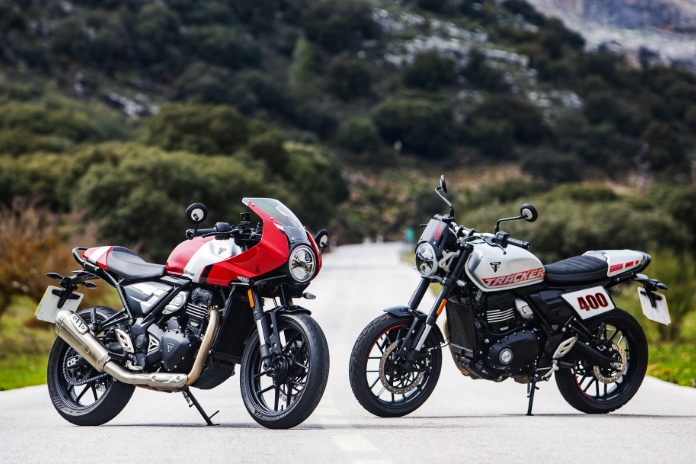
The Thruxton (left) and Tracker (right) make up the fourth and fifth members of Triumph’s 400 lineup.
2027 Triumph Tracker 400 / 2026 Triumph Thruxton 400 Specs
- Base Price: $5,995 / $6,295
- Website: TriumphMotorcycles.com
- Warranty: 2 yrs., unltd. miles
- Engine Type: liquid-cooled Single, DOHC w/ 4 valves
- Displacement: 398cc
- Bore x Stroke: 89 x 64mm
- Horsepower: 41.4 hp @ 9,000 rpm (factory claim)
- Torque: 27.7 lb-ft @ 7,500 rpm (factory claim)
- Transmission: 6-speed, cable-actuated slip/assist wet clutch
- Final Drive: Chain
- Wheelbase: 53.9 in. / 54.2 in.
- Rake/Trail: 24.4 degrees/4.24 in. / 24.5 degrees/4.0 in.
- Seat Height: 31.7 in. / 31.3 in.
- Wet Weight: 381 lb / 388 lb
- Fuel Capacity: 3.4 gal.
The post 2027 Triumph Tracker 400 and 2026 Triumph Thruxton 400 Review appeared first on Rider Magazine.
Continue reading...

