The rear brake fluid heats up as you are riding. it is behind a hot engine and next to hot exhaust pipes. It expands and needs an escape route for the fluid back to the reservoir. That is via a very tiny compensation port which sits inside the master cylinder just in front of the piston seal. As soon as you apply the brakes, the seal moves past that hole and the escape route is blocked. As soon as you release the pedal, the piston moves back and the tiny hole - the compensation port - is exposed again to allow pressure / fluid back to the reservoir.
That is what should happen. There are a number of reasons why it may not.
1. The brake lever has spring has become ineffective
2. The brake lever is unable to return because the pivot is clogged with corrosion / muck.
3. You are wearing large boots and are pressing on the pedal without realising.
4. The filter in the union where the hose from the reservoir joins the master cylinder is full of crud. (I am assuming that it has such a filter - I never looked when I had my 1100s)
5. The compensation port is blocked.
6. Seals / caliper piston bores are clogged preventing proper movement.
7. The rear reservoir is filled beyond the max line.
8. The slider pins are rusted, clogged.
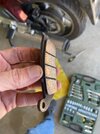
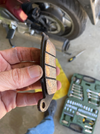
9. The chrome pad retainer clip is not seated properly.
You might get an idea about what is going on by removing the pads and caliper and trying to push in the pistons. They should push in fairly easily with thumb pressure. Note that one piston will push out when you push the other in. If that doesn’t happen, then you have an issue with pistons/seals/cylinder bores.
But you need to push in both pistons at the same time - or at least stop the other from being pushed out. If the pistons will not move, then you have an issue with the master cylinder.
Note that pistons must be cleaned before pushing them in.
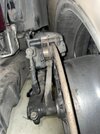
Do not undo the slider pins to get the caliper off. You have to remove the pads, remove the bracket - stopper bolt and axle bolt, and manoeuvre the bracket and caliper from the brake disc. The caliper should slide off the bracket easily.
This article was written for a model with linked brakes and abs - the 3 piston version. The detail may not apply to your model, but the logic is still sound.
https://www.st-owners.com/forums/threads/st1300-brake-maintenance-avoiding-the-pitfalls.135125/
Also - this explanation of how the master cylinder operates - drawn and described for the front master cylinder (brake lever). The rear master cylinder operates in the same way except the plunger end is pointing downwards, and the reservoir is attached by a hose.
https://www.st-owners.com/forums/threads/brakes-operation-of-the-master-cylinder.159167/
This next bit may or may not be relevant. I suspect that it is, but I really don't know.
I know your model does not have an SMC. But these are the only photos that I have that show the filter that I was talking about.
I have never looked seriously at the 1100 rear master cylinder port where the fluid enters from the reservoir, but looking at photos it seems to be similar to this - and the casting of the ST1100 master cylinder appears to have room for such a filter.
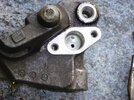
The left photo shows the bottom the filter from the ST1300s SMC. All you see from the other side is a white gauze. Inside that nylon filter is a very tiny compensation port, which can also become clogged.
I suspect that it is there, but I could be wrong. The part never appears on the microfiches - so that doesn't help.
@Uncle Phil may be able to say one way or the other.
Note that in the right hand photo, you can see the compensation port deep inside the recess. Just past 12 o'clock position. It is a dimple with a very tiny - smaller than a pin prick - hole. That hole will definitley be there. If either are clogged, your brakes will drag.
They become clogged by failing to replace the brake fluid every 18-24 months. The fluid absorbs moisture over time and starts to go gooey and then starts to form crystals.
To get fresh fluid through these holes, you need to push the pistons back in a tad, once the new fluid is in the system - just to get the fluid going back to the reservoir.