


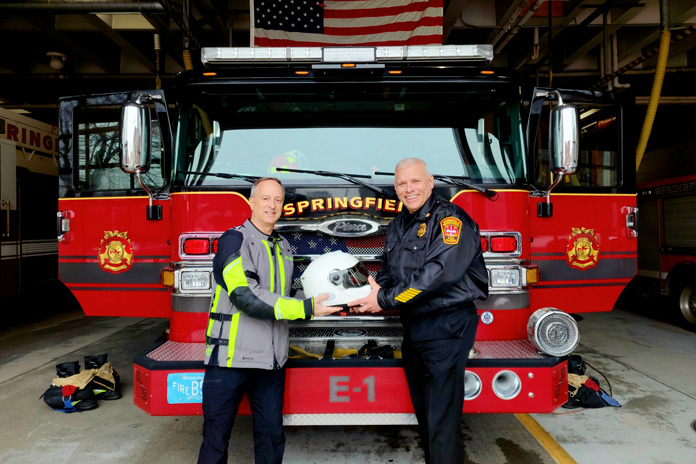
Donating helmets to Fire Commissioner Bernard J. Calvi of the Springfield Fire Department..
Several years ago, I took a training course called A Crash Course for the Motorcyclist, which taught basic skills for bystander assistance at an accident scene until professional help arrives. One key lesson was this: If a motorcycle crash victim is not breathing and a helmet interferes with breathing assistance, the helmet must come off – or the victim will die.
Members of our class practiced methods of removing a helmet in such an emergency to minimize stress on a victim’s neck. Of course, helmets are needed to practice these skills, but in talking with some first responders who were taking the course, I discovered that no one had motorcycle helmets at their stations for training. In fact, few had any practical experience with motorcycle helmets. I wanted to address that.
Check out our motorcycle helmet reviews
Rather than throw away a helmet that was ready to be retired, I donated mine to the Emergency Medical Services (EMS) team at my local fire station. The lead paramedic met me in the lobby, where I demonstrated how a modular helmet works by pivoting up the chinbar. “Never seen one like that,” he said. He called in the team members on duty and had me show them too. None had ever seen a modular helmet. I pointed out that modular helmets typically have a red release button on the chin and that raising the chinbar all the way up can allow access to an accident victim’s face without needing to remove the whole helmet. Talk about an “Ah-ha!” moment! A few years later, I donated a friend’s full-face helmet to my local EMS so they could practice helmet removal skills with that helmet style too.
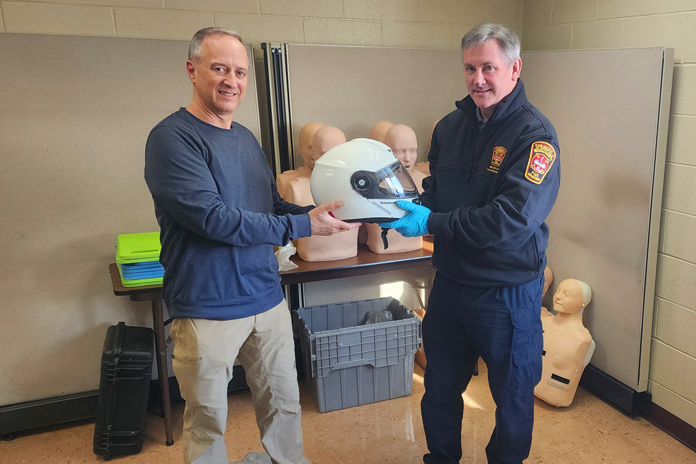
Donating helmets to Medical Coordinator Chris Kuczarski of the Springfield Fire Department.
More recently, I wondered if the EMS teams in the nearby city of Springfield, Massachusetts, would appreciate a helmet donation. To find out, I grabbed coffee with my friend and neighbor Brian E. Couture, a lieutenant with the Springfield Fire Department. Couture grew up riding dirtbikes, had a Yamaha R6 sportbike as a young adult, and sold Harley-Davidsons for seven years before he joined the fire service, so he already has a better understanding of bikes and riders than most people. As a leader in his department, he’s always looking for ways to help his people serve others more effectively.
“As first responders, I think we can be more compassionate if we better understand how an accident victim’s gear figures into the situation,” he explained. “Knowledge and experience constantly change best practices. That’s why ongoing training is so important. We haven’t done any specific training for helmets, but I think it’s a great idea.”
Couture connected me with Christopher F. Kuczarski, medical coordinator for the Springfield Fire Department, who was intrigued about a helmet donation. “I am focusing on first aid this year, so it would be great if I could add a module with donated helmets and pass along the information and training to the guys who are out there on medical calls.”
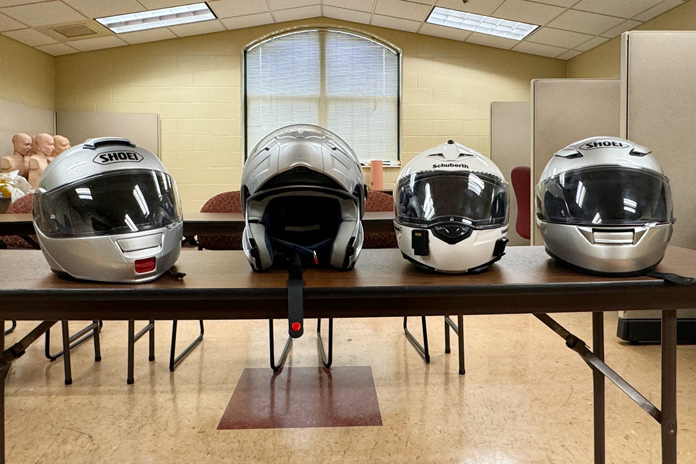
Springfield Fire Department first aid refresher training now uses donated motorcycle helmets.
Kuczarski served in EMS for 12 years, seven of those as a paramedic, before pivoting to training. “Three hundred firefighters will be taking refresher training this year,” he told me. “Thanks to this donation, helmet awareness, and when required, helmet removal, will be on the agenda. Training and practicing with the kind of helmets that our people may encounter at an accident scene is a great idea. So is having riders like Scott donate helmets for EMS teams to train with.”
With my recently retired helmet, plus three more donated by local riders, the Springfield Fire Department now has full-face and modular helmets in multiple sizes. This should enable training participants to play the roles of both accident victim and first responder to better understand what’s involved in helmet removal in an emergency.
Use your best judgment in evaluating when it’s time to retire your helmet (see sidebar). And when that time arrives, don’t just throw it away. Instead, donate your aged-out helmet to your local EMS team for first responder training. You just might help first responders save a life.
SIDEBAR: What’s the Five-Year Rule?

Once a helmet protects your head in an accident, it has done its job and should be retired immediately. But even when a helmet encounters no impacts, environmental exposure and normal wear-and-tear take their toll.
Perhaps you’ve heard of the Five-Year Rule. Major helmet manufacturers recommend that helmets be replaced after five years (some say seven) of use. Why? Because the materials in a helmet that work together to protect your head, such as Styrofoam, resins, and glue, break down over time and with exposure to sunlight, weather, and sweat.
The Snell Foundation, an independent nonprofit motorcycle helmet testing organization, points out that unused helmets stored in good condition do not automatically expire after five years. That said, Snell does recommend replacing helmets after five years of normal use.
What “normal use” means is a judgment call. Do you ride regularly in the hot sun? Do you sweat when wearing a helmet? Do you take long-distance rides in any kind of weather? These types of exposure accelerate the breakdown of helmet materials. If you take shorter and less frequent rides, your helmet won’t likely wear out as soon.
In any case, whenever you are ready for a new helmet, consider donating your old one to your local EMS for training.

Contributing Editor Scott “Bones” Williams was a freelance scribe and long-time Rider subscriber when it finally dawned on him to write for Rider. More than 20 years later, he’s still sharing stories about people, places, and roads he encounters on a motorcycle.
The post Donating Used Motorcycle Helmets appeared first on Rider Magazine.
Continue reading...