


It was a Sunday afternoon in late August 1985. “Maneater” by Hall & Oates was swirling into a set of Sony Walkman speakers I somehow managed to hotwire into my helmet, and my black and red Honda Nighthawk S was tracking through Malibu Canyon like a puma. Remember when Maverick rolled into Fightertown on his 900 Ninja? It was just like that. But then, without so much as a subtle tap on the shoulder, a massive gust of wind blew my motorcycle off the road and right up against the concrete barricade that stood between me and a 200-foot cliff. Not great.
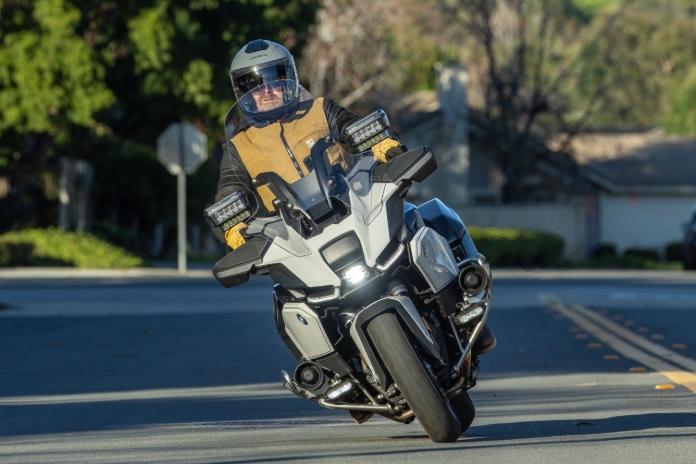
Like a shark: Back-and-forth motion within your lane mentally and physically prepares you for heavy wind gusts. (Photos by Kevin Wing)
Luckily, I managed to ride the railing and ricochet back on the road with minimal scrapes and bruises. But from then on, I vowed that if I was going to continue riding on the street, I had to come up with a process that kept me safe when the winds kicked up. And 40 long years later, I think I’ve finally got it dialed enough to share.
Today we’re going to jam out to a little yacht rock and discuss ways we can mitigate the negative effects of wind while on the motorcycle. We’ll focus on street riding only, as off-road and racing environments have their own challenges and solutions. Please understand these suggestions are just the ones I use. They are not “correct” or better than anybody else’s, but because I believe you should challenge yourself to have all the techniques and all the information, I’m sharing them with you.
Headwinds slow you down and tail winds speed you up. They’re easy peasy. The major challenge with wind is when it’s pushing sideways on us. Below I’ve generated a list of key areas I focus on when faced with the back-and-forth tug-o’-war that crosswinds create.
Speeds: I’ve heard people say that you should slow down in windy conditions, and if I was a lawyer representing a training company, I might agree. However, in my experience, more momentum means more stability, so if I can safely increase speed to help make me a more stable package, I will. This includes freeways, long multilane roadways, and areas without intersections and cross traffic. Where I do not employ increased speed is in canyons or otherwise winding roads. This is because an ill-timed gust of wind coupled with increased speed has the potential to push me wide in a curve. Given that most canyon roads are two-lane affairs, I’ll either end up heading into oncoming traffic or onto the shoulder. So in these situations, I slow down a bit. As for city riding, I focus on gaining stability by getting up to speed quickly from traffic lights, but due to the complex variables presented by urban areas, I keep my speed otherwise normal.
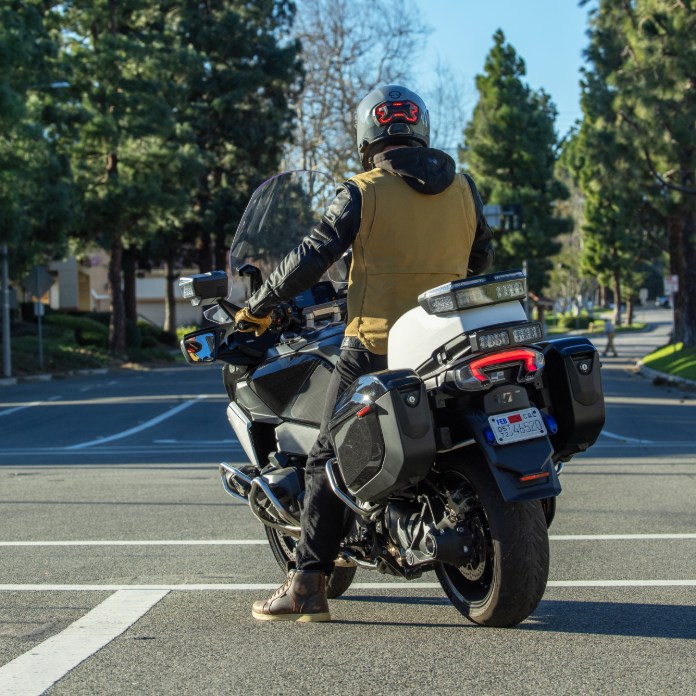
Avoid becoming a human sail in heavy wind.
Lane position: My vanilla answer here is to stay in the middle of the lane, as it allows some movement when you find that you are no longer in Kansas anymore. I don’t just stiffly drone down the road; I move like a shark and “hunt” a bit in the middle portion of the lane via side-to-side motion in preparation for the gust. Why? Watch a tennis player waiting for a serve, and you will notice they are not just standing frozen. Instead, they shift side-to-side anticipating the ball to come at them. This helps keep them mentally and physically fluid and takes the “hard edges” off when the action starts. I do the same thing on my motorcycle, and it works fantastically.
Situational awareness: Riding in the wind requires an even higher level of awareness, reaction time, and focus than we already employ while on our motorcycles. I’ve encountered tires, wood beams, coolers, tree branches, trash cans, and more. While it’s never fun, the good news is that most of the obstacles are predictable, because the wind tends to push them in a linear trajectory and at a generally consistent speed. Unlike a driver who might cross your path only to realize it suddenly and slam on their brakes, an item blowing across the roadway can’t stop, won’t stop, but will keep moving. The key here is tracking it and getting your timing right. Yes, some obstacles will be stationary and directly in your path, like a downed tree, but those are typically visible from a good distance off, so you can avoid them. In most other cases involving UFOs streaking onto the road, adjust your speed, time them properly, and they will scurry on past you.
Riding posture: The smaller I make myself, the better. I tend to lay myself on the tank like I’m in the middle of a
MotoGP race to help reduce my surface area. This settles the bike, reduces wind noise in my helmet, and connects me more to the motorcycle. Of course, good control of the motorcycle can never be compromised in the process, so I make a concerted effort to really squeeze the bike with my legs. While this is always a good idea, the added variable of heavy side gusts makes it all that much more important to stay connected to the motorcycle. I also slightly increase my grip on the bars but not so tight that it degrades my ability to safely manipulate the controls.
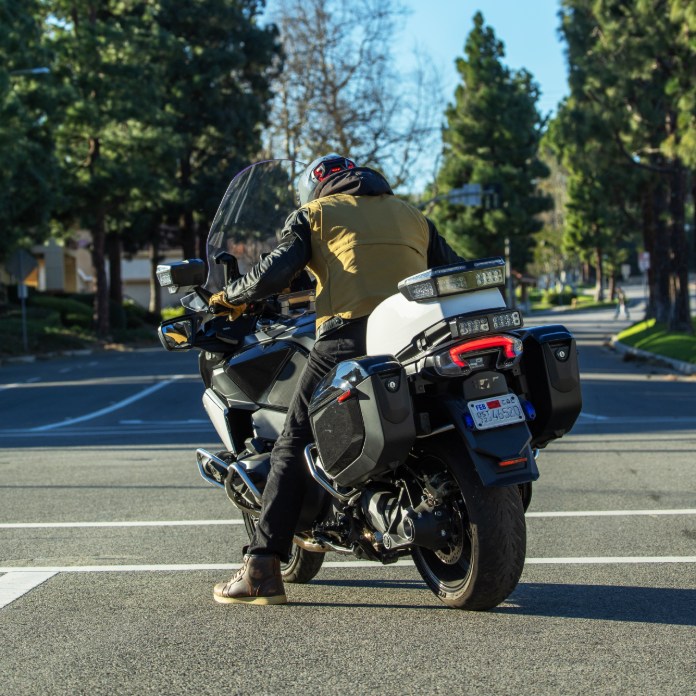
Make yourself small to reduce your frontal area. Leaning toward the wind also helps.
Breathe: I take ongoing deep breaths (box breathing) to calm both my body and my mind. Honestly, if you hear nothing else, hear this: Good breathing alone keeps you calm, reduces tunnel vision, improves decision making, and maximizes the likelihood that you will get home safely.
Sitting at a stop: Remember what I said about the benefits of momentum to keep you stable? Well, because we’re coming to a full and complete stop, that’s off the table. The first thing I do when I come to a stop is roll into it at an angle so I’m not fully sideways to the wind gusts. You know how ships approach large waves at a 45-degree angle to avoid getting pounded? Same idea here. I’m cognizant to stop within the lane in such a way that if my motorcycle blew over it wouldn’t hit any other vehicles or pin me between a bike and a hard place. For example, if the wind is blowing hard to the right, I’ll angle into the left portion of the lane.
In addition to stopping at a 45-
degree angle, I add a mild lean towards the wind to preempt the impact from the gusts. This will work your inside leg due to the added weight of the bike, but it’s a small price to pay to stay upright. Just in case, be prepared to immediately counter the inevitable gusts by keeping your outside leg on the ground too. If you want a gold star, make yourself
MotoGP-small like we discussed above and rest your upper body on the tank.
Taking off from a stop: When it’s time to take off from the light, I like to get up to speed assertively so I can generate some momentum to generate stability. I’m not suggesting you channel your inner Ricky Gadson and power wheelie off the light, but get moving.
Now at the risk of being a buzzkill, I’m going to close this out by offering this last bit of advice: If you can grab the keys to your dad’s Ford LTD Country Squire and avoid this entire situation altogether, go ahead and do that. Seriously, heavy wind gusts are no joke, and there’s nothing worse than being pinned down in the middle of nowhere when you finally realize it.
Quinn wears Schuberth helmets, Richa apparel, Lee Parks Design gloves, and Indie Ridge boots. Find out more at Quinn’s website, PoliceMotorTraining.com. Send feedback to rider@ridermagazine.com.
See all Motor School with Quinn Redeker articles here.
The post Motor School with Quinn Redeker: Candle in the Wind appeared first on Rider Magazine.
Continue reading...
Like a shark: Back-and-forth motion within your lane mentally and physically prepares you for heavy wind gusts. (Photos by Kevin Wing)
Luckily, I managed to ride the railing and ricochet back on the road with minimal scrapes and bruises. But from then on, I vowed that if I was going to continue riding on the street, I had to come up with a process that kept me safe when the winds kicked up. And 40 long years later, I think I’ve finally got it dialed enough to share.
Today we’re going to jam out to a little yacht rock and discuss ways we can mitigate the negative effects of wind while on the motorcycle. We’ll focus on street riding only, as off-road and racing environments have their own challenges and solutions. Please understand these suggestions are just the ones I use. They are not “correct” or better than anybody else’s, but because I believe you should challenge yourself to have all the techniques and all the information, I’m sharing them with you.
Headwinds slow you down and tail winds speed you up. They’re easy peasy. The major challenge with wind is when it’s pushing sideways on us. Below I’ve generated a list of key areas I focus on when faced with the back-and-forth tug-o’-war that crosswinds create.
Speeds: I’ve heard people say that you should slow down in windy conditions, and if I was a lawyer representing a training company, I might agree. However, in my experience, more momentum means more stability, so if I can safely increase speed to help make me a more stable package, I will. This includes freeways, long multilane roadways, and areas without intersections and cross traffic. Where I do not employ increased speed is in canyons or otherwise winding roads. This is because an ill-timed gust of wind coupled with increased speed has the potential to push me wide in a curve. Given that most canyon roads are two-lane affairs, I’ll either end up heading into oncoming traffic or onto the shoulder. So in these situations, I slow down a bit. As for city riding, I focus on gaining stability by getting up to speed quickly from traffic lights, but due to the complex variables presented by urban areas, I keep my speed otherwise normal.
Avoid becoming a human sail in heavy wind.
Lane position: My vanilla answer here is to stay in the middle of the lane, as it allows some movement when you find that you are no longer in Kansas anymore. I don’t just stiffly drone down the road; I move like a shark and “hunt” a bit in the middle portion of the lane via side-to-side motion in preparation for the gust. Why? Watch a tennis player waiting for a serve, and you will notice they are not just standing frozen. Instead, they shift side-to-side anticipating the ball to come at them. This helps keep them mentally and physically fluid and takes the “hard edges” off when the action starts. I do the same thing on my motorcycle, and it works fantastically.
Situational awareness: Riding in the wind requires an even higher level of awareness, reaction time, and focus than we already employ while on our motorcycles. I’ve encountered tires, wood beams, coolers, tree branches, trash cans, and more. While it’s never fun, the good news is that most of the obstacles are predictable, because the wind tends to push them in a linear trajectory and at a generally consistent speed. Unlike a driver who might cross your path only to realize it suddenly and slam on their brakes, an item blowing across the roadway can’t stop, won’t stop, but will keep moving. The key here is tracking it and getting your timing right. Yes, some obstacles will be stationary and directly in your path, like a downed tree, but those are typically visible from a good distance off, so you can avoid them. In most other cases involving UFOs streaking onto the road, adjust your speed, time them properly, and they will scurry on past you.
Riding posture: The smaller I make myself, the better. I tend to lay myself on the tank like I’m in the middle of a
MotoGP race to help reduce my surface area. This settles the bike, reduces wind noise in my helmet, and connects me more to the motorcycle. Of course, good control of the motorcycle can never be compromised in the process, so I make a concerted effort to really squeeze the bike with my legs. While this is always a good idea, the added variable of heavy side gusts makes it all that much more important to stay connected to the motorcycle. I also slightly increase my grip on the bars but not so tight that it degrades my ability to safely manipulate the controls.
Make yourself small to reduce your frontal area. Leaning toward the wind also helps.
Breathe: I take ongoing deep breaths (box breathing) to calm both my body and my mind. Honestly, if you hear nothing else, hear this: Good breathing alone keeps you calm, reduces tunnel vision, improves decision making, and maximizes the likelihood that you will get home safely.
Sitting at a stop: Remember what I said about the benefits of momentum to keep you stable? Well, because we’re coming to a full and complete stop, that’s off the table. The first thing I do when I come to a stop is roll into it at an angle so I’m not fully sideways to the wind gusts. You know how ships approach large waves at a 45-degree angle to avoid getting pounded? Same idea here. I’m cognizant to stop within the lane in such a way that if my motorcycle blew over it wouldn’t hit any other vehicles or pin me between a bike and a hard place. For example, if the wind is blowing hard to the right, I’ll angle into the left portion of the lane.
In addition to stopping at a 45-
degree angle, I add a mild lean towards the wind to preempt the impact from the gusts. This will work your inside leg due to the added weight of the bike, but it’s a small price to pay to stay upright. Just in case, be prepared to immediately counter the inevitable gusts by keeping your outside leg on the ground too. If you want a gold star, make yourself
MotoGP-small like we discussed above and rest your upper body on the tank.
Taking off from a stop: When it’s time to take off from the light, I like to get up to speed assertively so I can generate some momentum to generate stability. I’m not suggesting you channel your inner Ricky Gadson and power wheelie off the light, but get moving.
Now at the risk of being a buzzkill, I’m going to close this out by offering this last bit of advice: If you can grab the keys to your dad’s Ford LTD Country Squire and avoid this entire situation altogether, go ahead and do that. Seriously, heavy wind gusts are no joke, and there’s nothing worse than being pinned down in the middle of nowhere when you finally realize it.
Quinn wears Schuberth helmets, Richa apparel, Lee Parks Design gloves, and Indie Ridge boots. Find out more at Quinn’s website, PoliceMotorTraining.com. Send feedback to rider@ridermagazine.com.
See all Motor School with Quinn Redeker articles here.
The post Motor School with Quinn Redeker: Candle in the Wind appeared first on Rider Magazine.
Continue reading...