Hello. Sadly this brutal thread I did before was completely erased because servers issues. So I'm posting back again at least the most important of it, as it was close to a year of hard work cooking back a really bad-shaped ST1300. It will not be the 10-ish pages of pictures and explanations it was before, but I'll do my best so you can comment and ask back whatever you could need in order to help you rework or know better your ST1300.
Hello. It's stalled by now. I'm putting the next steps when I do them, by now I just started polishing the catalitic converters and haven't finished polishing the headlight I started like a month ago. I'm doing other stuff right now, as I'm not using the bike until next spring.
The main purpose was to show the insides of the ST1300 to everyone, and get people to ask specific questions about it to show how to fix specific stuff. If I start explaining everything I could be all my life and not finish it. For that you can just check out the workshop manual everytime you go to the bathroom. (I'm actually doing it with the Kawasaki EN500 workshop manual. I printed it and I'm on my way to read all that stuff. Same with the Yamaha Vmax 1200 soon).
SO, if you wan to know something SPECIFICALLY let me know, as I'm not getting deep on things if someone don't ask it.
I recall someone asking for wiring fixing, so I'm getting serious explaining that. Mine had the wires fully barbeque roasted so I found the connectors, special wires and made all the engine harness from scratch, but with thermal insulation improvings.
For those interested, I'm installing an alarm, a GPS tracker and a speeed-radar warning device, also a tire pressure small screen, a voltmeter and a thermometer for the alternator, where the dead-weak-point is in this bike (all the broken ones in Spain are dead because the alternator, the reason why I got mine for 500 euros).
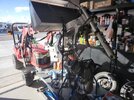
So, "In the beggining, there was a dead ST1300"... And it came to me like this:
All the parts absent in the picture were inside my car already. I was a rainy day. The diagnostic was a dead alternator, broken apart into pieces in my hands. The bearings failed and the rotor got mauled just enough to break the wiring. I was ready to open it and rework it but the workshop, kinda a zoo of monkeys, lost a key and the back of the alternator. I had to buy it new, as used was not worthy. I paid 800 euros for it new, as I'm not playing games when fixing stuff, no matter if it's for me or not, usually.
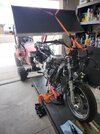
So, after a bit of thinking, I took off just the parts that needed some kind of fixing or cleaning.
Notice the plugs for the alternator hole and the admission things, I made them with 3D printer to fit perfectly and bear the brushing and all the thing I was going to do in order to get that nasty stuff off.
I'm creating a lot of posts so I'm not losing progress, I don't want to make massive posts, just in case.
I wasn't playing games, so I brushed it with gasoline, the only thing I know that dissolves grease and oily goo without damaging anything. I got really bad sniffing gasoline vapors, even using masks (carbon ones). I got to the point where even after showering I smelled gasoline in the air I was exhaling. Crazy. Anyways I'm good and just got some dizzy those days. I'm glad I'm not doing that everyday, just like 3 or 4 days every couple years with some project. The results were worthy.
It was the moment to fix anything on the back of the engine, starting for the slave clutch cylinder. I was sure it could be bad, but boy I wasn't expeting to get profecy levels:
Anyways some good cleaning did the trick and thing worked smooth like nothing. Everything was kinda marked because the crappy creppe it has inside but was OK to work another 100k kilometers. The secret is that water is more dense than brake fluid so it goes always down the system. Even if you bleed it the water remains at the lowest points if it has not a draining there. And our ST1300 has NOT a drain under the slave cylinder here, it has it at the upper part. So the water did not got out, rotting the thing from the inside. That's why I open the brake calipers too, you can take out the air, but not the water outside them.
I also fixed the gearbox bar, and changed the gearbox seal, as it looked like it was leaking. The speedometer wire was a bit cracky, so I cleaned it and reinforced it a bit.
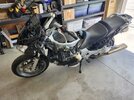
I forgot to post some other pictures of the cleaning's final results.
NEXT ONE, the starter motor:
Just cleaning, greasing and assembling again. The secret about starter motors is that the carbon from the brushes is conductive (obviously) so it makes short-circuits after some time in there filling gaps, making the motor to lose power and getting heaty faster, all bad stuff. Cleaning it every three years of this dust and changing the brushes on time makes it virtually eternal. Just cleaning with gasoline and greasing and is all good to go. The important stuff is cleaning between the copper bits, there is where the short circuits are made. I usually use a wire brush, and get to be sure all the copper is clean to the flesh.
NEXT ONE, the universal joint.
About this, the secret is that it can last almost forever if you grease it properly when it's needed. I don't know one of these going bad without losing its grease before. Even for my car I bought special ones with greasing knobs (or whatever you call those small balls to connect the hydraulic greaser). So, I was decided to get grease inside my universal joint. The way of getting inside that castity belt of a universal joint was cracking up a small cross at the middle of the lids, so my cobalt drill bit could break in. It was impossible even with an industrial drill press. Only that small cross did the trick to make a small hole to inject grease in there. And it worked great. All the dirt got out the joint clearly and my grease floooooded everything. I was so happy!
Only after being sure every dirt was out, I cleaned the outsides with paper towels taking out the profaned grease and sealed it with silicone based joint glue or whatever you call that. To be sure, I cleaned the surface where the silicone was going to go with gasoline, I needed that to be stuck there forever for real.
NEEEEEXT ONE, the swing arm.
I was sure it was BLACK. FFS. It was all dirt, all of it was DIRT. Just unearthy stuff.
Things got weird cleaning this. I first used an alcaline special soap for workshop floors. I got to notice the previous owner did some kind of road devil treaty where he did drive over fresh pavement, getting all of small bits of ticks of greasy black peanuts and small other rocks fully stuck on the surface.
AGAIN, gasoline did the trick.
I would drink gasoline just for the sake of its dignity if it weren't toxic. The swing arm got like new.
Assembling the swing arm. There are other parts in the pictures, from the wheels I think.
I made a special washer with cardboard for joints, to get the rubber boot for the universal joint in place. I don't know why but it wasn't getting there by itself. It was not deformed, it just was not that size, so that washer did the trick really good.
The rear shock absorber was broken, as expected, as the o-rings were gone long time ago, so the regulator was not working. All of those seals new and a bit of fork oil and there I fixed it! The hose, tube or whatever you called it (I just forgot the name...) was really bad, so I bought a teflon one new from aliexpress to the exact size and it fitted perfect the thing. It is really better than the old one, as it's teflon inside, a stainless steel braid outside and some plastic rubber over all that to protect it, with 250 bar of working pressure and 400 bar of bursting pressure. Extreme overkill for that task.