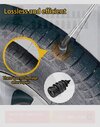
screw in tire plug ?

I pulled the metal object out of my tire. It was a screw and it went in almost sideways probably a 60 to 70° angle.
I didn't hear or feel any air coming out of the hole when I removed it, and then I checked the "hole" with soapy water looking for new bubbles to form as I ran my finger over the damaged area.
No bubbles, and this was when the tire had 35 psi in it.

So, I bumped it up to 44 psi and monitored it for 10 minutes. No change.

So I took the bike out riding.

It didn't lose any air over a 30 mile ride.
It's been in my garage for the last three days and it has lost 4 pounds after being parked for three days. Was 40 psi When I checked it last night.

I Don't think I will try to get this tire patched or plug it myself. Unless I have to take the rear tire off the wheel for some other reason, prematurely. But meanwhile I'll just monitor the situation with my new TPMS that arrived from Amazon the other day.
 

Attachments

  • IMG_3974.jpeg
    IMG_3974.jpeg
    122.9 KB · Views: 10
  • IMG_3971.jpeg
    IMG_3971.jpeg
    76.6 KB · Views: 10
I Don't think I will try to get this tire patched or plug it myself. Unless I have to take the rear tire off the wheel for some other reason, prematurely. But meanwhile I'll just monitor the situation with my new TPMS that arrived from Amazon the other day.

I think this is how I'd roll. It sounds like in went into the tread rubber but didn't penetrate the cord or into the inside of the tire. Does your new TPMS provide an audible alert?
 
Yes, but there's about zero chance that I would hear that audible signal while the engine is running with me wearing a helmet. However a red light illuminates the numbers when the number goes below the minimum threshold (factory preset I believe is 29 pounds, and I lowered one of my car tires down to 28 when I was testing it today and saw what that beeping sounds like and red warning looks like. I'm not sure if I could see that red on a bright sunny day, but it is very noticeable on a cloudy day (today).
 
So, it's been a month since I pulled that screw out of my rear tire and three weeks since I put a tire pressure monitoring system on the bike. RESULT my tires don't lose air pressure ( any more than normal).
Now that the weather is colder I did have to add a few pounds to each of them a few weeks ago but after that they seem to only lose about a pound every two weeks, and that's how it's always been on all the motorcycles I've ever owned and bicycles too. I made the mistake of intentionally bumping my rear tire up to about 44 pounds a few weeks ago figuring that it would settle down to 42 PSI after it leaked a little bit, but it didn't leak at all for a couple weeks ! And I noticed that after I was riding the bike it would heat up to 46+ pounds so I had to stop and bleed some air out of it to bring it back down to the recommended pressure.

SO, I got lucky -- that screw that went into my rear tire went sideways and never compromised the air seal it only went through the tread.
 
I recently bought a set of short recessed head screw-in tire plugs. They look like the product from the original post on page 1.

I got a set of them from Amazon for about $20.
I think I got 50 of these screws: 25 in the larger size, 6mm, and 25 of the smaller size, 3.5mm. But I can’t be sure they’re exactly the same thing as the OP asked about last fall.

Each screw plug is coated with a dry, crusty waxy substance and packaged individually in a plastic capsule that you would remove the screw from immediately before use.

IMG_1046.jpegIMG_1062.jpeg
 
Last week I spent $15 at the junkyard to buy a complete wheel and tire that holds air that I could stab holes into IMG_1044.jpegand experiment with.

( unfortunately they didn’t have such a wheel tire that would fit my vehicle, so I can’t take this tire out on the road and put it under a load, but I can poke holes in it, and plug those holes with various methods, and see how it holds air over the next few hours just sitting in my garage.)


IMG_1041.jpeg

IMG_1045.jpegIMG_1043.jpeg
 
Ive had a slew of flats and there has been one common occurance. I ran the battleaxes. Every time i flatted the sidewall held me up till i stopped. Itnfelt like the engine had no power. I used the rubber, bendable plugs every time. .
 
I’ve use the rubberized rope/worm type plugs as pictured here several times.

IMG_1050.jpegIMG_1051.jpeg

And I agree they generally work on my car, but the one time that I thought it would work on the motorcycle (and things seem to go well during the plug job at a gas station) that tire still had a leak that required two air pump stops over the next four hours before I got home.

Also, regarding my car tires, one time I pulled out a very small nail (or actually I think it was half of a staple— a commercial staple that wood trim and cabinets would be assembled with) and that hole in my tire was such a small diameter I could not force the reaming awl through the hole to widen it out and roughen up the hole for the gummy worm type plugs.
I had to use a cordless drill on that staple hole.

The smaller size of the screw-in tire plugs look like they would be the most useful kind, because they will accommodate small holes which resist being reamed out with manual force. I’ve generally got pretty good hand, arm, and upper body strength, but a couple times it was very difficult to ream out the hole,

and one time it was
impossible for me to do it.
 
I’ve use the rubberized rope/worm type plugs as pictured here several times.

IMG_1050.jpegIMG_1051.jpeg

And I agree they generally work on my car, but the one time that I thought it would work on the motorcycle (and things seem to go well during the plug job at a gas station) that tire still had a leak that required two air pump stops over the next four hours before I got home.

Also, regarding my car tires, one time I pulled out a very small nail (or actually I think it was half of a staple— a commercial staple that wood trim and cabinets would be assembled with) and that hole in my tire was such a small diameter I could not force the reaming awl through the hole to widen it out and roughen up the hole for the gummy worm type plugs.
I had to use a cordless drill on that staple hole.

The smaller size of the screw-in tire plugs look like they would be the most useful kind, because they will accommodate small holes which resist being reamed out with manual force. I’ve generally got pretty good hand, arm, and upper body strength, but a couple times it was very difficult to ream out the hole,

and one time it was
impossible for me to do it.
Thats what i use. I ran battleaxes and the sidewall saved me every time. I had five plugs in my rear on my first tour. Ifoolishly stopped kn a lot of safety zones for pics.
People underestimate the value of a good sidewall.
I go no where without my patch kit and a working pump.
 
The small hole I made in my spare tire was successfully plugged with the small screw- in plug device. Then a couple days ago I drilled a hole through that tire and plugged it with the larger ( 6 mm ) screw-plug. Now, 2 days later, that one is holding air just fine.

IMG_1075.jpegIMG_1076.jpeg
Of course these are “static” tests, without this wheel and tire being mounted on a vehicle, bearing weight, and being dragged down the road.
 
what type of screwdriver do you use? posidrive, jis , #1, #2 or #3. stuck on the side of the road trying to figure out why the head stripped out and how to remove it. :confused1:
 
Which makes me wonder, How come loose screws and bolts always work loose, but never tighten. I have seen the loose ones but they aren't tighter when I go back to look and tighten
Vibrations, in particular, induce transverse sliding, causing the bolt to rotate loose or the joint materials to settle. Thus the need for lock washers, stretch bolts and loctite to name a few. :thumb:
 
The small hole I made in my spare tire was successfully plugged with the small screw- in plug device. Then a couple days ago I drilled a hole through that tire and plugged it with the larger ( 6 mm ) screw-plug. Now, 2 days later, that one is holding air just fine.

IMG_1075.jpegIMG_1076.jpeg
Of course these are “static” tests, without this wheel and tire being mounted on a vehicle, bearing weight, and being dragged down the road.
Do u coat these with rubber or contact cement too?
 
No, although they come with some hard crusty waxy substance that breaks off and crumbles away when you screw them down into the rubber. I have no idea what that substance is or what it is supposed to accomplish.

If I were to do something to these things before they go into the tire I’m thinking that I would like to carry a miniature torch —like the kind used for lighting cigars—- and heating up the plug so that it softens the rubber as it gets screwed in minimizing the chances of the rubber cracking. I mean little cracks in the rubber going away from the hole which is newly enlarged and under constant tension by this screw wedging itself in there. But, even if there are such cracks present they shouldn’t be to be a big issue because they would only cause a very slow leak —that wouldn’t stop you from riding, even riding all day.
 
Back
Top Bottom