Rear brake binding

Question, did you rebuild, or replace the secondary master cylinder, or just the calipers?
Your rear wheel should turn a little over two full rotations with one strong push.
Have you checked the wheel spacers to see if the are on the correct sides, and are not inside out?
 
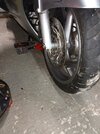
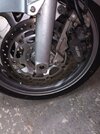
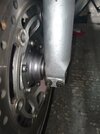
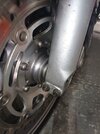
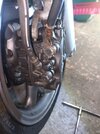
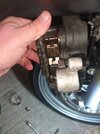
I was trying to illustrate measuring the front caliper disc spacings.
Hard to photograph.
 
Back to the question, did you rebuild the smc or replace it?
If you rebuilt it, the cartridge behind the smc may be clogged (return port) This will not allow the pressure to bleed off the brakes.
Nice Snap On screw driver!
 
I replaced the SMC.
They are snap on picks.
I was wondering if the rear brake master cylinder closed on the return port
 
Last edited:
Been out on a test ride, did not ho far as was raining heavily.
The rear wheel is spinning one and a half turns easily.
The front wheel us spinning three quarters of a turn.
Spun back wheel activated the smc by hand, wheel stopped immediately.
20251019_152555.jpg
20251019_152525.jpg
 
Sounds like your replacement SMC is working correctly, however, there is something seriously wrong with the front calipers if your front wheel only turns Three quarters of a turn!
Remember you have a linked brake system.
 
Update I raised front wheel off ground first.
I have pushed back both front calipers so that the wheel turned freely.
Activated front brake lever pulled straight back to handle bars. Took three pumps to firm up lever.
Spun front wheel, quarter turn.
20251021_200753.jpg
Pushed back pistons into calipers, wheel spins freely. Repeat test for rear brake pedal. Firm pedal one full spin of front wheel.
Not quite sure where to go with this next.
 
First, you need to completely clean and inspect both front calipers, check to make sure the clips are not damaged, inspect the guide dowels and grommets/boots for damage, make sure you didn’t put too much grease on them creating suction etc.
Are the front pads OEM or aftermarket?
If the are aftermarket such as EBC pads the may not fit properly.
After everything is clean and inspected, you should re-bleed the entire system in the correct sequence.
Post some pictures of the front calipers and condition of the pads.
 
The clips are new genuine Honda brake pads, pistons, seals, rubber boots all genuine Honda.
I used brake fluid on the piston seals and red rubber grease on the dust seals.
 
Post a photo of the other side of the front wheel ?
Also - did you by any chance fit spare white heat shields to the front pads (between the backing plate and the chrome squeal plate).
There is not enough room for them.
 
I was hoping to be able to see the spacer between the bottom of the left fork leg and the hub.

I cannot remember whether I asked - Where in the UK are you ?

Some stupid questions that I have to ask.

With the pads out, how freely do the wheels move ? You need a point of reference - 'cos with the pads in they aren't going to rotate more freely than with the pads out.

1. Are the pads fitted int he correct positions - the rear pads have a square notch in the tab end. The front ones don't - just check that you haven't switched two. (although it isn't possible to insert rear pads in the front caliper when new. But it
2. The chrome retainer clip into which the tab end of the pad sits. The rear one has a ridge in it which the notch sits over. If you accidentally put the rear clip in the front bracket, the pad will be unable to move away from the disk.
3. Check - ie look and see - the tab end of the pad seated correctly in each retainer clip. You can see this at the top of the caliper from the outside pad easily - you need a light to look through the spokes to see the inside pad - you may need to rotate the wheel. It is so easy to get it wrong. I know when I have got it right, but I still check every time.
4. It is possible to get the pad spring the wrong way round in the front calipers on an ST1300A6 and on all rear calipers. Broad part of the spring goes closest to the pistons.
5. The tag on the narrow part of the spring - the inside pad has to sit between the tag and the inside jaw of the caliper.

All new pads will scrape the disc surface and create a bit of drag - but not to cause that much drag.
 
I was hoping to be able to see the spacer between the bottom of the left fork leg and the hub.

I cannot remember whether I asked - Where in the UK are you ?

Some stupid questions that I have to ask.

With the pads out, how freely do the wheels move ? You need a point of reference - 'cos with the pads in they aren't going to rotate more freely than with the pads out.

1. Are the pads fitted int he correct positions - the rear pads have a square notch in the tab end. The front ones don't - just check that you haven't switched two. (although it isn't possible to insert rear pads in the front caliper when new. But it
2. The chrome retainer clip into which the tab end of the pad sits. The rear one has a ridge in it which the notch sits over. If you accidentally put the rear clip in the front bracket, the pad will be unable to move away from the disk.
3. Check - ie look and see - the tab end of the pad seated correctly in each retainer clip. You can see this at the top of the caliper from the outside pad easily - you need a light to look through the spokes to see the inside pad - you may need to rotate the wheel. It is so easy to get it wrong. I know when I have got it right, but I still check every time.
4. It is possible to get the pad spring the wrong way round in the front calipers on an ST1300A6 and on all rear calipers. Broad part of the spring goes closest to the pistons.
5. The tag on the narrow part of the spring - the inside pad has to sit between the tag and the inside jaw of the caliper.

All new pads will scrape the disc surface and create a bit of drag - but not to cause that much drag.
I am in SWales
I have removed the pads, right hand side.
20251022_192350.jpg
20251022_192432.jpg
20251022_192444.jpg
Checked the caliper slider pins there is movement, bit of drag on the new rubber
20251022_192956.jpg
20251022_193012.jpg
Then I pumped out the two outer pistons, applied red rubber grease and worked in and out. Pushed in easily. Repeated with centre piston, rear brake pedal. Pushed back easily.
20251022_193710.jpg
20251022_193717.jpg
Reattached caliper without pads fitted.
Half a wheel turn. The pads are still in the smc left hand side.
 
Last edited:
Thank you for the pictures, was hoping it would be something simple like your left spacer in backwards etc.
On my small phone and have not re-read entire thread, are you sure the wheel bearings were installed correctly?
One thing I did see in your pictures is way too much grease on the guide dowels!
This can cause suction and pull the caliper over the prevent it from moving back.
I know over on your side of the pond, you guys have to use that red grease on everything to keep rust away, however, you should only have a very slight film of grease on those dowels, and NONE packed inside the rubber boots etc.
Try cleaning all the grease off, and just put a light film on them and try that.
 
Thank you for the pictures, was hoping it would be something simple like your left spacer in backwards etc.
On my small phone and have not re-read entire thread, are you sure the wheel bearings were installed correctly?
One thing I did see in your pictures is way too much grease on the guide dowels!
This can cause suction and pull the caliper over the prevent it from moving back.
I know over on your side of the pond, you guys have to use that red grease on everything to keep rust away, however, you should only have a very slight film of grease on those dowels, and NONE packed inside the rubber boots etc.
Try cleaning all the grease off, and just put a light film on them and try that.
I did not change the front wheel bearings only the rear. Will clean the guide pins, I did notice the boots for the pins are tighter than the old ones.
 
If you are getting half a turn on the wheel without the pads fitted and half a turn on the wheel with the pads fitted, then the problem isn't to do with the brake pads !
That sounds like tight bearings may be the issue - if bearing have not been put in correctly - or the bearings are worn an/or out of grease.

You can check this, but it means removing the wheel. Put your finger into the bearing hole and rotate the inner race with your finger. It will be a little stiff, but it should move back and forth smoothly without any roughnesss or movement / rocking other than the turning. Check both sides. Do not try to spin the wheel with your finger in the hole. There is far too much inertia and if it isn't rotating properly it will screw your finger off your hand.
 
Back
Top Bottom