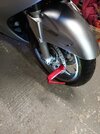
A quarter turn with both front brake pads fitted. Half a turn with just the smc side fitted.If you are getting half a turn on the wheel without the pads fitted and half a turn on the wheel with the pads fitted, then the problem isn't to do with the brake pads !
That sounds like tight bearings may be the issue - if bearing have not been put in correctly - or the bearings are worn an/or out of grease.
You can check this, but it means removing the wheel. Put your finger into the bearing hole and rotate the inner race with your finger. It will be a little stiff, but it should move back and forth smoothly without any roughnesss or movement / rocking other than the turning. Check both sides. Do not try to spin the wheel with your finger in the hole. There is far too much inertia and if it isn't rotating properly it will screw your finger off your hand.

You are using an out of date browser. It may not display this or other websites correctly.
You should upgrade or use an alternative browser.
You should upgrade or use an alternative browser.
Rear brake binding
- Thread starter ST1
- Start date
I have removed the left gand side pad set.A quarter turn with both front brake pads fitted. Half a turn with just the smc side fitted.
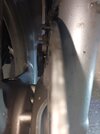

The front wheel spins freely three and three quarter turns.

So it is a pad / caliper issue or wheel installation issue.


Three quarters turn is not spinning freely.
He said three and three quarters though !! 3+3/4Three quarters turn is not spinning freely.

Ok. The wheel rotates OK without pads. It doesn't rotate OK with pads.
There are a number of things that can cause brake drag.
1 Wheel installation. The brake disk is mounted on the wheel which is on the axle. The brake calipers are mounted on the fork legs. If the wheel installation is not correct then the disks are not in the correct position in relation to the caliper. That will cause wheel drag especially with new pads.
Two tell tale signs. There should be 0.7m clearnance on both sides of the brake disk as it passes through the caliper.
The left hand end of the axle should be flush with the axle hole at the bottom of the left fork leg.
2. Brake Calliper movement - they must be able to slide in and out on their caliper slider pins (when the pads are not in). Push them in towards the wheel, they should stay there. Pull them out, they should stay there. Movements should be smooth and not difficult.
3. Pads should meet the disc flat face to face, not bottom first or top first.
4. The pads should release their grip on the disc immediately the pressure is released. With new pads this may take a few miles of riding and braking until they have bedded in.
5. All 3 pistons in each caliper should push into the caliper easily with just thumb pressure. Beware - pushing a piston in on one caliper will push out a piston in the other caliper. Also pushing in one of the two outside pistons will push out the other outside piston. Prevent this from happening - I have 3 blocks of wood, each wrapped with thin metal sheet, one for each caliper for this purpose. Slip one into the caliper in place of the pads and pump the lever to lock it into position. The metal sheet is to stop the pistons from burying themselves into the wood.
The purpose of this is to make sure that the fluid can be pushed back into the appropriate reservoir. (Rear reservoir for centre pistons, handlebar reservoir for the 2 outer pistons.)
I haven't got a clue what the fault is - if there is a fault - but these are the things that I would be looking into.
It is possible that nothing is particularly wrong - but the above need checking. MY own brakes bind and squeal like mad when I reverse the bike out of the garage. It is just the light surface rust on the disk causing resonance with the disk pads. This can happen over a couple of days even if it wasn't raining when I put the bike away. The first couple of stops are viscious - I mean closely inspect the inside of the windscreen viscious - but after that they work perfectly and when I put the bike away the bike is easy to move around - (or it would be if I hadn't put two tears in my calf muscle putting the damn thing on its centre stand).
I need to fit new pads - so I would normally go out and get a comparison for you - but at present my calipers are off, my brake hoses are dangling in plastic bags (to catch drips, and the front right fork just needs fresh oil after a rebuild before I reinstall that and start on the left fork.
So I cannot help in that respect - but there is an element of english / welsh weather that has to be take into account which may be all that you are seeing. If the rotation is getting better after a few manual rotations, then personally, I would be tempted to take it for a very short ride of a few hundred yards, stop without touching the brakes and feel the brake disk temperatures. Then try using the brakes to come to a stop, then move away and stop again without using the brakes. Centre stand and check how the wheel turns manually. If it is getting easier, then be a little bolder. Ride a little further and brake harder to get the discs warm. Pull the clutch lever in occasionally to see whether or not the brakes are dragging - the slowing down will be obvious if they are. Stop and check the disk temperature after a few hard stops. Dont touch, they will be very hot. Make sure that the wheel will rotate and then ride a mile or so and come to a stop without using the brakes. They should be cold again. Or at least, much cooler.
Always be aware that during these tests that you may be riding on the edge of disaster. The point is that after getting hot from braking, the pads should easily release from the disc surface and get cooler. If they don't then you have a problem and you need to abort and get back home. If you live on a level road, then doing this up and down the road would be enough and a safe precaution.
So beware - if there is still something wrong, then the brakes will get hot very quickly and might suddenly lock up. So it is baby steps to find out whether or not it improves. And you must do all of the inspection tests first.
Don't forget to keep checking the back brake, because if the front left brake is dragging, that will apply the rear brake. That is easier to do if you leave the panniers off. Every time you brake - lever or pedal - the back brake is applied.
Front disks should be cold if you come to a stop without using the brakes after a mile or so.
Rear brakes will never get stone cold because of the heat from the engine and exhaust. But youbshould be able to keep your finger on them without losing your finger prints.
Afterthought. You may want to try this test just using the front brake lever. That will leave the centre pistons out of the tests completely. But you still need to keep checking the rear disc temp.
If that works out ok then repeat the tests using the rear brake pedal only. That test the front centre pistons only, but will operate all 3 rear pistons. You may notice that the right front disk is cooler than the left. This would be because the front right piston doesn't operate under light braking, only if the braking is pressed harder than required for car park manoeuvres.
There are a number of things that can cause brake drag.
1 Wheel installation. The brake disk is mounted on the wheel which is on the axle. The brake calipers are mounted on the fork legs. If the wheel installation is not correct then the disks are not in the correct position in relation to the caliper. That will cause wheel drag especially with new pads.
Two tell tale signs. There should be 0.7m clearnance on both sides of the brake disk as it passes through the caliper.
The left hand end of the axle should be flush with the axle hole at the bottom of the left fork leg.
2. Brake Calliper movement - they must be able to slide in and out on their caliper slider pins (when the pads are not in). Push them in towards the wheel, they should stay there. Pull them out, they should stay there. Movements should be smooth and not difficult.
3. Pads should meet the disc flat face to face, not bottom first or top first.
4. The pads should release their grip on the disc immediately the pressure is released. With new pads this may take a few miles of riding and braking until they have bedded in.
5. All 3 pistons in each caliper should push into the caliper easily with just thumb pressure. Beware - pushing a piston in on one caliper will push out a piston in the other caliper. Also pushing in one of the two outside pistons will push out the other outside piston. Prevent this from happening - I have 3 blocks of wood, each wrapped with thin metal sheet, one for each caliper for this purpose. Slip one into the caliper in place of the pads and pump the lever to lock it into position. The metal sheet is to stop the pistons from burying themselves into the wood.
The purpose of this is to make sure that the fluid can be pushed back into the appropriate reservoir. (Rear reservoir for centre pistons, handlebar reservoir for the 2 outer pistons.)
I haven't got a clue what the fault is - if there is a fault - but these are the things that I would be looking into.
It is possible that nothing is particularly wrong - but the above need checking. MY own brakes bind and squeal like mad when I reverse the bike out of the garage. It is just the light surface rust on the disk causing resonance with the disk pads. This can happen over a couple of days even if it wasn't raining when I put the bike away. The first couple of stops are viscious - I mean closely inspect the inside of the windscreen viscious - but after that they work perfectly and when I put the bike away the bike is easy to move around - (or it would be if I hadn't put two tears in my calf muscle putting the damn thing on its centre stand).
I need to fit new pads - so I would normally go out and get a comparison for you - but at present my calipers are off, my brake hoses are dangling in plastic bags (to catch drips, and the front right fork just needs fresh oil after a rebuild before I reinstall that and start on the left fork.
So I cannot help in that respect - but there is an element of english / welsh weather that has to be take into account which may be all that you are seeing. If the rotation is getting better after a few manual rotations, then personally, I would be tempted to take it for a very short ride of a few hundred yards, stop without touching the brakes and feel the brake disk temperatures. Then try using the brakes to come to a stop, then move away and stop again without using the brakes. Centre stand and check how the wheel turns manually. If it is getting easier, then be a little bolder. Ride a little further and brake harder to get the discs warm. Pull the clutch lever in occasionally to see whether or not the brakes are dragging - the slowing down will be obvious if they are. Stop and check the disk temperature after a few hard stops. Dont touch, they will be very hot. Make sure that the wheel will rotate and then ride a mile or so and come to a stop without using the brakes. They should be cold again. Or at least, much cooler.
Always be aware that during these tests that you may be riding on the edge of disaster. The point is that after getting hot from braking, the pads should easily release from the disc surface and get cooler. If they don't then you have a problem and you need to abort and get back home. If you live on a level road, then doing this up and down the road would be enough and a safe precaution.
So beware - if there is still something wrong, then the brakes will get hot very quickly and might suddenly lock up. So it is baby steps to find out whether or not it improves. And you must do all of the inspection tests first.
Don't forget to keep checking the back brake, because if the front left brake is dragging, that will apply the rear brake. That is easier to do if you leave the panniers off. Every time you brake - lever or pedal - the back brake is applied.
Front disks should be cold if you come to a stop without using the brakes after a mile or so.
Rear brakes will never get stone cold because of the heat from the engine and exhaust. But youbshould be able to keep your finger on them without losing your finger prints.
Afterthought. You may want to try this test just using the front brake lever. That will leave the centre pistons out of the tests completely. But you still need to keep checking the rear disc temp.
If that works out ok then repeat the tests using the rear brake pedal only. That test the front centre pistons only, but will operate all 3 rear pistons. You may notice that the right front disk is cooler than the left. This would be because the front right piston doesn't operate under light braking, only if the braking is pressed harder than required for car park manoeuvres.
Last edited:
I have worked all the pistons in and out on both sides, the four outer and the two inner. They are all free, the bigger of the the slider pin rubbers on the right hand side are tight on the slider. I gave this a squirt with silicon spray, big improvement.
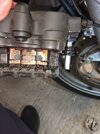
This is the rubber boot to the left in the picture.
Whent out on a test ride pulled in clutch down hill. Bike speed increased, road normally for a mile. Performed emergency stops, first with back brake. This stopped the the bike and then with the front brake this realy stopped the bike quickly. Placed bike on center stand rear wheel easy one and a half spins, disk to hot to touch. Both front brakes disks hot to touch.
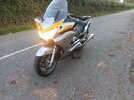
Rode home normally, bike place on centre stand all discs able to hold hand on rear slightly warmer. Rear wheel one abd three quarters spins.
Front wheel three quarters of a spin.
This is the rubber boot to the left in the picture.
Whent out on a test ride pulled in clutch down hill. Bike speed increased, road normally for a mile. Performed emergency stops, first with back brake. This stopped the the bike and then with the front brake this realy stopped the bike quickly. Placed bike on center stand rear wheel easy one and a half spins, disk to hot to touch. Both front brakes disks hot to touch.
Rode home normally, bike place on centre stand all discs able to hold hand on rear slightly warmer. Rear wheel one abd three quarters spins.
Front wheel three quarters of a spin.
So what you have learned from that is that the brakes work, and after being VERY hot, normal riding releases them to the point that they cool off. The low spin rate of the front wheel is not he front left dragging - at least not enought to activate the SMC to apply the rear brake.
Still not solved, but not dangerous. It might be the pads needing to be bedded in.
You will get more confident as time progresses - but be aware that we have done nothing to fix what seemed to be a problem. So it may still be there. But go riding. Pull the clutch lever in regularly when riding and it should never start to slow down immeditaley if you are on the level. As long as that is the case you can continue. The moment that you pull the clutchlever in and the bike suddenly slows is the time to get off and take a look at what is happening.
That situation I had before going off to Spain in two days time that I wrote about in avaoiding the pitfalls: - I seemed to have solved it - but I didn't know for sure. I'd been out on a post service test ride, pulled the clutch lever in and it was like applying the brakes. The rear brake was smoking hot. I redid everything and it seemed to work (the only thing I found was too much grease on the slider pins). But for the entire holiday and for months afterwards, I'd be pulling the clutch lever in every couple of minutes to check.
Revisit this after a few good rides when the pads have bedded in and soon after you have had a good run (eg the day after).
Top photo focusing on the rubber boot to theleft of the picture. Note that the rubber boot to the right of the picture has pulled out of its seat in the caliper bracket. IT should not do this. The rubber rim should fit inside the groove that is in the caliper bracket and it should stay there. If you are having trouble getting that boot rim into the groove, then it is probably because the boot has swelled - due to use of petroleum based grease - although it looks pretty new from what I can tell.
Both slider pins need a light smear of red rubber grease or silicone based grease so that the calipers can move back and forth smoothly. Too much grease and it creates pressure or vacuum which moves the caliper back like a spring - and that can cause the brake pads to move against the brake disk. You can get a tin of red rubber grease from places like Screwfix.
Still not solved, but not dangerous. It might be the pads needing to be bedded in.
You will get more confident as time progresses - but be aware that we have done nothing to fix what seemed to be a problem. So it may still be there. But go riding. Pull the clutch lever in regularly when riding and it should never start to slow down immeditaley if you are on the level. As long as that is the case you can continue. The moment that you pull the clutchlever in and the bike suddenly slows is the time to get off and take a look at what is happening.
That situation I had before going off to Spain in two days time that I wrote about in avaoiding the pitfalls: - I seemed to have solved it - but I didn't know for sure. I'd been out on a post service test ride, pulled the clutch lever in and it was like applying the brakes. The rear brake was smoking hot. I redid everything and it seemed to work (the only thing I found was too much grease on the slider pins). But for the entire holiday and for months afterwards, I'd be pulling the clutch lever in every couple of minutes to check.
Revisit this after a few good rides when the pads have bedded in and soon after you have had a good run (eg the day after).
Top photo focusing on the rubber boot to theleft of the picture. Note that the rubber boot to the right of the picture has pulled out of its seat in the caliper bracket. IT should not do this. The rubber rim should fit inside the groove that is in the caliper bracket and it should stay there. If you are having trouble getting that boot rim into the groove, then it is probably because the boot has swelled - due to use of petroleum based grease - although it looks pretty new from what I can tell.
Both slider pins need a light smear of red rubber grease or silicone based grease so that the calipers can move back and forth smoothly. Too much grease and it creates pressure or vacuum which moves the caliper back like a spring - and that can cause the brake pads to move against the brake disk. You can get a tin of red rubber grease from places like Screwfix.
I have completed a 100mile ride through the Brecon beacons today.
I stopped a couple of times along the way.
The left front smc side side is cool, the right front is slightly warm.
On returning home and given the front wheel a spin one and a half turns.
The rear disc on returning home is warm and the wheel give two full spins.
I checked the caliper to disc spacing before the ride, both sides within tolerance.

I stopped a couple of times along the way.
The left front smc side side is cool, the right front is slightly warm.
On returning home and given the front wheel a spin one and a half turns.
The rear disc on returning home is warm and the wheel give two full spins.
I checked the caliper to disc spacing before the ride, both sides within tolerance.
Last edited:
Great stuff. So that is much better after a good run. Keep your eye on it though.
Warm (not hot) rear disc is normal. It cannot cool properly in the hot air from the engine and the exhaust. Hence the white heat shield pads on the rear brake pads, but not on the front.
Warm (not hot) rear disc is normal. It cannot cool properly in the hot air from the engine and the exhaust. Hence the white heat shield pads on the rear brake pads, but not on the front.

Sounds about sorted! Great news!!
Yes I hope so it has been a long journey.Sounds about sorted! Great news!!
Is that a corbin seat unit on your bike.
Corbin Smuggler trunk (I appreciate the "bum-stop" that reduces sliding around during spirited riding, and the deceivingly enormous secure storage)
https://www.corbin.com/honda/st13smug.shtml
with Russell Day-Long solo seat
https://day-long.com/
NO padding but fits my bum nicely!!
/r
Brad
https://www.corbin.com/honda/st13smug.shtml
with Russell Day-Long solo seat
https://day-long.com/
NO padding but fits my bum nicely!!
/r
Brad
Last edited:
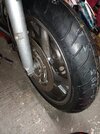
I needed a new front Tyre decided on a T32 Gt.

I have inspected the front brake pads and there is uneven where and the slider pins are rusty, I have bought a pair of titanium pins to fit.

The bottom set are are the right side as sat on the bike.
Earlier in the thread a dealer had fitted rear wheel bearings incorrectly he has reimbursed me and apologized.
I have inspected the front brake pads and there is uneven where and the slider pins are rusty, I have bought a pair of titanium pins to fit.
The bottom set are are the right side as sat on the bike.
Earlier in the thread a dealer had fitted rear wheel bearings incorrectly he has reimbursed me and apologized.

Sadlsor
Site Supporter
Oooooooh!
Shiny pins! Me like.
Got o-rings...?
Shiny pins! Me like.
Got o-rings...?
Sadlsor
Site Supporter
While it's all out, I would replace them.I was going to use existing.
Just makes sense.
At least inspect yours for cuts, cracks, dryness. Appropriate lube when reassembling.
Rubber bits degrade over time.
But the new pins still look great!
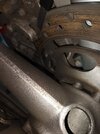


All back together waiting for dry day to test ride.yes they are titanium non magnetic. (off ebay).
The wheel is now fitted and checking the 7mm clearance.
after cleaning up the brake pads, signs of uneven wear are apparent.