TPMS recommendations

Many people rely on the TPMS to do a pre-ride pressure check in place of performing a tire pressure check with a gauge as part of their pre-ride inspection because it is easier to do so. Just my opinion of course, but I still think that the proper use of a TPMS is not to replace a proper tire pressure gauge. Its best used as a means to identify a loss of pressure while riding after having performed and adjusted tire pressure as part of the pre-ride inspection, not in place of.
 
Many people rely on the TPMS to do a pre-ride pressure check in place of performing a tire pressure check with a gauge as part of their pre-ride inspection because it is easier to do so. Just my opinion of course, but I still think that the proper use of a TPMS is not to replace a proper tire pressure gauge. Its best used as a means to identify a loss of pressure while riding after having performed and adjusted tire pressure as part of the pre-ride inspection, not in place of.
That's great advice in theory, but as someone who rides almost every day, I'm not going to check my tire pressure every morning at 4:30am. TPMS is a good solid compromise. A mediocre system you use is infinitely better than a perfect system you don't. But then, my BMW has the answer before I get down the driveway.
 
Nice to have :thumb: For my part, I don't see the big need for TPMS, check the air pressure in the spring after winter storage and maybe once again in the middle of the summer season. Experience very little variation in tire pressure unless I have a leak. Important to change the valve when changing tires.
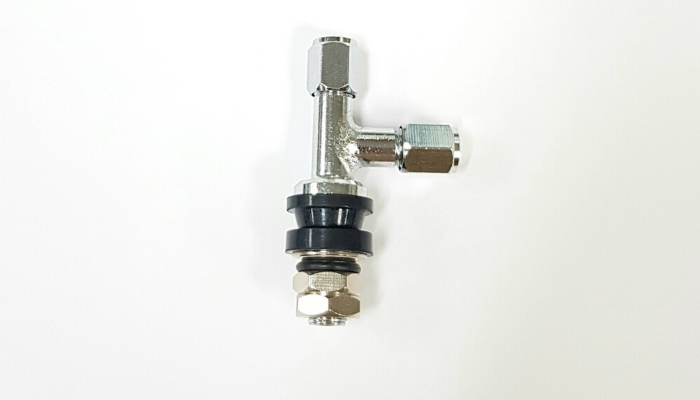
 
FOBO_TIRE_2161337.jpg


This is the version sold by Fobo Bike at $12 a copy. It's shorter on both arms than its predecessor.
 
Nice to have :thumb: For my part, I don't see the big need for TPMS, check the air pressure in the spring after winter storage and maybe once again in the middle of the summer season. Experience very little variation in tire pressure unless I have a leak. Important to change the valve when changing tires.
Gosh, I've never changed the valves, except when I put on the T-valves, and that's been many tire changes ago. Possibly true for the old rubber valves, (but I never did then) but I would consider these t-valves to be permanent.
 
FWIW, I buy the small 90 degree lever-type air chuck adapter that is apparently too expensive to include in today's tire inflators. No need for 90-degree stems so my TPMS doesn't shouldn't cause any deflection.

Cant say I'd recommend my TPMS but it isn't available anymore either, but it works fine.
 
Gosh, I've never changed the valves, except when I put on the T-valves, and that's been many tire changes ago. Possibly true for the old rubber valves, (but I never did then) but I would consider these t-valves to be permanent.
I have experienced fitting new tyres only to discover a leak in the valve while driving, a standard valve is cheap and quick to replace when the tyre is off. Not as easy when the wheel is on :thumb:
 
I just got my first bike with TPMS last week. Came on the used bike. It's a Garmin set up linked to a Garmin Zumo GPS. I made it 60 years and 5 months of street riding without a TPMS and wouldn't have this if it didn't come on the bike. I ride nearly every day and normally manually check pressures once a week or so on my other bikes. I can tell pushing my bikes backwards out of the garage if a tire is low. Will be interesting to see how this works. I know in my Camry the pressures will say one thing before I take off and be 3 or 4 pounds higher after having driven for awhile, so not sure how accurate checking before riding will be at different temperatures (40 degrees out vs 80 degrees out). Something else to obsess over I guess lol.
 
Nice to have :thumb: For my part, I don't see the big need for TPMS, check the air pressure in the spring after winter storage and maybe once again in the middle of the summer season. Experience very little variation in tire pressure unless I have a leak. Important to change the valve when changing tires.
It follows a puncture that the tire experiences a change in pressure. If the puncture happens when riding (when else?) and the puncture is small and the leak is slow and the ride is long then a rider ends up riding some distance with an under inflated tire that blows out or damages the sidewall leading to carcass delamination. A 500 Kroner investment is cheap when a blowout is expensive.
 
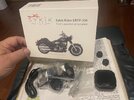
Based on your recommendation and that of a few other contributors to this thread,
I ordered and have now received the SYKIK brand TPMS system,
model SRTP – 300.

It's going to rain here all week, so I think I'll put the two sensors on my front tires on my cage for a few days to learn how the system works. Then I'll switch them over to the motorcycle.

I notice that the instructions say you have to ride for 5-10 minutes before you will get a reading on the display up on your handlebar/instrument cluster.

So, to prevent a situation where I begin a trip on a bike that only has 5 to 10 pounds of air in a tire without me noticing it until I get out on the public street I'll start thumping my tires with a hammer in my garage or my own driveway before I leave.
That should tell me approximately what my tire pressure is, give or take 10 pounds in either direction.

If I rode 10 miles away from home with one of my tires as low as 25 pounds, and then my TPMS system warned me about that, and I turned around and came back home, that wouldn't be a big deal.

IMG_3974.jpeg
A preride check is always good practice. MSF used to teach T-CLOCs. If not using a gauge on the stem then "kick the tires before lighting the fire" usually suffices In actual use to detect a low tire before riding. Or a hammer as you say.

In reality the pressures are active on the SYKIK when the wheels turns a few revolutions, even rolling a bike around the garage. Mine are up before the end of my driveway and if they take as much as a block or two I've learned to replace the particular slow-to-wake-up sensor battery soon as it is giving me warning that it is getting low.
 
a standard valve is cheap and quick to replace when the tyre is off.
Being flexible they're also way more versatile when you need to check/top off with the various filling chucks provided at gas stations...
And rubber valve stems have proven reliable since decades...

I've (3!) bike TPMS kits with internal sensors on the shelf and still cannot convince myself to install even one of them over the following:
- sensor/stem weight in the wheel requiring additional balancing weight
- issues with accessibility/seal of chuck while attempting to top off at gas stations
- unclear about possible leaks due aging rubber gasket (no spares avail to replace with every tire change)
- metal stem braking when hit by object (i.e. when having to pass through loose ground/roadworks) -> sudden deflation
- possible dodgy readings due (button) batteries running down (had such with various digital pressure gauges...)
- the issue about where to place that display unit on the bike
last but not least:
- the possible distraction by having another instrument to decipher

TPMS cannot be more then additional guidance (or distraction), but the responsibility to confirm/maintain with proper devices remains...
And as I'm checking inflation pressure every 2~3 days when on tour (once a week when commuting), I can't see the real benefit...
 
That's great advice in theory, but as someone who rides almost every day, I'm not going to check my tire pressure every morning at 4:30am.
Its good advice in practice as well. Because it may be considered inconvenient advice to follow does not make it bad advice.

The point that I am making is that a TPMS should not be in lieu of a regular tire pressure check and adjustment at regular intervals whatever interval a person considers to be acceptable. Whether that interval is before every ride, once a week, once a month, or any other interval is a whole different issue. I also understand that once a person has determined whether or not their TPMS is accurate, or how much it differs from a gauge that they trust, then they can trust the TPMS as well and that is fine as long as that equivalency has been established. In my case I also give the tire a good visual check-over as part of every tire pressure check. I have often observed that when a TPMS is being relied upon for tire pressure readings, and I suspect that this is because often the readings are only available after the motorcycle is underway with many models, the visual once-over also happens with less frequency.

As I wrote, my opinion. To each his own.
 
- sensor/stem weight in the wheel requiring additional balancing weight
With most systems the additional weight required is negligible. The interior mounted ones like you mention might require more weight. I don't know as I don't have one.
- issues with accessibility/seal of chuck while attempting to top off at gas stations
Easier access if the Tee valve type are being used.
- unclear about possible leaks due aging rubber gasket (no spares avail to replace with every tire change)
Some vendors do offer replacement grommets but you are correct in that they are not as readily available and not as easily replaced as replacing a rubber tire valve is.
- metal stem braking when hit by object (i.e. when having to pass through loose ground/roadworks) -> sudden deflation
No different than what happens if a rubber valve gets broken or torn. In that case you replace it with a new rubber valve and carry on. Same thing with the metal valve- Replace it with a rubber one and carry on.
- possible dodgy readings due (button) batteries running down (had such with various digital pressure gauges...)
That is a maintenance issue for which the operator is responsible just like any other maintenance issue. As an aside, most of them have a low battery warning that offers ample prior warning.
- the issue about where to place that display unit on the bike
That is always a concern and is one of personal choice, but it is not an insurmountable issue.
- the possible distraction by having another instrument to decipher
Again, rider responsibility and this is not the fault of the instrument. If a person can not trust themselves to not be distracted they should avoid additional items like this, and GPS, etc..
 
The value of a TPMS (I use Hawkshead) is to know if there is a leak before it can become catastrophic.
I had sudden front wheel deflate coming back from Moonshine Lunch Run one year where the bead broke loose because of low pressure.
Seldom do you check your tire pressure in the middle of a ride. ;)
If I had known I could have inflated the tire and avoided the issue since I always carry a compressor with me.
It ruined the tire and I had to have someone come a good distance with a trailer to rescue me.
The expense of that little 'expedition' would have paid for several deluxe TPMS systems - so I equipped all my ST1100s with them afterwards.
Also if you hit a road object it is nice to know if you have caused a leak.
I have completed a ride with a known slow leak that could not be fixed because I could monitor the pressure and limp to a safe place to 're-air'.
 
TPMS user here, I have checked the tires pre ride in the garage many times (digital and analog) to confirm the TPMS is close enough. On tour I have found 90f days turning into 45f nights resulting in 10 psi or so drop in pressure. With the TPMS I know to go top off with out getting on the ground needlessly. My tires and style like 44 in the front 42 in the rear, I try to maintain that. My TPMS (FOBO) is usually relaying before the bike is warm. If it took ten minutes I may consider a different product.

Interesting some riders don't loose air on a sitting bike, going to have to look into that. Sometimes they're good for a month, other times a week changes it. Part of the pre flight check, not really a problem.

As Dave and Andrew have said it's just one point of data that may add some connivence, I haven't found the two digit number tough to decipher.
 
A preride check is always good ...In reality the pressures are active on the SYKIK when the wheels turns a few revolutions, even rolling a bike around the garage. Mine are up before the end of my driveway .


I put those sensors on my car front tires around noon today and just put the display unit in my cupholder inside my car.

I found that the system goes to sleep in a minute if the car is parked and you don't move it at all, which includes shifting around in your seat opening or closing doors or other things that rock the vehicle's body but don't cause any rotation of the tires. So, it seems like the display unit
is where the motion sensor is --not the little valve stem caps.

I also found out that if you just rock the car while the display unit is sitting inside it, that will wake it up and show you your tire pressure numbers .

So, the paper instructions that came with this kit seem to be wrong when it says expect 5 to 10 minutes of riding before you get data. If I let the system go to sleep due to lack of movement it will come to life as soon as the display unit is moved.

If I manually turn off the display unit with the power button, it will stay off as I move or drive the vehicle.

When I manually turn it back on , by pushing & holding the power button ,
it powers up and shows me pressure & temp numbers right away.
 
Last edited:
So, the paper instructions that came with this kit seem to be wrong when it says expect 5 to 10 minutes of riding before you get data. If I let the system go to sleep due to lack of movement it will come to life as soon as the display unit is moved.
That may be the previous readings you see, and it takes time for the present pressure to update/refresh on the display.

My bikes' Spy TPMS-M1 displays wake up with very little movement, but take about 50' of rolling to update the reading.

I believe that they do that so the sensor batteries last longer than if they transmit continuously. I also have the T-stems.
 
I put those sensors on my car front tires around noon today and just put the display unit in my cupholder inside my car.

I found that the system goes to sleep in a minute if the car is parked and you don't move it at all, which includes shifting around in your seat opening or closing doors or other things that rock the vehicle's body but don't cause any rotation of the tires. So, it seems like the display unit
is where the motion sensor is --not the little valve stem caps.

I also found out that if you just rock the car while the display unit is sitting inside it, that will wake it up and show you your tire pressure numbers .

So, the paper instructions that came with this kit seem to be wrong when it says expect 5 to 10 minutes of riding before you get data. If I let the system go to sleep due to lack of movement it will come to life as soon as the display unit is moved.

If I manually turn off the display unit with the power button, it will stay off as I move or drive the vehicle.

When I manually turn it back on , by pushing & holding the power button ,
it powers up and shows me pressure & temp numbers right away.

I have this system and it does indeed go to sleep in about a minute after I get off the bike. Bumping it or closing the top box is enough to wake the system up if it has gone to sleep.
The numbers you see when it wakes up (or you power it on) are the last readings it had before it went to sleep or got shut off. You should be able to tell by the temperature readings next to the pressure readings.
Mine wakes up and I get front tire readings just backing the bike out of the garage. The back tire takes about 100' of riding to show up. That is if went to sleep.
If I shut if off (usually for charging the display) then turn it back on it will take 5 to 10 minutes to get both tires to show up. My front shows up within a few minutes but my back will take 5 minutes at least before it does.
I shut mine off and take the display into work to charge it. It turns on during charge but won't show any pressures or alarms as long as it's charging. Once back on the bike I have to turn it on manually and it will beep at me until both pressures show up again.
I do like that it's loud enough that I can just hear it in my helmet with ear plugs while I'm riding. In the sunlight the flashing isn't very noticeable but at night it's really clear.
 
I had a FOBO system that I used for a season and then swapped it out for a Hawkshead (iirc, @Uncle Phil set up a discounted group buy). The Hawkshead reads out as soon as I turn the ignition on, and since I've checked and it is w/in 1/2 psi to my two tire gauges (one digital, one Bourdon style), I use that as my tire pressure check before starting out. I supplement that with a every other week pressure gage check. I also replace the sensors' batteries at the beginning of every season.

Yes, tires do heat up from rolling resistance, we have all read that. I confess to being fascinated by the variation in pressures depending on outside temp and road temperature. The key to it all is the tire should be at the recommended pressure when cold, before riding. Any increase in temp and pressure is designed into the capabilities of the tire. That said, I have to wonder about desert riders dropping pressure off road in sand to single digit pressures, but since I don't do that kind of riding, its of academic interest.
 
Back
Top Bottom