
You are using an out of date browser. It may not display this or other websites correctly.
You should upgrade or use an alternative browser.
You should upgrade or use an alternative browser.
Look what I've got. Hope chinesium alternator
- Thread starter Alberto
- Start date

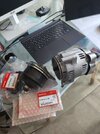
Got a few theoretical questions.
1. how do you check the alternator? If I feed 12V to the excitation terminal, it should generate a bit of voltage when I spin it, even by hand, right? And I should feel some resistance while turning the rotor?
2. Why use a Lewis pin to line up the meshing gears on the rotor? Why not use a splined tool to turn the inner rotor while pushing the gears in?
1. how do you check the alternator? If I feed 12V to the excitation terminal, it should generate a bit of voltage when I spin it, even by hand, right? And I should feel some resistance while turning the rotor?
2. Why use a Lewis pin to line up the meshing gears on the rotor? Why not use a splined tool to turn the inner rotor while pushing the gears in?

Uncle Phil
Site Supporter


It has been done - someone machined a jig to fit on the alternator shaft to spin it in a drill press to check voltage.
I thought the alternator would come to live a little even if I turn it by hand supplying +12v to voltage regulator terminal. It did't, hmm...to spin it in a drill
Uncle Phil
Site Supporter
Not for sure, but I think it has to be spinning at a certain amount of RPMs to work - don't know what that amount is.I thought the alternator would come to live a little even if I turn it by hand supplying +12v to voltage regulator terminal. It did't, hmm...
**EDIT - FWIW From Mr. Google -
Alternators typically need to spin at 1,400 to 2,400 RPM (rotor speed) to begin charging efficiently, though they can produce lower output at idle. Because the alternator spins 2–3 times faster than the crankshaft, this usually corresponds to a low engine idle speed of around 600–800 RPM.

By the time it takes to make a jig to spin it fast enough to test, I found I could install it and remove it faster if it didn't work.
If it's a real pain to install and remove, if one is available in your area take it to a alternator repair shop and have them test it.
If it's a real pain to install and remove, if one is available in your area take it to a alternator repair shop and have them test it.
That's exactly why I decided to test non-oem alternator first before replacing the old original oil-cooled one. Bring it to repairshop is a good idea, agree.it's a real pain to install and remove
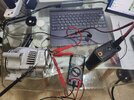
I understand that it has to be spun fast to produce sufficient charging voltage. But I just wanted to make sure it at least tries to generate some voltage when I spin it by hand...to begin charging efficiently,
I took a voltage regulator from an old Guzzi to a starter/generator auto shop in Akron years ago. The shop looked like something out of a 3rd world country and the test bench must have been 40 or 50 years old back then. It was laughable. BUT. The guy, who visually matched his shop, really knew his stuff and tested the VR in a matter of seconds. He pronounced it good and pointed to a damaged spade lug. I'd walked in the open garage door, he took care of me immediately, and refused payment. Sometimes you really cannot judge a book by its cover.


That's what I've told all my ex-girlfriends.... pffft..Sometimes you really cannot judge a book by its cover.

wjbertrand
Ventura Highway
Did you ground the casing to the negative terminal of your 12V supply?
Yep, I did. First time I used small power supply, it did nothing, because excitation coil eats more than 1A.Did you ground the casing to the negative terminal of your 12V supply?
Btw interesting why there are 2 contacts on the voltage regulator terminal if you use only one..
wjbertrand
Ventura Highway
I dunno, I figured that the electrical platform might be common across different vehicle platforms. (Even if the housings are application specific) Perhaps in some applications, a ground is needed? Maybe in the case of the ST, with the alternator bolted firmly to the block, this isn’t necessary?Btw interesting why there are 2 contacts on the voltage regulator terminal if you use only one..

Andrew Shadow
Site Supporter
On vehicles where the ECM controls the alternator output the second terminal is used for sensing battery voltage and provides that data to the ECM. The ECM uses that information to decide how much alternator output is appropriate at any given time. My guess is that the regulators are standardized to the two terminal configuration whether the vehicle has this function or not.
OMG it's online!
I did it. I haven’t finished the wiring yet, but everything else was doable. Installing the geared alternator base was easy - I decided to try the method using a hex thingy to mesh the teeth first, fixed the U-joint shaft with a screwdriver, and it worked on the first try. No need to use a Lewis pin with a cable.
But getting the alternator into place took a lot of time - it was like solving a puzzle. I had to remove the regulator from the alternator, and after many attempts it somehow passed through a narrow gap in the frame.


I did it. I haven’t finished the wiring yet, but everything else was doable. Installing the geared alternator base was easy - I decided to try the method using a hex thingy to mesh the teeth first, fixed the U-joint shaft with a screwdriver, and it worked on the first try. No need to use a Lewis pin with a cable.
But getting the alternator into place took a lot of time - it was like solving a puzzle. I had to remove the regulator from the alternator, and after many attempts it somehow passed through a narrow gap in the frame.
Uncle Phil
Site Supporter
Did you pull the swingarm or not?
Most folks pull the swingarm on an alternator replacement.
Most folks pull the swingarm on an alternator replacement.
Yeah, I had to. I have no idea how to replace the alternator without pulling the swingarm, everything is so tight there.pull the swingarm
Uncle Phil
Site Supporter
When pulling the engine, I've been able to work the alternator out of the engine before the pull, but I know of no way to remove it/replace it without removing the swingarm.Yeah, I had to. I have no idea how to replace the alternator without pulling the swingarm, everything is so tight there.
100% — you have to pull the swingarm or engine. While waiting for the site to go online, I finished the wiring and even changed the clutch on the go. The Chinese alternator is putting out 14.3V on idle — I like it.no way to remove it/replace it without removing the swingarm.
Last edited: