Riding in wind

I started riding my ST1100 five years ago and I experienced similar issues when first riding the ST. my first year and a half I hated the wind. Can't tell you how many times I got blown into a different lane out in the farm lands. This is what I learned about this bike. You have to ride it with confidence. If you don't this bike is a handful and will try to do what it wants. I agree with the auto correct comment. Once you just let your hips go with the flow not so bad. I found the OEM windscreen gives the bike the best handling. Have a large windscreen that came with the bike., kind of a huge sail. Personal opinion! The bike isn't that bad in the wind, but definitely worse than any other bike I have owned. Again personal opinion.
 
I've found it to be a fairly stable bike in the wind. My ST still has the factory windshield and it gives me good coverage. I still get buffeted about by big rigs in the oncoming lane on the two-lane blacktops. So I move to the right edge of the lane and barely notice it. Having no top box helps though.

I've been in some decent winds but never felt the need to accelerate to punch through them. There is one spot near me where the winds are really strong most year round. There were a bunch of us – maybe 20+ bikes. Going through the pass the wind was really strong but steady. The strongest ever in the pass said some of the frequent riders. Bikes were heeled over like the sloop John B. That the wind was steady was really something. Every bike's seat showed a major pucker factor.

That was fun. :redface:
 
I've been in some decent winds but never felt the need to accelerate to punch through them.
This may just be a question of semantics, so a picture might help explain what I meant by relative speeds and vectors.

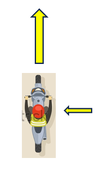
First diagram is a bike moving at 50 mph in a 25 mph cross-wind. (And yes, the smaller arrow is 50% of the size of the larger arrow.) The force going forward is greater than the force coming from the side. The side force is still there, but it has less of an impact.

1775409796148.png

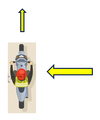
On the other hand, if you slow down to 12.5 mph going forward, the opposite will be true. The side force will have a greater impact on what is transmitted to the rider because now the larger force is coming from the side.

1775409976885.png

In practical terms, when I took my "Epic Post-Retirement" ride through the five national parks in Utah, we when through a stretch near the south end of the Hogback. I wanted to stop to adjust something on my helmet cam and realized when I stopped that I needed to get moving immediately. While I was moving, the wind was there, but wasn't a huge deal. But as soon as I stopped, I realized that the wind would blow me and the bike over.

So in my mind the idea is to slow down some, but not too much. Slowing down too much, just makes the wind have more effect on you.

Chris
 
(And yes, the smaller arrow is 50% of the size of the larger arrow.)
(Actually, if it's 50% wide and 50% long, it's only 25% the size (in area.) ;) )

So in my mind the idea is to slow down some, but not too much. Slowing down too much, just makes the wind have more effect on you.
No doubt due to reduction in stability that comes from inertia and gyroscopic forces.
 
I have ridden in some pretty high cross winds, the kind that tip over highway tractors, over the last 48 years.

What I found is that people who have lots of trouble with crosswinds are subconciously steering into the side wind. When you instinctively put the slightest pressure on the handlebars, towards the wind, the bike goes the opposite way, which gives you the feeling of being blown into the next lane.

I have ridden in 30mph+ sidewinds with no hands, on the handlebars , to demonstrate this to freinds. Simply by leaning 'into' the wind you can counter any sidewind pressure. ( I don't recommend this for anyone, but I have done it many times.)
 
:D Can you fit 4 of the little arrows into the area of the big arrow? I thought about adding a caveat that I'm not a math expert, but didn't. ;) Should've. :D

Yeah, I was going to add all that in your second comment, but felt it would probably detract from the point.

Also on that Epic Post-Retirement ride, we made time on one day riding through the Great Basin. The side winds were so strong that more than once I thought that if my helmet wasn't strapped on my head, that it would be ripped off. I made an interesting observation on that day and a few others that followed. We think of weight as being an advantage to resisting things like cross-winds. Yet it wasn't in this case.

He weighed I'm sure over 300 lbs. He was BIG. He rode a Goldwing. That should've been an unbeatable combination and far superior to mine. I weighed somewhere around 170 lbs. My ride was a 2014 BMW F800GT that wet comes in at 470 lbs. With luggage, etc, maybe it weighed 520 lbs. In any case, much much lighter. Yet when we got to our rooms, he would collapse in bed for an hour or so, while I ditched my bags and went off exploring the local area. He was also the first person to complain about the wind. I never did. And I'm sure he was 10-15 years younger.

Happy Easter!

Chris
 
:D Can you fit 4 of the little arrows into the area of the big arrow?
Theoretically, yes.

Yeah, I was going to add all that in your second comment, but felt it would probably detract from the point.
Intended to embellish, not criticize.

He weighed I'm sure over 300 lbs. He was BIG. He rode a Goldwing. That should've been an unbeatable combination and far superior to mine.
Especially in square footage, both him and the bike.

I weighed somewhere around 170 lbs. My ride was a 2014 BMW F800GT that wet comes in at 470 lbs. With luggage, etc, maybe it weighed 520 lbs. In any case, much much lighter.
As well as less flat surface.
 
This may just be a question of semantics, so a picture might help explain what I meant by relative speeds and vectors.

First diagram is a bike moving at 50 mph in a 25 mph cross-wind. (And yes, the smaller arrow is 50% of the size of the larger arrow.) The force going forward is greater than the force coming from the side. The side force is still there, but it has less of an impact.

1775409796148.png

On the other hand, if you slow down to 12.5 mph going forward, the opposite will be true. The side force will have a greater impact on what is transmitted to the rider because now the larger force is coming from the side.

1775409976885.png

In practical terms, when I took my "Epic Post-Retirement" ride through the five national parks in Utah, we when through a stretch near the south end of the Hogback. I wanted to stop to adjust something on my helmet cam and realized when I stopped that I needed to get moving immediately. While I was moving, the wind was there, but wasn't a huge deal. But as soon as I stopped, I realized that the wind would blow me and the bike over.

So in my mind the idea is to slow down some, but not too much. Slowing down too much, just makes the wind have more effect on you.

Chris

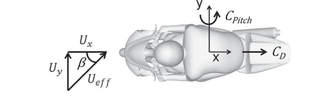
This is a key consideration for sure. Your speed Ux sets the angle of the effective air speed Ueff that is hitting the bike.

1775506663850.png

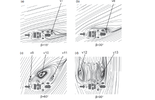
The simulation below shows more comfort with speeds high enough to keep the angle below 30 deg. Of course, not always possible with strong side winds, but still, trying to go fast enough to keep the angle smaller than 60 deg helps with stability, as shown here.

1775505978484.png

 
Interesting. If you want to jump to the "cliff notes" go to the conclusion at about 17:40. I found the visual mapping of the turbulence at each of the angles to be more useful than the numerical charts.

_____________________________________________

Added: I've long been interested in motorcycle aerodynamics. My BMW F800GT impressed me a lot with how well they designed it. The fairing seemed very minimal. If I laid my hand down around the knee, it was in relatively smooth air. Move it out about 1.5 inches, and it hit the full blast of the airstream. Heat was another interesting observation. The bike had a reputation for being hot enough to roast the "family plan" and burn the inside of the thighs. But that only happened under certain crosswind situations. Otherwise, I never felt anything unusual.
_____________________________________________

Thanks.
 
Last edited:
Interesting. If you want to jump to the "cliff notes" go to the conclusion at about 17:40. I found the visual mapping of the turbulence at each of the angles to be more useful than the numerical charts.

_____________________________________________

Added: I've long been interested in motorcycle aerodynamics. My BMW F800GT impressed me a lot with how well they designed it. The fairing seemed very minimal. If I laid my hand down around the knee, it was in relatively smooth air. Move it out about 1.5 inches, and it hit the full blast of the airstream. Heat was another interesting observation. The bike had a reputation for being hot enough to roast the "family plan" and burn the inside of the thighs. But that only happened under certain crosswind situations. Otherwise, I never felt anything unusual.
_____________________________________________

Thanks.

The paper itself is easier to browse through.

https://www.tandfonline.com/doi/epdf/10.1080/19942060.2015.1071524?needAccess=true,A
 
I have found that spreading the knees for a while cools everything off.
Yeah, a very simple solution to a "problem".

The bike that was really hot for me was my NT700V. The roads leading up to the freeway HOV lane had about 8 traffic lights in that many blocks. The sun hit those streets full on in the hot summer. And the bike just sat there idling. The NT700V had a metal gas tank sitting directly over the engine. It'd cool off once I got moving, but for those 8 blocks, you had no choice but to straddle the seat with that hot metal tank threatening to scald your inner thighs.
 
Like others have said... you have to be flexible on the bike. I've ridden my monster sail '90 Gold Wing in sudden 50 mph cross wind gusts when a storm front blew past. Like 90 deg to my direction of travel. That time I had my wife on the back. She was scared but not too much since she could sense I was in control of the bike in spite of the gusts. But the way I ride the bike I only actually drifted half a lane across the road. Never crossed any lines on either side of my lane. Another bike (CTX1300) was really no different than the ST but handled wind like it truly ignored it. The first ride home from the dealer I was riding 145 miles due south with a steady 35 mph east wind with 45 mph gusts riding through mostly open crop fields. On that bike I was only being pushed maybe 2 ft to the side at each gust at the most. When a gust hits me broadside it is more like the bottom of the bike is pushed and not the top... which results in pulling me or keeping me on the line of travel where I want to be. The bike automatically leans into the wind gusts. I guess it's a learned response to riding in strong winds and gusts. When I was riding my ST1100 it was no different than on my GW. I'm certain if I were not so flexible in my control of the bike and were stiff in controlling the steering I'd likely get pushed all over the road a lot more.

Kinda the same relaxed control as when riding over steel grate bridges or on deep rain grooves in concrete roads. Let the bike wobble along the grate or grooves but still in control. But the reaction of the bike in those conditions is different than with wind gusts, yet how stiffly you try to grip or control the bike is similar.
 
Interesting. If you want to jump to the "cliff notes" go to the conclusion at about 17:40. I found the visual mapping of the turbulence at each of the angles to be more useful than the numerical charts.
One factor I'm missing: lift...

i) affecting the motorcycle already by its speed over ground/cutting through the air (at 180kph/110mph the front wheel load of an ST1100 is down to ~9kg/20lbs... despite that spoiler in the forward belly pan segment...)
ii) affecting the motorcycle additionally by any cross airflow, the fairing might not have been fully designed for...

example:
a motorway bridge crossing over a V-shaped valley in a right hand curve...
you're approaching at speed (normal lift already unloads suspension/wheel contact patches...), with a leaning angle to the right, and upon entering the bridge a significant gust hits from the right...

The amount of air by the side wind gets wedged between fairing and road surface, pushing upward... low pressure at the leeward side creating even more lift (see: aircraft wing)...

The handlebar gets really, really light... steering impulse barely effective... that ~1500lbs bike (two up with luggage) gets literally grabbed and lifted across the lane to the left... :oops:
(if you question the purpose of the square openings in the side covers, located right before the panniers... to aid through exactly that situation/effect...)

Situations like this are most likely the reason for the safety warnings by Honda to no exceed 130kph/80mph when having any accessory, like top-case or tank-bag installed...
 
One factor I'm missing: lift...

i) affecting the motorcycle already by its speed over ground/cutting through the air (at 180kph/110mph the front wheel load of an ST1100 is down to ~9kg/20lbs... despite that spoiler in the forward belly pan segment...)
ii) affecting the motorcycle additionally by any cross airflow, the fairing might not have been fully designed for...

example:
a motorway bridge crossing over a V-shaped valley in a right hand curve...
you're approaching at speed (normal lift already unloads suspension/wheel contact patches...), with a leaning angle to the right, and upon entering the bridge a significant gust hits from the right...

The amount of air by the side wind gets wedged between fairing and road surface, pushing upward... low pressure at the leeward side creating even more lift (see: aircraft wing)...

The handlebar gets really, really light... steering impulse barely effective... that ~1500lbs bike (two up with luggage) gets literally grabbed and lifted across the lane to the left... :oops:
(if you question the purpose of the square openings in the side covers, located right before the panniers... to aid through exactly that situation/effect...)

Situations like this are most likely the reason for the safety warnings by Honda to no exceed 130kph/80mph when having any accessory, like top-case or tank-bag installed...
Why do I suspect you experienced this yourself.
 
One factor I'm missing: lift...

i) affecting the motorcycle already by its speed over ground/cutting through the air (at 180kph/110mph the front wheel load of an ST1100 is down to ~9kg/20lbs... despite that spoiler in the forward belly pan segment...)
ii) affecting the motorcycle additionally by any cross airflow, the fairing might not have been fully designed for...

example:
a motorway bridge crossing over a V-shaped valley in a right hand curve...
you're approaching at speed (normal lift already unloads suspension/wheel contact patches...), with a leaning angle to the right, and upon entering the bridge a significant gust hits from the right...

The amount of air by the side wind gets wedged between fairing and road surface, pushing upward... low pressure at the leeward side creating even more lift (see: aircraft wing)...

The handlebar gets really, really light... steering impulse barely effective... that ~1500lbs bike (two up with luggage) gets literally grabbed and lifted across the lane to the left... :oops:
(if you question the purpose of the square openings in the side covers, located right before the panniers... to aid through exactly that situation/effect...)

Situations like this are most likely the reason for the safety warnings by Honda to no exceed 130kph/80mph when having any accessory, like top-case or tank-bag installed...

Why do I suspect you experienced this yourself.
I was thinking this was a lead in to recommending more pancakes at breakfast! :D :D :D

Chris
 
FWIW, in the ancient volumes of ST1100 lore there are two 'devices' that are supposed to help that situation.
One is a Stefi Plate and one is a Belly Pan.
Some say they do help some say they don't.
I have them both on all of my ST1100s and to me they help.
What is a "Stefi Plate"?
 
Back
Top Bottom