Starter Valves Sync, Valve Clearances and Fuel Economy

The starter valves richen the fuel/air mixture for cold starts and have no effect on fuel/air mixture above off-idle rpm. If you look at the tiny starter valve passages that allow air flow when the butterflies are closed compared to the intakes when the butterflies open you see why. Honda's Programmed Fuel Injection system controls fuel/air mixture in the ECU based on sensor inputs from coolant temp, O2 in the exhaust, and intake tract air pressure.
 
Filling up on the side stand, means a little bit less fuel than if you were on the Center Stand, filling up to the same mark. However, if your riding is at an average speed of 85 km/hr or 51 mph and if in the 5th gear. You should get some great gas mileage. 85 km/hr is about the sweet spot for a rebel 250. That engine loves 50 mph. I had a nighthawk 250, so that is how I know. There does not seem to be anything wrong with your bike.

Here is my 0.1c. Fill up your tank the way you normally do and go on a 450 km solo trip (225 km each way), possibly on the highway (to eliminate variables of stop and go and variation in speeds) and see where the flashing bar comes on. Maintain an indicated speed of 115 km/hr. You should be able to get close to 450 km.
One of my friends live exactly 210 kms away door to door, I guess it's time for a visit. Without stop and go traffic and maintaining a constant 115 kmh, I would expect even better mileage. The Roads we typically ride have a 80 KMH speed Limit anyway, but yeah, the wife's Rebel 300 kinda likes that speed. Anything more and she complains that it gets a little too buzzy. Meanwhile, My ST is gliding in 5th and I barely know the engine is running. It's just a bit confusing since nothing has changed except for the addition of a slightly larger windshield, yet I am down a whopping 80 KMS per tank. I am not sure if this means anything but when my last bar starts flashing, I fill up with 22.5 to 23 Liters. Always around the same amount. I understand it is a 29 liter Tank, so shouldn't it take a bit more?
 
The starter valves richen the fuel/air mixture for cold starts and have no effect on fuel/air mixture above off-idle rpm. If you look at the tiny starter valve passages that allow air flow when the butterflies are closed compared to the intakes when the butterflies open you see why. Honda's Programmed Fuel Injection system controls fuel/air mixture in the ECU based on sensor inputs from coolant temp, O2 in the exhaust, and intake tract air pressure.
In that case, it could be any one of those sensors causing my fuel efficiency problem. I might be misunderstanding, but since the starter valves have no effect off idle, is it still worth synching them?
 
Random thought, has Canada increased any non Dino base fuel to the gas pumps?
I wasn't aware that was a thing or whether there are any plans for that. Whatever it is, we are paying way too much for it. Last night I filled up at $2.10 per liter for 93 Octane. Regular was $1.80 per Liter. Robbery!!!!
 
One of my friends live exactly 210 kms away door to door, I guess it's time for a visit. Without stop and go traffic and maintaining a constant 115 kmh, I would expect even better mileage. The Roads we typically ride have a 80 KMH speed Limit anyway, but yeah, the wife's Rebel 300 kinda likes that speed. Anything more and she complains that it gets a little too buzzy. Meanwhile, My ST is gliding in 5th and I barely know the engine is running. It's just a bit confusing since nothing has changed except for the addition of a slightly larger windshield, yet I am down a whopping 80 KMS per tank. I am not sure if this means anything but when my last bar starts flashing, I fill up with 22.5 to 23 Liters. Always around the same amount. I understand it is a 29 liter Tank, so shouldn't it take a bit more?
1. Travelling at 115 km/hr in the fifth will increase your fuel consumption vs 85 km/hr in the fifth. You will notice the difference. But you should still get about 450 km. Try it.

2. When the last bar starts flashing there are 5 liters left in the tank. So filling up with 22.5 to 23 liters is about normal. Also, while the tank capacity is listed at 29 liters. No one has been able to fill 29 liters even when they ran out of gas. Most I heard on this form is about 27 liters or 7.3 gallons. I myself filled up with 7.1 gallons on the CS after I rode the bike 40 miles with the bar flashing.
 
The starter valves richen the fuel/air mixture for cold starts and have no effect on fuel/air mixture above off-idle rpm. If you look at the tiny starter valve passages that allow air flow when the butterflies are closed compared to the intakes when the butterflies open you see why. Honda's Programmed Fuel Injection system controls fuel/air mixture in the ECU based on sensor inputs from coolant temp, O2 in the exhaust, and intake tract air pressure.
That's not quite the way I understand things; the starter valves just admit air around the closed butterflies, and provide idle speed control by allowing more or less air into the engine. For a faster cold idle, the starter valves are opened more to let more air in.

The FI system is reading intake air pressure and temperature along with engine revs, throttle position, coolant temperature and O2 sensor readings to determine how much fuel to inject; low coolant temperature instructs the FI system to make the mixture richer for cold starting, not the starter valves.

The starter valves are always open to some minimum extent and so would have a minor effect on airflow when the butterflies are open, although they are tiny compared to the full bore of the intake. If the SVs are grossly out of adjustment then it is conceivable that there would be slightly more or less air entering a particular cylinder, and that would make for slight mixture differences as the FI system applies the same injection volume to each (as long as the injectors all flow evenly...). The 5-way T connects all 4 intake vacuums so the MAP sensor is working on effectively an average air pressure.

Poorly adjusted starter valves give a rough idle as the cylinders will be wanting to idle at different speeds, but I doubt that would affect fuel use in any meaningful way
 
“Every now and then I’d blast the line from the rubber hose joint on the left hand side near to the long pivot bolt for the rear of the tank.”

… Is this the solo hose forward front of the (2) rearward hoses that are parked together?
Thanks-
Not sure which ones you mean. The hose to which I refer starts here :
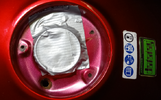
1784731777106.png
The larger hole nearer the bottom catches rainwater that flows freely around the outside of the filler cap. Front of the bike is facing left in this photoe. The hole is in the 10 o'clock position (9:30 ish) when sitting on the bike facing forward.

A metal tube passes through the upper tank, through the fuel and emerges at the underside of the tank at the rear - here:
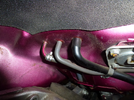
1784732124466.png

This is looking back under the raised tank from the handlebar end. The clip above here is the Elbow fuel hose conencted to the bottom rear of the tank. I THINK that the water drain pipe is the black one.

In the digram in the manual (below) it labels this oddly as the Fuel Tank Drain hose ! That sounds like a hose to drain the fuel tank. If it is the one that I think it is, it is a rainwater drain hose from the top of the fuel tank.
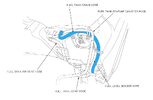
Fuel Tank Tubes.jpg

t then follows a route down to near the oild filter.
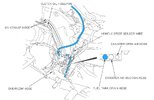

Fuel Tank Tube lower.jpg
So it is coming from under the tank - I think that is the earthing bolt just below the hose I have colured blue under the letter E in 'PIPE'.

Half way down there is a white band that I have not coloured in. A little above where the arrow head is for the line labelled Vehicl Speed Sensor wire.
That is almost where the bolt is to atatch the fron of the left hand side panel. It is where the seat from is bolted to the main silver painted frame There are two tubes there are obvious when you start probing around and you can get at both and separate them easily. One is an inline plastic butt connector joining the tubes end to end. The other is an elbow joint and is much more obvious.

Further down is a clip where the ends of three hoses stop - open ended. I've coloured in the one that continues to say Fuel Tank Drain Hose.
If you are in parts of the USA, you have an evap cannister near the right tip over bar I think, and I believe that at least one of these hoses goes to there. In the UK we don't have an evap cannister.

Now - I do this once in a while. I have never tried to record which pipe it is. I separate the two joints, gently blow compressed air up one of them and see if the air emerges at the filler cap. I think it is the black hose under the tank and the butt joint. But I really don't know for certain, and I no longer have the bike to pop out and find out. I might have a photo from when I installed my wiring harness that shows the tube joints. If I find one I'll add it here.

I found a better one - this taken from my A6 when I was fitting the side panel infills that are standard from 2008 onwards. You have to fashion something to mount them on for the left hand side.

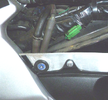
So view from left hand side. where the coloured side panel fits. Fuel tank seam below the green connector. The two tubes are very obvious here.
The left one is the black one that comes from under the fuel tank - with the butt joint connector. The one on the right is the one with the elbow joint.

The blue coloured hole is the screw hole for the front side panel mount. I drilled a massive hole in my aluminium sheet and put a rubber grommet around it. That support for the side panel fill-in just sits on it, and is secure when the side panel is installed. The rubber grommit stops it from vibrating.

1784734262436.png
 
Last edited:
Just ordered a set on Amazon
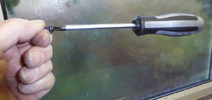
Excellent. Using Phillips drivers on Hondas (and probably every other Japanese motorcycle) has ruined a lot of fasteners because it's the wrong tool for the job. Way back when – Honda was 'known' for using what were called cheesehead screws because they were so often easily damaged. By using a Phillips driver not JIS.

The only thing that seemed to work well was the cross-point screwdriver bit and the red plastic or the T-handle. If the screws still resisted a massive Vessel impact driver (and four bits in a blue metal case) did the job. Who knew at the time that was because the screw driver and the Vessel use JIS bits not Phillips.

Use only JIS drivers/bits on any cross point screw on your ST. There could theoretically be a chance that someone used a Phillips on some third party add-on or replacing a factory screw. The JIS will work well on a Phillips screw but not the other way 'round.

The Vessel Impact driver is also a good driver to keep on hand.
 
That's not quite the way I understand things; the starter valves just admit air around the closed butterflies, and provide idle speed control by allowing more or less air into the engine. For a faster cold idle, the starter valves are opened more to let more air in.

The FI system is reading intake air pressure and temperature along with engine revs, throttle position, coolant temperature and O2 sensor readings to determine how much fuel to inject; low coolant temperature instructs the FI system to make the mixture richer for cold starting, not the starter valves.

The starter valves are always open to some minimum extent and so would have a minor effect on airflow when the butterflies are open, although they are tiny compared to the full bore of the intake. If the SVs are grossly out of adjustment then it is conceivable that there would be slightly more or less air entering a particular cylinder, and that would make for slight mixture differences as the FI system applies the same injection volume to each (as long as the injectors all flow evenly...). The 5-way T connects all 4 intake vacuums so the MAP sensor is working on effectively an average air pressure.

Poorly adjusted starter valves give a rough idle as the cylinders will be wanting to idle at different speeds, but I doubt that would affect fuel use in any meaningful way
Point still being that starter valve adjustment has negligible effect on mpg.
 
I wasn't aware that was a thing or whether there are any plans for that. Whatever it is, we are paying way too much for it. Last night I filled up at $2.10 per liter for 93 Octane. Regular was $1.80 per Liter. Robbery!!!!
Does Canada have Ethanol as an ingredient in fuel? My MPG can be adjusted to the percentage of Ethanol in the fuel I use. For example, I get 10-15% better MPG on Ethanol free fuel. My question stems from the possibility that your fuel has more filler in it than before, your MPG is technically the same just using more to get the same distance.
 
Does Canada have Ethanol as an ingredient in fuel? My MPG can be adjusted to the percentage of Ethanol in the fuel I use. For example, I get 10-15% better MPG on Ethanol free fuel. My question stems from the possibility that your fuel has more filler in it than before, your MPG is technically the same just using more to get the same distance.
Yes, we have ethanol in our gas. Regular Gas has between 10 and 15 percent ethanol. Premium gas also has ethanol but the exact percentage is not posted on the pumps. Ethanol-free gas is not widely available and I believe only SOME Shell stations offer an ethanol-free option in my part of the Country. I am not aware of any recent increase in ethanol.
 
Not sure which ones you mean. The hose to which I refer starts here :

1784731777106.png
The larger hole nearer the bottom catches rainwater that flows freely around the outside of the filler cap. Front of the bike is facing left in this photoe. The hole is in the 10 o'clock position (9:30 ish) when sitting on the bike facing forward.

A metal tube passes through the upper tank, through the fuel and emerges at the underside of the tank at the rear - here:

1784732124466.png

This is looking back under the raised tank from the handlebar end. The clip above here is the Elbow fuel hose conencted to the bottom rear of the tank. I THINK that the water drain pipe is the black one.

In the digram in the manual (below) it labels this oddly as the Fuel Tank Drain hose ! That sounds like a hose to drain the fuel tank. If it is the one that I think it is, it is a rainwater drain hose from the top of the fuel tank.

Fuel Tank Tubes.jpg

t then follows a route down to near the oild filter.


Fuel Tank Tube lower.jpg
So it is coming from under the tank - I think that is the earthing bolt just below the hose I have colured blue under the letter E in 'PIPE'.

Half way down there is a white band that I have not coloured in. A little above where the arrow head is for the line labelled Vehicl Speed Sensor wire.
That is almost where the bolt is to atatch the fron of the left hand side panel. It is where the seat from is bolted to the main silver painted frame There are two tubes there are obvious when you start probing around and you can get at both and separate them easily. One is an inline plastic butt connector joining the tubes end to end. The other is an elbow joint and is much more obvious.

Further down is a clip where the ends of three hoses stop - open ended. I've coloured in the one that continues to say Fuel Tank Drain Hose.
If you are in parts of the USA, you have an evap cannister near the right tip over bar I think, and I believe that at least one of these hoses goes to there. In the UK we don't have an evap cannister.

Now - I do this once in a while. I have never tried to record which pipe it is. I separate the two joints, gently blow compressed air up one of them and see if the air emerges at the filler cap. I think it is the black hose under the tank and the butt joint. But I really don't know for certain, and I no longer have the bike to pop out and find out. I might have a photo from when I installed my wiring harness that shows the tube joints. If I find one I'll add it here.

I found a better one - this taken from my A6 when I was fitting the side panel infills that are standard from 2008 onwards. You have to fashion something to mount them on for the left hand side.

So view from left hand side. where the coloured side panel fits. Fuel tank seam below the green connector. The two tubes are very obvious here.
The left one is the black one that comes from under the fuel tank - with the butt joint connector. The one on the right is the one with the elbow joint.

The blue coloured hole is the screw hole for the front side panel mount. I drilled a massive hole in my aluminium sheet and put a rubber grommet around it. That support for the side panel fill-in just sits on it, and is secure when the side panel is installed. The rubber grommit stops it from vibrating.

1784734262436.png
Thanks, John. That’s a fabulous write up. I see it now. Cheers, wishing you continuing wellness.
 
Point still being that starter valve adjustment has negligible effect on mpg.
Mine seemed to go up after balancing the starter valves. The smooth rapid throttle response certainly went up and I got more miles per litre - but it wasn't a controlled test, just an casual observation.

I came back to post this JIS screwdriver trick. Try that with a Phillips or PoziDrive. And this is the driver with the impact drive / heavier handle.

1784810715808.png
 
Last edited:
1. Travelling at 115 km/hr in the fifth will increase your fuel consumption vs 85 km/hr in the fifth. You will notice the difference. But you should still get about 450 km. Try it.

2. When the last bar starts flashing there are 5 liters left in the tank. So filling up with 22.5 to 23 liters is about normal. Also, while the tank capacity is listed at 29 liters. No one has been able to fill 29 liters even when they ran out of gas. Most I heard on this form is about 27 liters or 7.3 gallons. I myself filled up with 7.1 gallons on the CS after I rode the bike 40 miles with the bar flashing.
I meant to clarify why I presumed 115 kmh on highway might result in better fuel economy. The smaller back roads we typically ride, have traffic lights and stop signs, so there is a fair bit of stop and go. Steady cruising with no stops, albeit faster, might equalize things.
 
For best fuel consumption on any vehicle, get rolling and don't stop, or slow and accelerate often. The ST is a heavy bike and it takes a reasonable amount of energy to accelerate it, and I know from experience with my MT10 and VFR1200 they do a whole lot better on fuel at 120km/hr than 60-80km/hr. On my own 1300, 16-17km/L seemed to be pretty standard with open road use without being a squid.
 
So, I tried the "burnt hand" technique as suggested by @TerryS and it would appear that my thermostat is functioning properly; I felt a sudden rush of heat after a couple minutes.

I also wanted to eliminate anything Brake related so I decided to remove the pads, clean and apply some silicone grease to the Calipers. After reinstalling everything, I tried the wheel spin again and this time the intermittent "rubbing" sound (on the rear wheel) was gone. It is now a consistent and slight friction all the way around. This would suggest that @Grand Rouge was right and the Disc was NOT warped. Thanks @Grand Rouge, you saved me the cost of a new Disc. Did the same cleaning/lube on the front wheel Calipers. The front wheel spin (after caliper cleaning) was no different than before, but at least they are now cleaned and lubed.

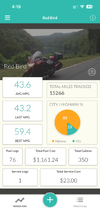
Having done all of that, it was now time for that 450-kms, strictly highway driving, round trip, as suggested by @etalors. Filled up the tank as I normally do and was off to see the wizard. 431 Kms later, speed on average 115 kph with some unavoidable surges to 140 kph, and I still have 2 Bars left. This outcome puts me back in the 450 kms (average) per tank territory. Could it be entirely attributed to all-highway driving? Or, could it be because of the caliper cleaning which eliminated the intermittent rubbing sound of the rear disc and the pads? Maybe a bit of both? Either way, it feels good to be once again getting the type of MPG I was accustomed to. The next fill-up, driving the same familiar roads as before, will reveal the truth.

Coming soon: STARTER VALVES SYNCHRONIZATION!!.
 
. The front wheel spin (after caliper cleaning) was no different than before, but at least they are now cleaned and lubed.
I can get about 550km a tank,,, when touring at moderate speeds. Although I rarely let it get below 2 bars. It wasn't always that good,, mostly because the previous owner let his brake maintenance deteriorate. I serviced all the sliding components on the calipers, of course,,, but the thing that really helped was when I started polishing the pistons right in the bike,, at every pad change. It's all been written up before,,, but the main ingredients are Autosol metal polish and a hockey skate lace. You develop your own technique for manipulating the pistons,, and doing a good job requires patience and practice. But this polishing,, every time,, allows the pistons to retract more freely. It felt like the bike went from about 90% to 98% rolling freedom. Everything else with the brakes has to be good though. And,, a bonus is that I never have to bleed air, at regular brake service. Sounds like you are getting there,,,, cheers,,, CAt'
 
I can get about 550km a tank
Wow!!! Cat, 550 kms a tank? That's absolutely amazing. These Bikes are so pleasurable to ride with the added benefit of excellent fuel economy. However, I would never have imagined 550 kms a tank is possible. I am already thrilled with my measly :D450 Kms per tank, but I will do a deep dive into this Autosol Polish and Lace hack for the next time I clean out the Calipers.
 
Having done all of that, it was now time for that 450-kms, strictly highway driving, round trip, as suggested by @etalors. Filled up the tank as I normally do and was off to see the wizard. 431 Kms later, speed on average 115 kph with some unavoidable surges to 140 kph, and I still have 2 Bars left. This outcome puts me back in the 450 kms (average) per tank territory. Could it be entirely attributed to all-highway driving? Or, could it be because of the caliper cleaning which eliminated the intermittent rubbing sound of the rear disc and the pads? Maybe a bit of both? Either way, it feels good to be once again getting the type of MPG I was accustomed to. The next fill-up, driving the same familiar roads as before, will reveal the truth.

Coming soon: STARTER VALVES SYNCHRONIZATION!!.
Based on this test ride. You are already better than 550 Kms, by extrapolation. Since you had two bars left after travelling 431 Kms, that implies you could have gone another 100 Kms easily, in the last two bars. The last two bars have approximately 2.8 U.S. gallons of fuel. Travelling at a constant speed of 115 kph you could have easily gone another 130 km. That would mean riding about 25 kms with the flashing bar, which tends to test the inner forte.

FYI: I have routinely travelled about 80 miles or 130 Kms, in the last two bars, while travelling at an actual constant speed of 70 mph or 115ish Kph. The reason I say actual is because the ST speedometer is about 5 mph optimistic. An indicated 120 Kph is roughly 112 Kph or 70 mph in actual speed. I travel about 370 kms before I reach two bars at a true 70 mph on the U.S. interstate.

The caliper cleaning may have had some effect, but your wheel was spinning fine in the video you posted. I believe the highway ride at a constant speed eliminated a lot of variables and elements that cause the fuel consumption to increase. This brought out the realistic performance of the engine.

Based on what you have said and your test ride, I would say your bike is running fine with one of the best fuel mileage on record. Leave it alone. :)
 
Last edited:
Make a determined effort to track fuel economy in terms of distance divided by fuel burn. A tank here and a tank there is shooting in the dark, there's too many variables. Track many tanks in varying conditions and seasons to account for many variables.

IMG_0653.PNG
 
Back
Top Bottom