
Hi Folks Big Breaks back looking for info on Brakes Lol, The Irony .been 24 months loss of memory since then tracking down bolts nuts, Not sure am I missing a bit bolt nut that attaches rear of break caliper Arm to swingarm or does the 14mm bolt that's on caliper that's seen in picture remove & fit somehow , Also any handy way to get calipers back in seem very stiff, can't get a video removing rear caliper ?

You are using an out of date browser. It may not display this or other websites correctly.
You should upgrade or use an alternative browser.
You should upgrade or use an alternative browser.
rear caliper mounting
- Thread starter BigBrakes
- Start date
Here are imagesHi Folks Big Breaks back looking for info on Brakes Lol, The Irony .been 24 months loss of memory since then tracking down bolts nuts, Not sure am I missing a bit bolt nut that attaches rear of break caliper Arm to swingarm or does the 14mm bolt that's on caliper that's seen in picture remove & fit somehow , Also any handy way to get calipers back in seem very stiff, can't get a video removing rear caliper ?
Attachments
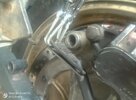
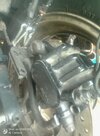

There's a bolt with a 14mm head (IIRC) that screws into that swingarm hole and fits inside the empty hole you show in the left picture between the hex head and the clips at the end of your bungees.
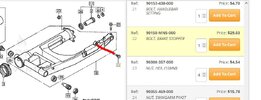
here's a part reference, if you lost it. Its not cheap, and I don't think a regular bolt can be substituted in its place. It has fairly large threads, then tapers down to a non-threaded portion that just fits inside the brake bracket, but doesn't thread into it. If you got a regular bolt to fit the threaded part, it would be too large in diameter to fit inside the brake bracket hole unless you ground it down to a smaller diameter.
here's a part reference, if you lost it. Its not cheap, and I don't think a regular bolt can be substituted in its place. It has fairly large threads, then tapers down to a non-threaded portion that just fits inside the brake bracket, but doesn't thread into it. If you got a regular bolt to fit the threaded part, it would be too large in diameter to fit inside the brake bracket hole unless you ground it down to a smaller diameter.
Attachments

Uncle Phil
Site Supporter


Normally the rear caliper 'rotates' on the axle and the rotor (assuming the caliper pistons are pushed in) so you can swing it down and insert the special bolt Doug is talking about.
That bolt keeps the caliper from rotating and it has a 14mm head IIRC.
I can't make heads or tails of what is going on from your pictures - sorry.
That bolt keeps the caliper from rotating and it has a 14mm head IIRC.
I can't make heads or tails of what is going on from your pictures - sorry.

- Joined
- Mar 10, 2013
- Messages
- 92
- Age
- 70
- Location
- Gloucester, UK
- Bike
- 1990/2002 ST1100
- 2026 Miles
- 007263
You can see the relevant bolt on the following Ebay sale. For £14 I'd grab it. They are £21+ new and not in stock at Fowlers or David Silver Spares (special order at both) and this way you get a spare caliper mounting as well  https://www.ebay.co.uk/itm/178186569898?_skw=st1100+rear+brake+calipermounting+bracket+retaining+bolt&itmmeta=01M03435RB1FK66S7FJJQ2MDGJ&hash=item297cbf48aa:g:hlwAAeSwQodqHuk~&itmprp=enc:AQALAAABIGfYFPkwiKCW4ZNSs2u11xAP5bkVlGoRRiIP8Ukb4YpNnxFFbrQoB7W3uethrSnEdJAnutwhqf+pBPlGTwWO3fGylijhCzLXetQ3kfSWOpHiMCCdJP3r6T7mnr7RIJP3nSyKouooESkIPAp894NT5OwrztuuY--1Gql51vI7npFCpNAEg6Uvc/T04PaahHmpM07sRMaYn9mg5z1xaS+mjw9MizfHD1rUOS/41HTWatsDGakg3SPW1KDE2wQiiuBwywgJA/a8RAxRL1t1+X3kg9sUFVsLk77g5EszTIJ4JwO2YNxJCUguEXM9sfo+Hvkn/klt66cbppKU1XYT5DKflBUoYzWa2dHAh10JIXzZF/F9bmjM9Do8MajaEunBNaeskA==|tkp:Bk9SR8bcjOSAaA
https://www.ebay.co.uk/itm/178186569898?_skw=st1100+rear+brake+calipermounting+bracket+retaining+bolt&itmmeta=01M03435RB1FK66S7FJJQ2MDGJ&hash=item297cbf48aa:g:hlwAAeSwQodqHuk~&itmprp=enc:AQALAAABIGfYFPkwiKCW4ZNSs2u11xAP5bkVlGoRRiIP8Ukb4YpNnxFFbrQoB7W3uethrSnEdJAnutwhqf+pBPlGTwWO3fGylijhCzLXetQ3kfSWOpHiMCCdJP3r6T7mnr7RIJP3nSyKouooESkIPAp894NT5OwrztuuY--1Gql51vI7npFCpNAEg6Uvc/T04PaahHmpM07sRMaYn9mg5z1xaS+mjw9MizfHD1rUOS/41HTWatsDGakg3SPW1KDE2wQiiuBwywgJA/a8RAxRL1t1+X3kg9sUFVsLk77g5EszTIJ4JwO2YNxJCUguEXM9sfo+Hvkn/klt66cbppKU1XYT5DKflBUoYzWa2dHAh10JIXzZF/F9bmjM9Do8MajaEunBNaeskA==|tkp:Bk9SR8bcjOSAaA
nice picture, so if he has it around somewhere in a jar or can of fasteners he can find it and not have to buy a new one.You can see the relevant bolt on the following Ebay sale.
Thanks no luck finding have everything else took apart getting at swingarm am usually very careful with key components had most stuff left in side pockets of cowl or back box of bikenice picture, so if he has it around somewhere in a jar or can of fasteners he can find it and not have to buy a new one.
Not cheap for me in Ireland Almost €60 end up costing shipping /taxes/ etc...You can see the relevant bolt on the following Ebay sale. For £14 I'd grab it. They are £21+ new and not in stock at Fowlers or David Silver Spares (special order at both) and this way you get a spare caliper mounting as well

You must tighten that bolt before you tighten the axle bolt. But make sure your calipers are sliding ok on the two slider pins first. It is a very heavy duty bolt which requires a high torque setting.
the service manual is vague on this point. For the removal procedure that bolt is the first to be loosened, but there's no "installation is the reverse of removal" line like sometimes appears, so there's an interpretation gap. With no other information, I'd assume "installation is the reverse of removal" to be the default, and therefore that bolt would get tightened last.You must tighten that bolt before you tighten the axle bolt. But make sure your calipers are sliding ok on the two slider pins first. It is a very heavy duty bolt which requires a high torque setting.
anything else in the manual that would contradict that?
Uncle Phil
Site Supporter
From my experience, as long it is pretty tight BEFORE you torque the axle nut.
Otherwise trying to tighten it if the caliper is press hard against it will be a 'challenge'.
I always tighten it first before I torque the axle nut to avoid that possible problem.
And I have never used a torque wrench on it because it is too much of a hassle to get to.
I have a special ratcheting wrench with a bend in it that makes removal/install a lot easier without removing the silencer.
And never had one loosen up on me either ...
Otherwise trying to tighten it if the caliper is press hard against it will be a 'challenge'.
I always tighten it first before I torque the axle nut to avoid that possible problem.
And I have never used a torque wrench on it because it is too much of a hassle to get to.
I have a special ratcheting wrench with a bend in it that makes removal/install a lot easier without removing the silencer.
And never had one loosen up on me either ...
With my senior memory, and low mileage riding years I can't recall which order I typically do them in. But IIRC the unthreaded part fits into the caliper bracket with a little bit of play possible and after the axle nut is tightened down the entire caliper bracket doesn't rotate anyway. So as long as the bolt is already in the hole and snugged into place, then the axle nut is tightened down, tightening the caliper bolt down all the way doesn't change anything in the way of alignment.
And yes, its in too odd a place to use a torque wrench, I'm pretty sure mine has never been put back with the 51ft-lbs the manual calls out, and in 29 years its never loosened up on me.
And yes, its in too odd a place to use a torque wrench, I'm pretty sure mine has never been put back with the 51ft-lbs the manual calls out, and in 29 years its never loosened up on me.
the service manual is vague on this point. For the removal procedure that bolt is the first to be loosened, but there's no "installation is the reverse of removal" line like sometimes appears, so there's an interpretation gap. With no other information, I'd assume "installation is the reverse of removal" to be the default, and therefore that bolt would get tightened last.
anything else in the manual that would contradict that?
I've thought about this quite a lot a good many years ago. The following few snippets are, I think, relevant to the decision to tighten the stopper bolt first.
First of all, the workshop manual does say to Torque the stopper bolt first - although I had to look that up. I don't remember reading it before either. This is taken from a purchased electronic version of the manual, but I checked ith my 2003-2004 printed version and it is exactly the same. Tighten the stopper bolt first.
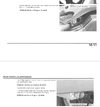
But that doesn't address the reason.
I can only speculate - but I'm never satisfied with answers that I don't understand - but I think that the results of my ponderings are pretty robust.
- The hole in the caliper bracket is elongated. To allow for expansion of the caliper bracket due to the heat caused by brakes.
- The stopper bolt is to stop the caliper bracket from turning. When the brake pads grab hold of the brake disc, the easiest thing for the caliper to do is to hang on the the brake disc and spin around the axle. The stopper bolt stops the caliper bracket from doing this.
- The braking force is transmitted from the brake pads - the tab end of the pad's metal plate is pressed firmly agains a recess (which has the silver retainer clip) which is part of the caliper bracket. The caliper bracket is therefore subject to a lot of stress:
a) At the axle bolt - it is stopped from being pushed forward by the caiper grabbing hold of the brak disc.
b) At the stopper bolt which stops the caliper bracket from rotating. - All screw threads have quite a bit of 'play' in them. The stopper bolt itself is screwed into a boss on the swing arm. A thick shaft protrudes from the other side of the boss and into the hole in the caliper bracket. The shaft is prevent from moving by the nature of the thread and by the heavy torque that is placed on it when tightening. This ensures that shaft threads are pulling tightly against the threads in the boss and that the head of the bolt is clamped agaisnt the face of the boss The oval shaped hole in the caliper bracket is set firmly at 90 degrees the shaft of the stopper bolt.
- The caliper itself is mounted using two relatively flimsy slider pins. These slide very loosely inside one hole in the caliper and one hole in the caliper bracket. The holes have a rubber bush to prevent water ingress. It should be possible to move the caliper in and out - towards and away from the brake disc - when the pads are not fitted. There will also be a little wiggle movement available. All the caliper has to do is to press the pads agains the brake disc. When it clamps the disc, the pads will try to slide forward. They cannot because they are pressing against the retainer clips in the bracket. The bracket cannot move forward because it is held in place with the axle. It cannot rotate becasue it is prevented by the stopper bolt. No strain is put on the caliper itself. It is all transferred to the stopper bolt.
The above is true if the stopper bolt is tightened first.
But if the axle is tightened first, there is a tendency for the caliper to want to rotate clockwise. It can't by very much - because the stopper bolt is in place - but it can a bit becasue it is looseley fitted and there is play in the threads. So when tightening the axle nut, the stopper bolt will tend to be lifted slightly - taking up some of the play in the thread. Continue tightening of the axle will lock this position in place. The stopper bolt at a slight angle.
Subsequently, tightening the stopper bolt will then be tightening against threads which are not in the correct position. It will not clamp the stopper bolt in position properly and the head will not be flush against the face of the boss. It will be clamped by the fact that the angle of the bolt is preventing it from moving any further. The slightly rotated caliper bracket is preventing it from tightening properly and it will be held at a slight angle.
So every time the brake is applied the bracket is presented with a stopper that is not at 90 degrees. So it isn't a stopper. It is now a deflector.
This twists the caliper bracket over time. So the slider pins are no longer at the correct angle. So every time the calipers want to move, they move at the wrong angle and the pads meet the discs at the wrong angle. The pressure forces them into place - there is leeway ont he lsider pins for the caliper to twist slightly - and braking is OK. But gradually the symptoms show. The recess in which the retainer clip sits, starts to wear. The pads start to wear unevenly and the pads do not move well against the slider pins - because the caliper is now working at an angle to, instead of parallel with, the slider pins.
The hole in the caliper bracket becomes patterned with a helical pattern (like the rifling in gun barrel - I believe as a result of being hammered and released by the caliper bracket on a bolt that isn't secured properly and not at 90 degrees. I guess also that the threads will be taking a bit of hammering as well.
(I cannot explain that behaviour convincingly enough - but there is something there that rings true. I remember as a kid being given the privelege of 'ringing the bell' for playtime at the end of morning lessons. It was a handbell and the clanger was on a chain.
I couldn't do it. The ball just whizzed around the inside of the bell chamber - round and round making a pathetic metallic scraping noise. I couldn't get it to hit the other side and 'clang' properly. Many years later I realised that I wasn't moving the bell up and down - so the clanger was not hitting the bell at right angles. It was deflected and just went round and round the inside of the bell.
So that behaviour with the sprial markings and the behaviour when something hits something else that isn't quite at right angles ? Well it sort of rings a bell.
Last edited:
interesting, but that's the 1300, we're talking about the 1100, and the 1100 manual says nothing about it.First of all, the workshop manual does say to Torque the stopper bolt first - although I had to look that up. I don't remember reading it before either. This is taken from a purchased electronic version of the manual, but I checked ith my 2003-2004 printed version and it is exactly the same. Tighten the stopper bolt first.
And it looks like they repositioned the bolt on the 1300 to make it easier to access than on the 1100.
If I had to guess on what I've done in the past, I probably do torque the caliper bolt first. That's because as long as I have to put it in there and start the threads into place as the first step, I probably just tighten it down while I'm at it, rather than go back later to finish the tightening. And, doing that in two steps rather than one introduces the possibility that you could get distracted in between steps and forget to go back and tighten it later, so experience tells me to never do that.
To address one of your points, I'd tend to agree with your premise that if the caliper bolt is fully secured at the time the axle nut is tightened, that will prevent any unwanted motion that might affect the alignment of the bolt before its fully secure. However, I doubt anything in the axle nut torquing process is going to rotate the caliper bracket in the first place. The tightening force is applied to the nut, which then applies force to the final drive unit, which is fixed. Nothing produces any rotational forces on the wheel in that process, and even if it did, the rear brake rotor is generally free to turn without putting much (if any) force on the caliper bracket because the brake pads are usually floating at that point since you've spread them open far enough to put the caliper back over the rotor.

Andrew Shadow
Site Supporter
The question is being asked with regard to the ST1100. The photos that you have posted look quite familiar so I think that they might be from the ST1300 service manual. You might be using the ST1300 as an example of the same principle- just pointing it out as an F.Y.I..First of all, the workshop manual does say to Torque the stopper bolt first - although I had to look that up.
In section 15 of the ST1100 service manual under the instructions for the rear caliper removal it states that Assembly is in the reverse order of assembly. If these instructions were followed to the T the rear axle nut would be installed and torqued to specification before the stopper bolt was even installed.the service manual is vague on this point. For the removal procedure that bolt is the first to be loosened, but there's no "installation is the reverse of removal" line like sometimes appears, so there's an interpretation gap. With no other information, I'd assume "installation is the reverse of removal" to be the default, and therefore that bolt would get tightened last.
anything else in the manual that would contradict that?
thanks for that, I was previously referencing section 14 on rear wheel removal, which covers the same types of things.In section 15 of the ST1100 service manual under the instructions for the rear caliper removal it states that Assembly is in the reverse order of assembly. If these instructions were followed to the T the rear axle nut would be installed and torqued to specification before the stopper bolt was even installed.
What I can't recall from experience is if the caliper bracket can be rotated by hand after the axle nut is torqued down, or if the clamping force from the axle nut prevents that. If it can be re-aligned by hand, then the caliper bolt can be put in last without any issues.
- Joined
- Mar 10, 2013
- Messages
- 92
- Age
- 70
- Location
- Gloucester, UK
- Bike
- 1990/2002 ST1100
- 2026 Miles
- 007263
You must tighten that bolt before you tighten the axle bolt. But make sure your calipers are sliding ok on the two slider pins first. It is a very heavy duty bolt which requires a high torque setting.
Lots of discussion on this..... too much.... as a non-technician it goes like this... I tighten the bolt first before tightening the axle nut 'cos if I don't then I can't get the bloody hole and bolt aligned... 'cos the caliper mounting won't move once the axle bolt is tightened

Andrew Shadow
Site Supporter
My last ST1100 was totaled in 2008 so I honestly don't want to say as I can't recall with that much detail. However, the ST1100 and the ST1300 rear caliper mounting are very similar in design. On the ST1300 it is not that difficult to rotate the rear caliper after the axle nut has been torqued to specification. If the stopper bolt has not been put in, or has not been torqued down, the caliper can be rotated to a position where there is no contact between the stopper bolt and the sides of the hole that receive it in the caliper. This allows the stopper bolt to be in proper alignment where it can be seated and torqued to specification while ensuring proper alignment. As I said, I can't really remember on my ST1100's so I hesitate to say one way or the other but, as they are so similar in design, I tend to think that the same applies.What I can't recall from experience is if the caliper bracket can be rotated by hand after the axle nut is torqued down, or if the clamping force from the axle nut prevents that. If it can be re-aligned by hand, then the caliper bolt can be put in last without any issues.
Last edited:
Uncle Phil
Site Supporter
Nope, can't rotate the caliper after the axle nut is torqued - at least not by hand.thanks for that, I was previously referencing section 14 on rear wheel removal, which covers the same types of things.
What I can't recall from experience is if the caliper bracket can be rotated by hand after the axle nut is torqued down, or if the clamping force from the axle nut prevents that. If it can be re-aligned by hand, then the caliper bolt can be put in last without any issues.
I can confirm thatNope, can't rotate the caliper after the axle nut is torqued - at least not by hand.