Temperature Guage

Joined
Sep 3, 2026
Messages
2
Age
74
Location
Los Angeles Calif
Bike
1997 Honda ST1100
I"m preparing my 1997 (68,000 miles ) ST1100 to sell. I'm trying to get the engine temperature gauge to work. If I put the sensor wire to ground the gauge moves to the right. That's a test I found on line and it's suppose to tell me the gauge is OK. I also tested the sensor and that tested OK but I bought a new one just in case. I've also tested the ground and wire to the sensor and they are good. Last thing was testing the thermostat and it opened 180F which is spec. I'm out of ideas and hope someone may be able to help me get this solved. Any help will be greatly appreciated

Thanks
 
I would replace the temp sensor (below and near the radiator cap) and see it that fixes it.
The other option would be the check the main ground under the rear grab handle and the one at the bottom of the engine to see if there is corrosion. messing up the ground.
I don't recall a ST1100 temp gauge going south and sounds like your wire is fine if the gauge is moving.
 
it sounds like you've tested all the individual components and they check out OK. Only other things to check are how well is the temp sensor making ground in the T-stat housing, and is the T-stat housing grounded to the frame? Since the temp sensor is a single-wire connector, it requires a path to ground which is accomplished through the threads on the T-stat housing and the housing itself being grounded.

I'd hook a multimeter to the temp sensor part where the connector attaches, and the negative battery terminal, and see what kind of resistance reading you get. At room temp its not specified, but at normal running temp it should be about 30-50 ohms.

If you have some fixed resistors available, connect something in that range between the sensor wire and ground and see where the temp gauge reads, that will also confirm your gauge is working properly.
 
it sounds like you've tested all the individual components and they check out OK. Only other things to check are how well is the temp sensor making ground in the T-stat housing, and is the T-stat housing grounded to the frame? Since the temp sensor is a single-wire connector, it requires a path to ground which is accomplished through the threads on the T-stat housing and the housing itself being grounded.

I'd hook a multimeter to the temp sensor part where the connector attaches, and the negative battery terminal, and see what kind of resistance reading you get. At room temp its not specified, but at normal running temp it should be about 30-50 ohms.

If you have some fixed resistors available, connect something in that range between the sensor wire and ground and see where the temp gauge reads, that will also confirm your gauge is working properly.
I'll test the resistance per your recommendation. But I did run a wire from the negative battery terminal to the ground on the sensor, That didn't help.
Yhanks
 
I'll test the resistance per your recommendation. But I did run a wire from the negative battery terminal to the ground on the sensor, That didn't help.
be a little more specific with info like this. "didn't help" is vague, what exactly were you checking, and what was the result?

Also, "run a wire" is similarly vague, did you have a clamp on both ends? hold it with your fingers?

take a resistance measurement across the same two points where you ran the wire, and report back with the resistance value.
 
1997, and 1998 anecdotally had a bad ground wire to the frame, as a result the temp gauge would run In The red zone, I would run a separate ground wire to the gauge and see if that helps.
Uncle Phil mentioned the main ground wire to the grab rail bolt…check it. It’s also possible that main ground is hooked to the bolt holding the pannier rail on the left side.
 
1997, and 1998 anecdotally had a bad ground wire to the frame, as a result the temp gauge would run In The red zone, I would run a separate ground wire to the gauge and see if that helps.
Uncle Phil mentioned the main ground wire to the grab rail bolt…check it. It’s also possible that main ground is hooked to the bolt holding the pannier rail on the left side.
I have a '97 and mine has had a flaky temp gauge for about the last 20 years or so. I checked that ground point and it seemed OK. No corrosion or looseness, but now that I mention it I can't recall if I actually removed the wires, cleaned everything even though there was no corrosion, and put it back together. I'll try again and clean everything.

edit: after further thought I'm about 99% sure I removed the wires and sanded the circular terminals at the end of each wire with 400 or 600 grit wet/dry sandpaper and reattached them. There was no sign of corrosion, and the connection was tight, but I cleaned them up by sanding anyway. It did not fix the problem.

My symptom is the temp gauge will randomly climb into the 12 o'clock range, then drop back down to the normal operating location.
 
Last edited:
Could it be an intermittently sticking thermostat? If so it of course would not do it when you’re testing it!
I've changed the T-stat once since the issue started, and that didn't fix it so I suspect that isn't the cause, but that would match my symptom. Also changed out the temp sensor.

I remember others having this same issue many years ago. I think some cured it by cleaning that ground connection, but I think others like myself have never found the magic cure.
 
Dwalby and I were going back and forth a number of years ago when I had my 97. At the time his and my issues were very similar, however I was able to resolve mine, though it did take some time and coin.
I replaced, every sensor and component in the system, thermostats, temp sensor, fan sensor, gauge, water pump, flushed the radiator about three times.
I had it in to the dealership to try and resolve the issue…he thought it was an electrical issue. That led me to using a jump wire to ground the gauge independently. It was later, when I was trying to fix something under my seat I noticed the grab handle was loose, and in turn the main ground was attached to that grab handle bolt. Tightened it up and the Gremlins went away. The money and time I spent all because of a loose connection. :(
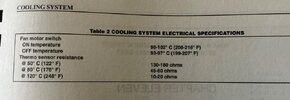
If you hook an ohm meter to the temp sensor, you can determine if in fact the cooling system is working as it should. The resistance numbers are in Clymers, and the shop manual.
I’ve attached a photo below for quick reference. The ohms reading will indicate the temperature range. Each value indicates, when the thermostat opens and when the fan comes on.
 

Attachments

  • IMG_0679.jpeg
    IMG_0679.jpeg
    121 KB · Views: 12
Back
Top Bottom