
My personal view on facing wiring issues.

Test lights are useful but can also be misleading. For example 8v will light up a test light but the system your testing requires 12v, does the light lead you to assume voltage is good? You can get a test light with a integrated voltmeter fairly cheap. But be aware of voltage range.
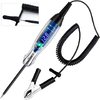

1793897102443.png
This is a good thread and this is going to be my first test light in probably twenty years. Gotta get me one of them
Situation well articulated in post 13.
Many of my wiring issues are the result of errors or tampering compounded by shoddy repairs. But it's easy to imagine you're better than the next guy while you're scheduled to follow up on a nice day after someone got someone heat or refrigeration or whatever at 2:00 am in the pounding rain.
Same has to hold true for motorcycle repairs; sometimes it's whatever you got to do to avoid leaving it where it is. No one sets out to make a mess but either out of necessity or time or material constraints it often becomes the root of the problem.
In my experience, especially in later years exposing as much as practicable and careful visual inspection with good lighting, a pair of 1.5X and 3.5X, a one inch inspection mirror and a two inch inspection mirror, feeling / removing and reinstalling conductors and connectors, cutting open anything previously repaired, and visual inspection more often than not trumps test equipment
You will be surprised how handy it becomes. Just remember it doesn't work below 3-4v.
 
There is also fall-of-potential testing, which is checking for voltage between the battery + and the load + terminal, and between battery — and the load — terminal.

Switches that are on, good fuses, solid connections, etc., should test just like solid wire, with no voltage across them. The load must be connected and on for this to work.

The idea is to make sure that points that should be energized really are energized (at 12v), and that points that should be grounded really are grounded (at 0v.)

Any appreciable voltage drop between points (that should be at the same voltage) will indicate a resistance in the current pathway that should not be present.

The fault in the pathway can be pinpointed by a process of elimination, with additional point-to-point testing, until you find voltage between points should not be there.

A test light is much easier for most troubleshooting than a voltmeter for just about everything except for when you need to know the actual voltage, which is rare.

As an electrician, I use a solenoid type of voltage tester 99% of the time. It requires “real” power to indicate voltage, and ignores “phantom” (induced) voltage.
 
Last edited:
Back
Top Bottom