st1100 abs I forks rebuild- stock or progressive?

Joined
Sep 4, 2019
Messages
157
Age
50
Location
Georgia
Bike
ST1100
Hi there! Planning to rebuild the forks on my ST1100 (ABS I version, 41 mm) next year. I’ve started filling the shopping basket with parts and remembered that I should replace the springs as well.
At first I was going to stick with OEM springs, but then I came across progressive springs and thought they might be a better option?
After reading a few threads on this forum, though, I found that aftermarket/progressive springs can require some additional setup- different oil level, different spacers, etc.
So, is it actually worth going with progressive springs on 30y.o motorcycle, or would you recommend just buying new OEM springs and keeping everything close to the factory setup?
 
I went with all Race Tech stuff (gold valves, their springs, etc.) and was not disappointed in the results.
IIRC, they are not progressive but I have run progressive ones before and the difference was not much according to my 'butt dynamo'. ;)
But the Race Tech stuff was really a big improvement by the same measurement.
 
I have progressive on my 2002 ABSII, and like them, they are an improvement over OEM. I have installed RaceTech on my VStrom and there was major improvement over OEM. Having said that, my VStrom was used for a much wider spectrum of conditions that my ST wouldn’t encounter.
If I had the funds, and were younger and more aggressive in my riding practices, I would go for RaceTech on my ST
 
I'm running Hyperpro linear progressive springs with 7W oil in the non-ABS (the Wilbers ones were way too harsh for road use...)
Good compromise between precise handling, firm planting during braking whilst still comfortable (i.e. frost beaten alpine roads...)
 
emm, valves? I thought that I need to buy just springs, guide busings, dust/oil seals?
Yes, Race Tech can be a complete 'redo' of the front forks internally.
I was lazy and had a trusted suspension shop rebuild all of mine.
 
Thanks! If I install aftermarket springs, will I have to mess around with the spacers, or is it basically plug and play?
 
Thanks! If I install aftermarket springs, will I have to mess around with the spacers, or is it basically plug and play?
When I originally did progressive springs myself, IIRC I 'messed around with spacers' - but that has been a long time ago. ;)
 
Thanks for helping me dive into this topic. Forks are pretty much the only part of the bike where I still don’t really understand the magic happening inside them. :)
The springs are the same for ABS I and non-ABS pre-1995 models, aren’t they?
 
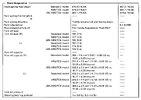
one more thing, what does the right column mean in the table?
left column is the original spring length, right column is the service limit. When the spring free length has compressed to the length in the right column its no longer considered to be in spec.

edit: this got my curiosity going so I pulled the spring out of a spare fork I have lying around from a '97 standard. The spring measured at 414mm, which is within 1-2mm of the original length and well within spec.

As I suspected, the springs don't really "wear out" over time, so unless you're trying to change the ride characteristics of your bike, you might just want to leave the original springs in there after all.
 
Last edited:
I didn't measure the spring length during the last rebuild unfortunately. But the mechanic who worked on the bike said that I'd better replace them. It was a few years ago. I don't know, maybe I'll go with the original springs.
 
If you need a stiffer front you can add or modify the spacer to get a higher preload.
this was always a bit of a mystery to me why this works.

Back in the UJM days this was the common wisdom because it always felt like the ride got stiffer/harsher if you increased the preload. Mathematically the spring rate is the same, only the ride height changed because of the greater preload. The spring is compressed by the weight on the forks, which doesn't change, so the spring compresses by the same amount regardless of the spacer length. So even with a progressively wound spring, the spring rate is the same regardless of preload. What changes is how far the upper fork tube moves into the lower fork tube to oppose the weight on the forks.

From what I can tell, what actually changes to stiffen the ride is the rebound dampening. When I owned a sport bike with fully adjustable forks, I was able to re-create that same stiffness/harshness without adjusting the spring preload at all, just a couple turns on the rebound dampening screw. My guess is the same thing happens when the ride height of a conventional forks is raised, but I can't explain why.

I think by putting in "cartridge emulators" you can also tune the rebound dampenening, and I think Uncle Phil and others have gone this route. I'm curious to hear their experiences on this particular topic with the emulators.
 
Back in the UJM days this was the common wisdom because it always felt like the ride got stiffer/harsher if you increased the preload. Mathematically the spring rate is the same, only the ride height changed because of the greater preload...
Yeah, IMO is tweaking the suspension to fully hard a bit like "loud pipes"... ;)
And by "eliminating" the soft/tight wound part of the spring, you not only loose comfort, you also obliterate the suspension's ability to absorb the smaller road surface irregularities... leading to bounce/drifting out a corner wherever the tarmac isn't flat like a billiards table...

So "soft" in the (early) start of the suspension travel/compression isn't "bad"...

During my very first contact with Wilbers they suggested/sold me their 2-step progressive fork springs with a 20W oil...
uh-boy... :oops:
literally felt like having broomsticks in there... right: tall, but felt like they wouldn't compress at all... OTOH agile and precise handling like you could cut glass...
Surely great on the (probably) absolute smooth tarmac of a racetrack, but even by trying to soften it with 10 or 5W oil simply unbearable on normal roads... suffered really sore wrist after an hour... (plus the hard vibration and bouncing starts hammering all fairing fixings apart...)

Changed to the linear-progressive wound Hyperpro springs... what a difference... just the right compromise...
Played with fork oils, ended up with 7W...

And compared to the '94 with OEM suspension, the '00 ST with Hyperpro front and Wilbers rear feels like a different motorcycle... no unintended movement, no twitching, no drifting in cornering which increases confidence...
The '94 is an identical bike, even the same tires on, so technically it could do it... it just doesn't feel as right when pushed...
 
And by "eliminating" the soft/tight wound part of the spring, you not only loose comfort, you also obliterate the suspension's ability to absorb the smaller road surface irregularities... leading to bounce/drifting out a corner wherever the tarmac isn't flat like a billiards table...

So "soft" in the (early) start of the suspension travel/compression isn't "bad"...
I think you missed my point.

Adding more preload to the forks doesn't change the spring compression at all, it compresses by the same amount regardless of what length spacer is inside the fork because the force being applied (the weight of the bike on the forks) is the same regardless of the spacer length. The spring compresses only as far as it needs to counteract the weight being applied to the forks, and that weight didn't change.

All that changes is where the spring is positioned inside the fork under the weight of the bike. A longer spacer moves the top of the spring further down in the upper tube, requiring less travel between the upper and lower tube to reach equilibrium after weight is applied to the front end. So, the ride height is all that changes, the spring is compressed exactly the same way as it is with a shorter spacer.

My comment in the earlier post was that even though the spring rate didn't get any stiffer, the ride did, and it was due to something in the new geometry affecting the rebound dampening response of the fork, it had nothing to do with the spring.
 
Back
Top Bottom