1996 ST1100A ABS II: Rebuilding the Rear Master Cylinder & Post-installation Bleeding Tips on LBS

Joined
Jul 30, 2007
Messages
33
Location
San Diego, CA
Model: 1996 ABS II with Linked Braking System
Symptom: Persistent soft rear brake 'pedal' before and after fresh brake fluid flush

Forum Members,

Hello. I have rebuilt master cylinders and am comfortable with the rebuild process.

However, I have not removed & replaced the rear brake master cylinder on a motorcycle with a linked braking system. Being the low point of the brake system, I expect loss of fluid from the lines servicing the front brakes, as well as the rear brakes.

Will bleeding both the front (left, right, upper & lower) and rear brake (front & rear) be required after installation of the rear master cylinder?

Any tips on minimizing brake fluid loss without damaging lines or avoiding excessive brake bleeding would be appreciated.

Can appropriate sized bolts and nuts be used to terminate the end of the brake lines during the rebuild process?
I suppose pinching the hose should be avoided...

(I will start this activity tomorrow, Sunday, April 5th.)

Thank you!
 
The bolt attaching the hose is not just a bolt. Common name is a banjo bolt. It has holes in it for brake fluid to flow. May be able to use a correct size nut and bolt (M 10?) with the crush washers or maybe plain washers and a nut.

If you can get the hose end to be the highest point of the system, it might drip but it won't flow.
 
Thanks Ron. I will learn tomorrow if this is a straight forward process (as for the clutch & front brake). I don't mind the time-consuming and sequence-dependent process of bleeding all the brakes again. I simply want to minimize getting air trapped in the system.
 
Any banjo bolt that you remove or slacken needs to have new crush washers fitted. These are either aluminium (or an aluminium alloy) or copper - a soft metal. During the tightening process, they are squashed / deformed so that the metal faces seal perfectly against any tiny imperfections in the surface of the banjo union or the casting of the caliper, master cylinder or banjo bolt. Once crushed with the correct torque, they cannot be re-used - they are no longer soft and will not seal properly. I use copper bought in bags of 100 from goodridge, but your dealer/service centre will probably sell you some cheaper than buying them individually.

When reassembling, I tend to tighten these to about 20 Nm so that they seal ‘enough’ for bleeding and checking purposes, but the washers are not yet crushed. The actual torque required is much higher than this - but this allows me to slacken the bolt to burp any air at the union.

Front brake outer pistons on both sides are not affected by work on the rear master cylinder, but you will have to bleed at the centre pistons (ie the lower bleed valve) on both front brake calipers.

It is worth exercising the SMC while bleeding at the rearmost bleed valve on the rear caliper. The SMC operates only on the two outer rear pistons.

From the rear master cylinder there are two brake lines. The shortest and easiest to bleed is to the rear centre pistons- the one in the middle top of the rear caliper. Then bleed the centre pistons on the front calipers (lower bleed valve) - right side first. Then the rearmost bleed valve on the rear caliper. Repeat.

Air bubbles get trapped at the top of ‘n’ bends in the hoses and at the bottom of u bends. Also at any joint. Flex and tap as you are bleeding to dislodge them.

Take a look at this link. https://www.st-owners.com/forums/th...g-all-the-air-out-of-the-brake-system.156754/

Now before you say - ‘mine is an ST1100’. I know. I have owned an ST1100 with ABS II and linked brakes. The plumbing is almost identical to the 1300 so much of what I say applies equally to the 1100….
… except for two things that are mentioned in that article:.

1. The SMC on the 1300 is integral to the caliper bracket and it is not upright - it therefore needs to be tilted. The SMC on your front left caliper is positioned vertically like the rear master cylinder and doesn’t need to be tilted. But it is worth checking that the bracket linkage moves freely while you have no fluid in the system. It can seize up with time and neglect and may cause the same rear brake locking issues that are often seen with time and neglect on the 1300 SMC I’ll post a link to that info for the 1100, below.

2. The 1300 has a bleed valve at the highest point - roughly near your right knee when sitting on the bike. It is referred to as the PCV bleed valve - as it is near to the proportional control valve. Don’t go looking for it on your bike, because the ST1100A does not have that bleed valve. Any air in the system after the SMC has to be pumped out through the rearmost valve on the rear caliper.

Apart from that, the logic in that article link applies to your ST1100.
Also watch the video of bubbles trapped in plastic tubing at n bends, u bends and joints.

Final tip. When you get to the point when you have got rid of most of the air, but your pedal is still softer than you want, pump the brake pedal a few times and hold it down. Tie it down tight. Also suspend a heavy weight from it. Leave it overnight. The weight will take up any drop in pressure due to release of trapped air and contraction as temperature drops. Then bleed at the two front calipers centre pistons, right first, then left. And at both valves at the rear caliper, rearmost valve first. You can expect a stream of cloudy fluid, and fluid with lots of bubbles.

Don’t forget to torque up your banjo bolts . Check the exact value - I believe that it will be around 34-35 Nm. But check for yourself.

St1100. SMC linkage : post #14 - https://www.st-owners.com/forums/threads/linked-brakes.191361/

 
Last edited:
  • Like
Reactions: jrp
John, Hello and thank you for your very detailed reply with links to extremely helpful content! I appreciate your time and effort to share your knowledge with the forum. The information is excellent. I need to remember to search for similar topics on the ST1300 that overlap between the ST1100 & ST1300. Lots of valuable information that is shared between both models. Thanks again!
 
Final comment - I forgot to add. If your rear brake disc has a slight warp in it, then as it rotates, it will nudge the pistons back into the caliper a little. This will give a feeling of a ‘long brake pedal’. Press it and release and press again, it will firm up. When on the road this could be mistaken for air in the system. But in the workshop your brakes should be as firm on the second press as it is in the first. Or vice versa.

I got so used to the excellent combined front and rear braking system that I hardly ever used the brake pedal when riding. When I did it always felt soft because the pads had worn down a bit, and the centre pistons on all 3 calipers are only moved by the rear pedal. The pistons had further to move to reach the pads !

I gave my ST1300 to my brother in January and now have a Spyder touring beast - a trike. It has only a brake pedal. I want my brake lever back !
 
Last edited:
2000 ABSII here
I've had ongoing soft rear brake issues and noticed that when bleeding the front calipers it would firm up.
Fast forward, after lots of bleeds and a Rear master rebuild it would keep happening. Thinking the Bleed nipples were leaking or rather ingesting air into the system I replaced all four of the nipples on the front calipers. I bought speed bleeders for convenience and so far the rear is remaining firm.
The new bleeder nipples has a coating around them that might help with the seal, and I wonder if something like some Teflon wrapped around the old ones might have worked just as well.
 
When I had my ST1100 I replaced the rear brake master cylinder and rebuilt the calipers etc. - I stumbled upon a method to bleed the front to rear circuit very easily. I found that it bleeding the lower bleed nipple on the front caliper all the way through to the rear caliper with a check valve bleeder made the job so much easier.
 
Just for info - the top bleed nipple on the front calipers is for the two outer pistons has absolutely nothing to do (hydraulically) with the rear brake line.
The lower bleed valves in the front calipers bleed the centre piston. That is an integral part of the system from the rear master cylinder - the brake pedal - and it has no hydraulic connection with the front brake lever.

If you are chasing a soft rear pedal, and your front brake lever is nice and firm then there is no need at this stage to open the top bleed nipple on the front calipers. The front master cylinder to the two front brake caliper outer pistons are a completely separate and straight forward hydraulic system.

But @Slydynbye is correct probably correct in his observation that when he bled the lower bleed valve on the front caliper (the one for the centre piston) that the pedal felt firmer.
One of the two brake lines connected to the rear master cylinder heads forward. It goes to the front forks. and splits - one goes throught the delay valve to the front right centre piston. One goes across the musdguard to the front left centre piston. That branch continues to the SMC (behind the shroud), then to the proportional control valve (Which makes sure that when the SMC is being worked hard that it cannot apply to much force to the rear brake outer pistons.

When bleeding the rear brake lines it is important to use the centre piston bleed valve on the front calipers to get rid of any air - which will likely get trapped in the n bend as the line comes from near the steering head to the front forks - before continuing to the rear caliper outer pistons. The rear caliper centre piston is connected directly to the master cylinder for the rear brake pedal via the second banjo bolt. It is best do fill and bleed that first so that it is full of fluid before doing the lines that go to the front.
 
On my VFR800Fi linked brakes, I found I needed a third hand (or half of a willing accomplice) to properly bleed the SMC and get a firm pedal. I think air likes to lurk in the SMC unless it is physically pumped through by the SMC piston. What worked for me was:
Bleed front centre pistons as specified in the manual (right first, then left)

Incline the SMC so that the outlet is above the inlet
Press pedal to pressurise the SMC
Manually push the SMC in and hold it there while cracking the PCV bleeder
Close the bleeder
Press the pedal as needed to repressurise the SMC and pump it out fully
Repeat as needed
Refit the SMC

Bleed rear centre
Bleed rear outer
 
John & bdalameda:

Good evening. Thank you very much for your additional input and suggestions.

My 30 year ST1100A only has 23,000 miles on it. I think the issue I am experiencing is similar to the the issue Slydynbye shared above.... faulty bleeder valves. The rear brake can become firm while bleeding. However, it becomes soft or a 'long pedal' after some time. Typically, it pumps up nicely after a quick pump of the pedal.

Both of my rear bleeder valves are functioning perfectly. The fluid comes out like a core sample of the earth.... very solid with no air.

The front bleeders constantly has air, even after pumping the equivalent brake fluid volume of two reservoirs... TWICE, and suspending weight from a primed rear brake for two nights. I am using a vacuum pump (Mini-Vac IIRC) and zip ties on all hose junctions. The weak point of the vacuum pump may be the cup. I will try to install a couple ports on a mason jar to eliminate the plastic cup. While tracing the brake lines from the rear to the front, it becomes apparent how easily trapped air can remain in the system. I am surprised excess air in the brake line is not more common.

Btw, I will depart for a 2500-3000 mile trip within a couple days. The rear brakes are okay for now, but not 100%. The front brakes are perfect... impressive. Most of the time, I only use the front brakes... therefore, no problem.

I am going to order new bleeder valves for the front calipers and will report back with results in a week or two.

Everyone's input is appreciated!
 
Last edited:
TerryS: Hello. Thank you for your post.

It is nice to read suggestions from forum members from the UK and NZ. I was fortunate to ride NZ for two months a few years ago on an old Africa Twin. Beautiful countryside, kind people and great riding! Thanks again Terry!
 
John: Thank you for the extra keystrokes to clarify the front hydraulic system is independent to the linked rear/front brake hydraulic system. I understand.
 
The front bleeders constantly has air, even after pumping the equivalent brake fluid volume of two reservoirs... TWICE, and suspending weight from a primed rear brake for two nights. I am using a vacuum pump (Mini-Vac IIRC) and zip ties on all hose junctions. The weak point of the vacuum pump may be the cup. I will try to install a couple ports on a mason jar to eliminate the plastic cup. While tracing the brake lines from the rear to the front, it becomes apparent how easily trapped air can remain in the system. I am surprised excess air in the brake line is not more common.
The vacuum bleeders are good at pulling the fluid into the system - but they are useless for the final bleed. The problem is, that even if you wrap PTFE tape around the threads of the bleed nipple, when you suck air through the nipple with a vaccuum pump, it is easier for it to pull air past the thread and back up the hole in the centre than it is to pull the fluid through the system - even with PTFE tape on. So you get a constant stream of tiny bubbles.

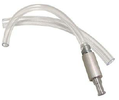
1775674220397.pngThe best way is to finish off is with a bleed tube that has a built in no-return valve. Put the tube on the nipple - put the end tube into a glass jar.
Make sure that the arrow on the side of the metal valve casing is pointing towards the glass jar.
Pump up the brake lever 3-4 times, hold the lever in.
Release the bleed nipple, keep the lever held in. The built in pressure will push the fluid out.
Before the fluid stops flowing, tighten the bleed nipple again.
Repeat.
Very quickly you will feel an improvement in the feel of the brake lever.

The non return bleed valve helps to prevent fluid and air flowing back into the system - but if you use the above method, that cannot happen any way. With the bleed nipple always under pressure when it is open, no air can get in. Fluid can only get out.

When no more air is coming out, then make sure the valve / nipple is secured -it doesn't need to be very tight - I think it is just 2Nm. Check though - that is from memory and is not to be relied upon.

Pump up the brakes a few times and then see how they feel at the lever.

The same method applies to the rear brake bleed procedure. You may need help and it is much much easier if you have bleed tubes attached to all 4 bleed points. But it took me a long time to get round to paying for 4 bleed valves !

You said that you have to pump up the rear pedal and then the brakes feel firm. That can happen on that long circuit with the SMC in it - but get someone to pump it up while you feel the SMC body and the pushrod end sticking out of the bottom. That should stay still. If there is any movement then report back and we can have a think about that behaviour.
 
Back
Top Bottom