


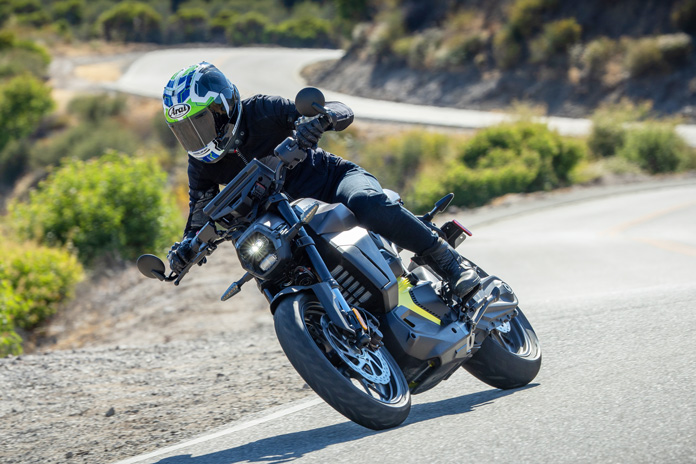
Dressed in matte Carbon Black, the Can-Am Pulse looks as stealthy as it sounds. (Photos by Kevin Wing)
Electric motorcycles usually come with baggage: whispers about range anxiety, soulless rides, and that awkward “sci-fi toy” vibe. The Can-Am Pulse doesn’t quite play by those rules. Yes, it’s battery-powered, but it packs BRP’s new 35-kW Rotax E-Power drivetrain, which means twisting the right grip rewards you with an instant surge that’ll lift the front wheel and your eyebrows at the same time. Where many EVs feel like futuristic appliances, the Pulse feels like a motorcycle, just quieter. It’s not the ultimate canyon carver, and it can’t go toe-to-toe with a gas bike in terms of range, but it has a surprising simplicity that makes the whole experience refreshing.
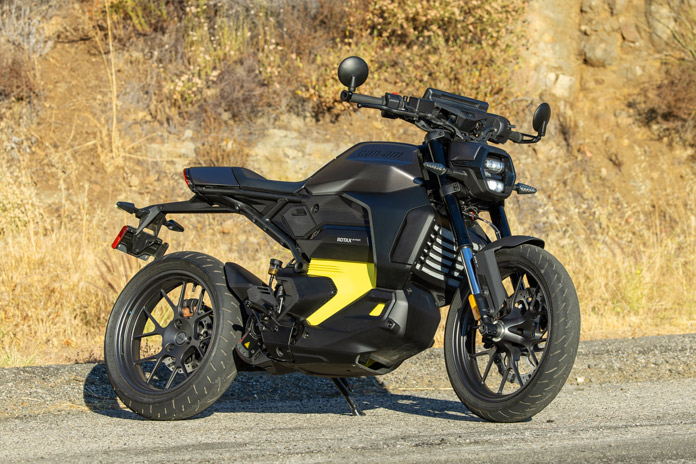
With a 390-lb curb weight, a 55.6-inch wheelbase, and a 30.9-inch seat height, the Pulse is sized like a naked middleweight (think Yamaha MT-07 or Kawasaki Z650). It feels light and narrow between the knees, and you really notice that when weaving through traffic or lifting it off the sidestand. I expected it to feel heavy and wonky, but it was a very easygoing ride. Instead of the usual bolt-in battery box, the Pulse’s frame doubles as the battery housing, a design that, according to BRP, improves weight distribution, and it does feel balanced in corners.
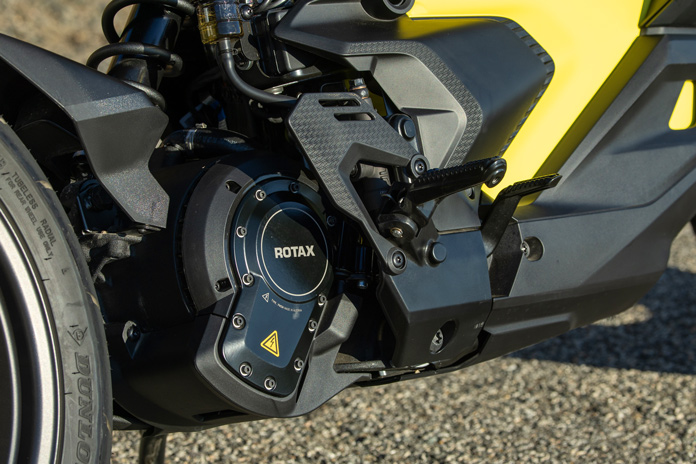
The Rotax E-Power motor makes 47 hp.
Torque is where the Pulse really shines, delivering 53 lb-ft from 0 to 4,600 rpm, which helps it rocket from 0-60 mph in 3.8 seconds. There’s 47 hp on tap too. The great thing about electric bikes is that they make incredibly consistent power. Rolling on the right grip sends more power directly to the rear wheel, just like turning up a dimmer switch increasingly brightens a room. No dips, no hiccups. Power response is snappier than most 650-700cc Twins, though I noticed a slight hesitation when rolling back on the throttle after regenerative braking. When I tried to trail brake, I struggled to get the motor to respond precisely when I wanted it to, feeling like it was lagging after a roll off.
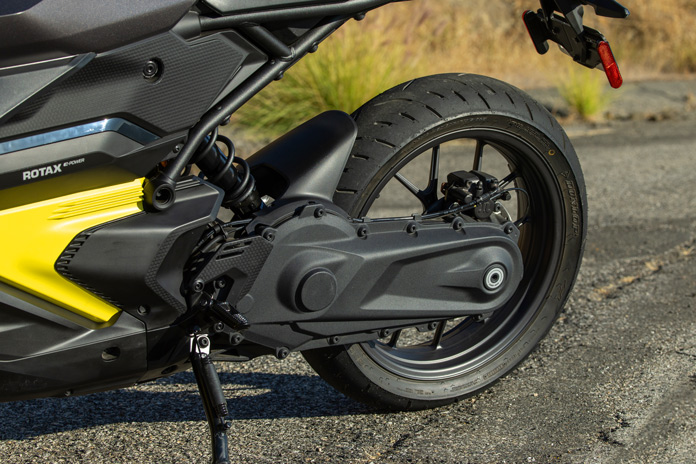
The drive chain is fully enclosed.
The Pulse offers four ride modes. Sport+ sharpens response for maximum grin factor, while Normal dials things back for everyday sanity. Eco reins in acceleration and caps top speed to extend the range, and there’s a Rain mode that softens power ramp‑up and leans hard on ABS and traction control. TC can be adjusted but must stay on in Eco and Rain modes.
Can-Am splits regeneration into passive and active systems, both of which can be adjusted (Off, Min, or Max) in any ride mode. Passive regen kicks in the moment you roll off, similar to engine braking. Active regen adds extra decel when you twist the grip forward (think mountain‑bike e‑brake). Once you’ve dialed in the combo that feels right, you can almost ride the Pulse without touching the front brake lever, saving wear on the front pads (connected to a single J.Juan 2-piston floating caliper) and adding a smidge of juice back into the battery.
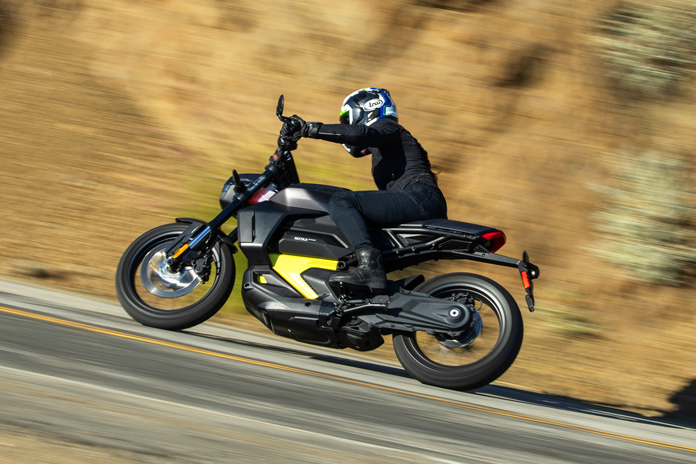
The use case for an electric motorcycle favors commuting and city riding. The Pulse is a blast on canyon roads, but limited range keeps it on a short leash.
Even though the regen can slow the bike down on its own, I still put the brakes to the test, and they have good bite and stopping power. I was able to comfortably use one finger on the lever for trailing and quick stops.
The suspension leans toward comfortable rather than sporty, absorbing bumps on highways and canyon roads without complaint. A nonadjustable KYB 41mm fork pairs with a preload-adjustable Sachs rear shock, both with 5.5 inches of travel.
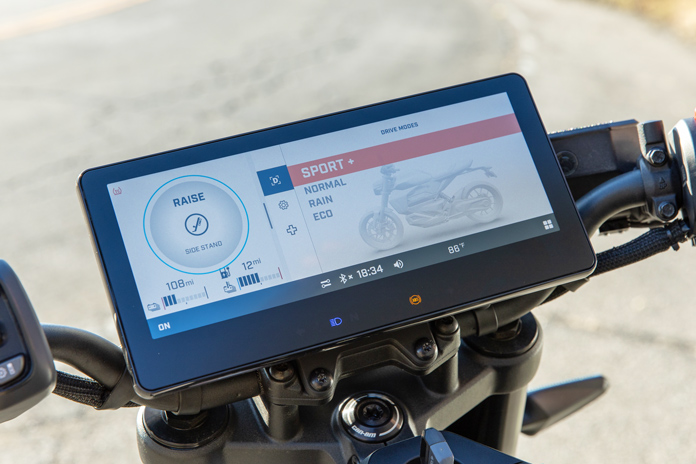
Mission control is a big TFT display.
With EVs, the conversation always circles back to range. Can-Am claims 100 miles in the city or about 80 for mixed city/highway riding. Those figures are for ideal conditions, such as Eco mode on flat terrain at conservative speeds. If you head to the canyons where you’ll work the right grip more and contend with elevation changes, you’ll see range drop fast. During a test ride in the Santa Monica Mountains, I started with a 77% charge, and the menu reported a remaining range of 41 miles. Even without pushing too hard, after 20 miles the remaining range was 12 miles – not the 21 miles I expected to see on the dash. Even using active regen, I didn’t see much improvement in range. The Pulse is ideal for cruising around town and short-hop commuting, but highway speeds drain the battery, and top speed is limited to 80 mph.
Replenishing the 8.9-kWh battery pack is painless if you have the right plug. The Pulse comes with a 6.6-kW charger that supports Level 1 (120v) and Level 2 (240v) charging. Level 2 charging will top up the battery from 0-80% in 50 minutes and 0-100% in 90 minutes. Level 1 charging using a standard 120v outlet only makes sense for overnight charging: 0-80% takes 3 hours and 10 minutes, and 0-100% takes 5 hours. There’s no Level 3 DC fast‑charge option.
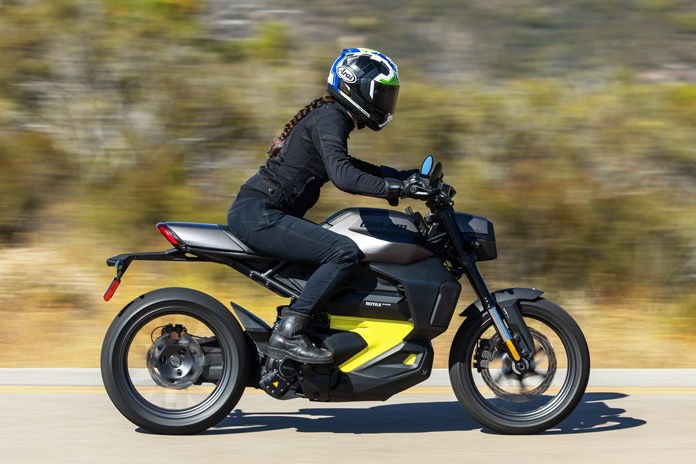
The roadster riding position strikes a balance between sportiness and comfort.
GEAR UP
- Helmet: Arai Corsair-X
- Jacket: Dainese Airframe Jacket
- Gloves: Sedici Chicane 2 Women’s Gloves
- Pants: Alpinestars Daisy V3 Jeans
- Boots: Sedici Tourisma WP Women’s Boots
Tech-wise, the 10.25-inch TFT display syncs with your phone for calls, music, and navigation through the BRP GO! app. The app also lets you check charge status and precondition the battery, which is handy on cold mornings, since the liquid-cooled pack self-heats to stay in its sweet spot. That cooling system also manages heat under load. Battery life can be extended by using preconditioning during cold days as well as maintaining proper operating temperatures. This extra step is part of the EV learning curve.
There’s something refreshing about the simplicity of the Pulse: no clutch, no shifting, just twist and go. It builds speed fast, though it lacks the emotional character of combustion. The direct-drive system paired with an oil-lubricated, enclosed chain (with automatic chain tensioner) keeps everything smooth and whisper-quiet. In fact, the sound is more like a small jet spooling up than a typical electric whine.
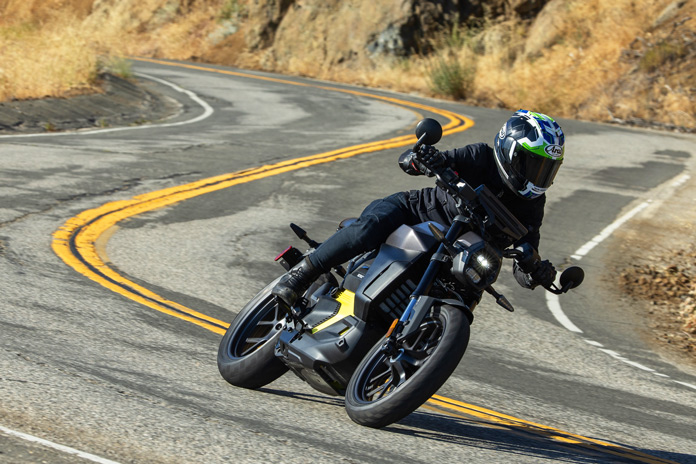
Smooth, quick acceleration with linear power delivery is the name of the electric game.
I’ve spent time on a handful of electrics – the Zero DSR/X, Beta Explorer, and BMW CE 02 – and the Pulse stands out. It feels more like a “normal” motorcycle than any of them. EVs get better every year, and the Pulse further closes the gap between electric and gas-powered motorcycles.
I tested the standard Pulse ($10,999), available in Carbon Black or Bright White. There’s also a Pulse ’73 version ($12,999) that includes a flyscreen, signature LED lights, Sterling Silver paint, special trim, and a bike cover. If your lifestyle and commute align with its range, the swift and silent Pulse is worth considering.
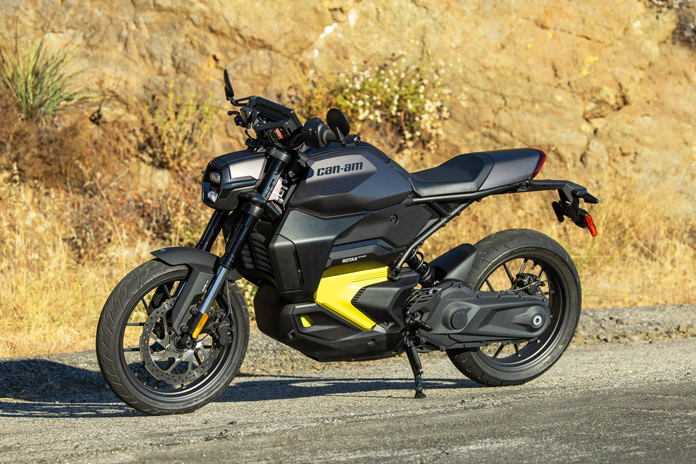
2026 Can-Am Pulse
- Base Price: $10,999
- Website: Can-Am.BRP.com
- Warranty: 2 yrs. vehicle, 5 yrs. battery
- Motor: Liquid-cooled, 35-kW Rotax E-Power
- Horsepower: 47 hp peak, 27 hp continuous
- Torque: 53 lb-ft from 0-4,600 rpm
- Final Drive: Enclosed chain w/ automatic tensioner
- Wheelbase: 55.6 in.
- Rake/Trail: 27.2 degrees/4.0 in.
- Seat Height: 30.9 in.
- Dry Weight: 390 lb
- Battery Capacity: 8.9 kWh
- Battery Consumption: 100 miles city, 80 miles city/highway (factory claim)

A veteran of the U.S. Navy, Sylvia Houston now provides MSF training for military personnel. She’s a club-level sportbike and supermoto racer, an avid rider of anything on two wheels, and a big fan of wheelies!
The post 2026 Can-Am Pulse Review appeared first on Rider Magazine.
Continue reading...




 I'm at the point where it is just mildly interesting. When I quit riding my current bike, I'll move on to fly fishing and camping.