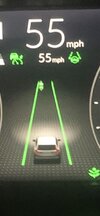
Adaptive cruise control

I'll preface this with saying I'm sure you guys will think I'm nuts.

I put ACC in something of the same category as traction control and the other safety net "features". I think traction control and the other electronic aids were invented because motorcycles reached the point that the average rider couldn't get out of the dealership parking lot without them...or he'd wreck it into little itty bitty parts.

Here's a quote from an article on the original Hayabusa that bears this point out.

The 1999 model year represents the only time the Hayabusa was sold without electronic intervention. These bikes are identified by their unrestricted 220 mph (340 km/h) speedometers. In this original form, there were no secondary throttle plates to soften the power delivery, and no software-coded speed cap. Independent testers frequently saw 191 to 194 mph on radar, figures that caused a political firestorm in Europe.

Riding a 1999 model is a different experience than riding later generations. The throttle response is more immediate, and the lack of a 186-mph limiter allows the engine to pull through the top of sixth gear. This version of the bike required a high level of rider discipline; without traction control or ABS, the only safety net was the rider's right wrist. This lack of intervention is a far cry from the best motorcycle safety features found on contemporary motorbikes. The original Copper and Silver paint scheme from this year has since become the most sought-after configuration for collectors.

What made the original machine feel “too fast to handle” though, was the blatant absence of any electronic restraint. The 1,299cc inline-four produced immediate, muscular torque from as low as 4,000 rpm, lifting the front wheel in first and even second gear with nothing more than a firm throttle roll. There was no ABS, no traction control, no wheelie control, and no lean-sensitive IMU calculating grip in milliseconds. There was no slipper clutch to smooth aggressive downshifts, and no electronic safety net to save a ham-fisted rider mid-corner. The only fallback you had was a silent prayer if things got too hairy.

Modern liter-class motorcycles may produce comparable horsepower figures, but they rely on cornering ABS, slide control, launch control, quickshifters, and vastly superior tire compounds to manage it. The 1999 Hayabusa asked the rider to manage 175 horsepower and a tidal wave of torque with pure mechanical feedback alone, so it's no wonder it earned its reputation as a machine few could truly master.

Chris
 
I love the ACC cruise on my wife's Volvo. When we go up to the Bay Area and frequently get stuck in traffic the Volvo ACC will actually let the car come to a complete stop and then slowly follow the car in front of you without touching the gas pedal or brake. It as close as you can get to making driving in stop and go traffic tolerable.
 
You do understand I bought the Civic and the CRV for my wife's safety mainly? I'm still super manly tough and smoke cigars when Jack gives them to me. I was in a terrible fist fight just last week but luckily I beat her good.
:roflmao-2x:

Ok that last bit is a little cringe but I do get that's humor. R-R-R.
 
I have been working as a hiker, or on-call driver, for a family of dealerships that include Mazda, BMW, VW, and Mini. I drive trips from 30 to 250 miles a few days a week in a variety of late model/new cars and SUVs. There are big differences in ACC and lane departure implementation among brands and across models within a brand. If you don't like how ACC works in your old or newish car or motorcycle don't discount strides manufacturers have made. I had to laugh at pictures of sleeping drivers. I trust the tech in their car more than I trust all the other "awake" drivers looking at their phones, laptops, books while texting or slapping their kids in the back seat or driving 95 mph weaving through traffic.
 
not a fan of adaptive cruise ...my wife loves it on her car. Pay attention and I don't think you need it.
I felt the same until my RT has the adaptive cruise control. I love it especially when following someone on a two lane highway. Comes in real handy in that scenario.
 
Updates to questions on the Honda CRV ACC. I've been watching it a lot as I drive it and it always see motorcycles per the dash-panel image shown. See pic below, the bike is shown on there.

Another item, the Collision Mitigation Braking System or CMBS has been thoroughly tested and works great. I was in some heavy traffic this week and I was braking suddenly myself (not asleep to some's dismay) to what I knew was going to become a dicey stop as in close as heck to his bumper. The CMBS didn't like it so it took over. I was holding the brake pedal down but it decided to brake much harder and prevent the close as heck ending. It completely stopped us at least 2 car lengths back. I was just fine and did like that. ACC was off as I was on the brake pedal which like in normal CC kills the ACC.

I'm sure my wife loves her ACC car as much as she loves me.

IMG_8571.jpeg
 
I actually should have said I was following 1.5 to 1.8 seconds behind the vehicle in front of me. I was using selection 2 most of the day per Honda, see below. I find in today's heavy traffic If I follow as far back as I want to then that 3 second space is filled by the cars hurrying to pass everyone from the adjacent lanes.

Yes it does back you off at higher speeds and is selectable with the interval setting. At "4 bars" and 80 mph it follows at 3 seconds or 352 feet. Same setting at 25 mph is 3 second or 110 feet. You leave 110 feet at 25 mph ahead of you and it will soon be filled by another car. The average car length I found for 2026 is 14.7 feet.

You do understand I bought the Civic and the CRV for my wife's safety mainly? I'm still super manly tough and smoke cigars when Jack gives them to me. I was in a terrible fist fight just last week but luckily I beat her good.

Honda ACC Interval Chart

Interval SettingApproximate Time GapInstrument Panel IconDescription
Short~1.0 - 1.2 seconds1 barBest for moderate traffic; leaves just enough room for safe braking.
Middle~1.5 - 1.8 seconds2 barsThe default setting upon vehicle startup; recommended for normal highway driving.
Long~2.0 - 2.3 seconds3 barsProvides a larger buffer; great for higher speeds or light rain.
Extra Long~2.5 - 3.0+ seconds4 barsMaximum distance; best for heavy rain, snowy conditions, or open rural driving.
Raymond, I am glad I can continue to contribute to your bad habits, it is one of the few things I am good at. Just so you know, I recently acquires an excellent box of Habana Black Pearls and I have sequestered a couple for when our paths next cross so we can enjoy some lung cloggers together. Safe travels my friend.
 
I have a 2017 CR-V and a 2024 Prius both with ACC. They both have four following distances, but each Prius increment is noticeably shorter than the corresponding one on the CR-V.

I will use this to put in a plug for the conventional cruise control sold by MC Cruise out of Australia. As close to an OEM cruise as you're going to get for the 1100 and 1300.

A couple of years ago at NEWSTOC the speed sensor on my bike failed which in turn rendered the cruise control that derives the vehicle speed from that sensor. Of course, the manual aids I had used prior to the MC Cruise - a Cramp Buster and Go Cruise - were sitting in a drawer of my toolbox. Not anymore!

From this I learned that the stock return spring on the 1300 makes my ride torture if not supplemented with some sort of assistance..
 
In the good ol' days, we'd use the Caterpillar O-ring cruise control. Simple. Effective. And takes up virtually no space in your tankbag.

Chris
 
When following you on the slabs and your bike slows as it catches up to traffic, the brake lights do not go on. If you or your bike slow quickly then yes they do light up. We need to verify hill assist brake light on or off.

My Bronco Sport does iluminate the brake light during hill assist braking.
Hill assist does activate the brake light.
 
Back
Top Bottom