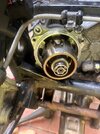
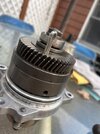
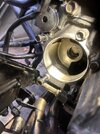
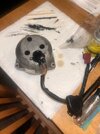
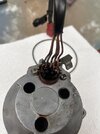
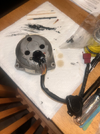
Alternator update…

Joined
May 15, 2022
Messages
38
Age
58
Location
Shelton, CT
Bike
1991 ST1100
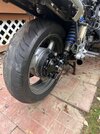
New swingarm and rear wheel back on…

She’s definitely doing “chargy” things.

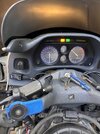
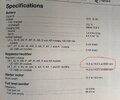
Service and repair manual says it should be 12.6 to 15.0 volts at 5000 rpm. I have 13 volts at 5000 rpm which is within spec (but lower than I’d like). Test ride was averaging 12.6 around the back roads. I’ll continue to clean as many wires as I can to bring the voltage up a bit, but I think she’s rideable again. I’ll check reg/rec connections, etc. Having a really hard time trying to find a used 28 amp OR all of the parts to do the 40 amp upgrade ☹️.

Any thoughts about how to bring voltage up any more? ‍♂️ LED’s on the headlights and taillights? ✌️
 

Attachments

  • IMG_9036.jpeg
    IMG_9036.jpeg
    192 KB · Views: 29
  • IMG_9043.jpeg
    IMG_9043.jpeg
    346.2 KB · Views: 29
  • IMG_9046.jpeg
    IMG_9046.jpeg
    288.9 KB · Views: 24
  • IMG_9041.jpeg
    IMG_9041.jpeg
    166.8 KB · Views: 21
  • IMG_9039.jpeg
    IMG_9039.jpeg
    150 KB · Views: 24
  • IMG_8986.jpeg
    IMG_8986.jpeg
    125.8 KB · Views: 22
  • IMG_8988.jpeg
    IMG_8988.jpeg
    137.1 KB · Views: 22
  • IMG_8980.jpeg
    IMG_8980.jpeg
    101.7 KB · Views: 23
  • IMG_8937.jpeg
    IMG_8937.jpeg
    158.5 KB · Views: 24
  • IMG_8921.jpeg
    IMG_8921.jpeg
    109.8 KB · Views: 24
  • IMG_8911.jpeg
    IMG_8911.jpeg
    149.5 KB · Views: 27
  • IMG_8853.jpeg
    IMG_8853.jpeg
    123 KB · Views: 25
  • IMG_8807.jpeg
    IMG_8807.jpeg
    96 KB · Views: 31
Where are you measuring the voltage? I’m assuming it’s directly at the battery. If not, you maybe getting readings under load.
With my 28 amp unit and voltmeter at the battery I was getting 14.7 at idle up to 15.1 running.
LED headlights will make a difference, will get you another half volt. In the meantime, consider disconnecting one headlight low beam, that should give you another half volt.
 
Borrowed your photo, Mark.
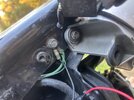
That little grommet/seal that guides the wires into the backside of the alternator seems to be the weakest link in the design. Vibration/time will cause the sealing function to fail and you'll have an oil leak.
I'm uncertain if this is related to alternator failures. It would certainly be a challenge to replace the seal with new if they were available and do so without causing leakage or damaging a wire or two after all that work.
My 1991 has no leaks anywhere so I suppose my choice ten years back was fortunate. I did replace all the hoses of all sorts right after I bought it. I'm impressed with the durability of the oil seals. Suppose I've been luck with mine as this seal is still working and the wires/insulation are still flexible.
1761306919499.png
I certainly hope all this work pays off!!
 
Just for reference, earlier this summer before I had any trouble with my bike I decided to put the battery on a smart charger after a long day riding and see if it needed any charging at all, even a little, from the smart battery tender.

All voltage readings were taken from the same two conductor pigtail plug that leads through 8 inches of wire and then goes to the battery. The positive side has an in-line blade fuse and the negative has no fuse

The exposed metal stud of the battery tender plug got clamped with a miniature alligator clamp on my voltmeter. For the other side, which was recessed, I put a tight fitting screw into that and clamprd the other alligator clip onto the screw.
I believe this was a good zero resistance contact.

RESULTS: When I plugged in the battery tender the blinking light sequence told me my motorcycle battery was already over 80% charged but it could use some more to top it off. Exactly 30 minutes later it told me the charging had ended because the battery was 100%.

VOLTAGE: As soon as I disconnected the battery tender I checked the voltage while the battery was still warm from being charged I got 13.53.

Then I waited 33 minutes and checked it again --it dropped down to 13.37.

So I let the bike sit overnight in the garage the next morning I checked it stone cold the battery was 13.1 V.

I left the voltmeter in place while I cranked the engine, and during those short two seconds of cranking before the engine came to life, the voltage never dropped below 10.9.


Once the engine started and it was idling at a fast idle, probably about 1000 RPM the voltage was 14.1.


I waited a few minutes while I geared up for a ride, and then I revved the throttle to see if the voltage would change, and it did not. I forgot to write down the reading on the tachometer but I would estimate I ran it up to 4000 RPM for a couple seconds.

End of test. Then I went riding!
 
My alternator leaks for years - but it is small and does not affect oil level at all, only back of engine is grimy. So decided to leave it as it is until something else is happening to it
I've noticed the same. There are still functional original oil cooled alternators on high mileage 1100's. There must be some common cause of relatively early failures. Multiple part producers? Garage parked vs outside? Why the oil cooled version in the first place.....something new and different?...concern about air-cooling in that mounting position? Since it's out of production for nearly 30 years, does speculation matter?
 
I believe the designers of the ST1100, underestimated the electrical demands that riders were accustomed to for long distance riding. Brighter lights for night riding, heated gear for example or for that matter when ABS was added. It all comes down to the bottom line.
The concept of a totally enclosed unit in my mind is desirable keeping foreign matter out. I imagine if the oil cooled alternator was a 35 or 40 amp output to begin with, we would not have a failure rate. Having said that, the volume of oil required to cool it would make the package unwieldy, too heavy and too large to fit behind the engine and frame.
 
. There are still functional original oil cooled alternators
Yeah, it worked fine for years even if leaked, but now it’s definitely time to retire this poor alternator. It started giving inconsistent voltage, especially at idle — all the lights flicker when the engine is idling. Not sure what exactly failed: could be a bad coil, could be the rectifier, who knows.


Either way, I’ve decided to replace the whole thing and upgrade to a 40A air-cooled alternator.
 
The ST1100 had its sights on the BMW, wanting to be the alternative or better than the BMW in the sports touring market. I did a quick search to see what the Alternator/stator output of the BMW models at the time.
“The alternator output for a 1990 BMW motorcycle depends on the specific model:
R100 models (Airheads): The stock alternators on the 1990 and later R100 models were typically rated at 238 watts or 17 amps.
K75 models: These models came with one of two capacities: early K75s had a 450 watt (32 amp) alternator, while later or ABS-equipped models (including some 1990 models like the K75RT) used a 50 amp alternator.
K100 models: The alternators on K100 models (like the K100RS or K100LT which were available in 1990) are generally 32 or 50 amps, with early models being 32 amp and later ones 50 amp.
The system voltage for all these models is 12 volts, with a normal operating voltage range of around 13.8 to 14.5 volts with the engine running. ”
The ST was producing 366 Watts 1990-95 and 524 Watts from 96-2002. I kinda wish we had the 50 amp option (600 Watts)
 
Just my 2 cents worth,
I also own Honda CX/GL bikes with oil immersed alternators.
I have found that often oil changes help prolong the life of the alternators due to the acidic effect as oil gets older and contaminated, also high temp riding and a faulty/old/discharged battery will reduce the alternators life expectancy.
All The Best....Keith....:cool: .....
 
Back
Top Bottom