HEL brake lines - USA models install complications? (answered - check your brake hoses fiche vs Pan)

Some helpful install pics:
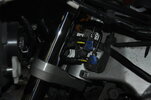
The right side of the headset:
HEADSETRIGHT.jpeg
That's marked for parts fiche line 7 and master cylinder line.

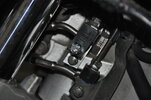
The left side of the headset:
HEADSETLEFT.jpeg
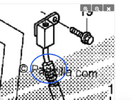
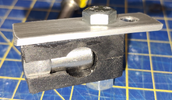
Marked for parts fiche lines 5 and 1. Note the steel tab on 5 (8 mm hex head below the 5). The HEL does not have this tab. I
fabricated a tab out of 1/8 aluminum stock.

TABMOD.jpeg
That's a 1/4-20 carriage bolt and nylon insert lock nut.

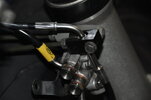
HOSESFRONT.jpeg
Marked for lines 7, 1, and 5

PIPEBOLT.jpeg
The (right fork) pipe mounting bolt was pushed to the right four or so mm so could not be inserted. I tried a different approach. With the pipe unattached to the forks I tightened the connectors. I mounted the nylon block to just the right fork by 4 or 5 threads. With the pipe pulled away from the forks I inserted the mounting bolt for the left fork. With some thumb pressure I got the left mounting bolt started about 4 or 5 turns also.
Tightening each side a few turns at a time brought the pipe evenly to the forks.


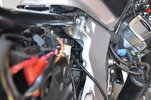
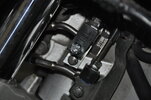
There are two pipe connections forward of the shock. Here's what it looks like up there:
SHOCKPIPES.jpegSHOCKPIPES2.jpeg
This is looking in through the battery location. Lifting the HEL connectors will expose more of the 13mm hex. The connection can then be tightened and pushed back down. The mounting nut for the HEL blocks can just be seen on the left, next to the line. The mounting bolt is welded in place.

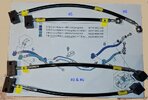
A cheat sheet for the front. The measurements in red correspond to the length of the HEL lines and help ID them.

hoses.png
 
Last edited:
The bike passed the low speed reliability test. I had already put the plastic on as I woke up early this morning (3:00) and couldn’t wait. After ten minutes freeway I pulled in for gas and noticed a half dozen flecks of brake fluid randomly scattered, tank, compartment cover etc - less than a half drop in total. I wiped them up with washer fluid and a towel and went another ten. No problem, it was just fluid in a crevice or two blowing out. Scary though. I should have washed the bike first. Lesson learned. During another half hour through some light canyon at an easy pace the brakes really performed. Very little pull brings on quick powerful braking. I wish I could say ”It’s the lines!” But I know I had air in the old lines, so.. It’s nice to be back on the road.
p.s.
The front discs were just above ambient when I got back. The rear was luke warm, it would’ve been hot before the new smc. I can spin the tire by hand for about 1 1/4 turn with a good tug (I’m 70).
p.p.s.
I’ve gone well over 100 miles now and it’s rock solid. Honestly, I’m amazed with myself.. I’ve worked on minor mods for my bikes, riding since ‘66 but this is my biggest undertaking of the unknown and I had my doubts. Sirbike‘s advice to go slow and one step at a time is dead on. If something wasn’t just right, I tore it back down and did what needed it, no matter the difficulty - and at times I really didn’t want to. It was a learning experience. Determination, patience and thought required. If you’ve got grit, you can do it. It’s not that bad.
 
Last edited:
Wow. That is really useful @billo . Its winter and nearly 10 years since I bought my current A9 in Jan 2014, brand new off the production line mid September 2013.

I keep an eye onmy brake lines but somewhere, sometime I read 5 years. I was thinking that I was pushing my luck so went hunting. Goodridge don't do a kit. Came across the HEL. name.

I've not looked for a brake line replacement thread before, but I had visions of double stacking banjo bolts eg for that line from front centre caliper to feed the SMC. I had visions of hoses leaving the banjo at a straight angle, rather than at the correct one. I was unsure about the hose guide clamps coping with the much thinner braided lines. I was unsure about the long pieces that have pipework in the middle.

So you posted this at exactly the right time for me. Thank you. Especially for the photos. It looks really neat.

Some questions if I may.

Are the nylon blocks just securing pieces ? I cant imagine that they are subject to fluid pressure ?

Are parts 3, 8 and 6 on the diagram ie the metal pipework - replaced with new lines ?

Not entirely sure how that joint on the right fork leg for the front caliper top banjo works, but I guess it must be obvious or you would have mentioned it. This would be the HEL line 7 and the metal pipe 8. I've spotted the joint in a very clear photo in your post #21 - and I think that is the original pipe#8 attached (answered my earlier question ? - but can't work out how they are linked.

The end result looks very smart and neat. Much better than I was thinking it would be for a replacement kit.

Final question. How do you judge the torque setting for those gland nut fastenings. Ive done it on existing pipework and they were fine. Tight enough, but not too tight. But it was a lucky 'educated' guesstimate'.

Many thanks again.
 
Last edited:
@jfheath
A nylon block holds the joint in place and secures it to the frame. The block is separate from the line so no pressure. All block mounting holes are tight
so plan on drilling them out a bit.
No pipes were replaced. I tightened them down pretty good with my calibrated elbow and no leaks.
Pipe 8 is screwed into a "T" on line 7. The "T" is visible in the photo where the top of the nylon block is slotted. The block can be pulled off and the joint tightened with wrenches, then attached to the fork.
I found it impossible to torque the pipes (gland nuts?) especially the ones in front of the shock. Those were not fun to tighten but manageable.
My lines were 16 years old and my concerns on longevity and new installation mirrored yours exactly. My old rubber lines were stiff and had "memory".
I'm sure you've researched and found no other reference material on HEL install as did I. Very surprised at that.
 
Last edited:
Brilliant @billo. Thank you.

I'm wondering about my next step. I cannot find a different model bike that fits both me and pillion. It is getting to 70,000 miles and usually at this stage I think - shall I replace, or find a newish low mileage version (there are some around in the 10,000 mile bracket). I think I'd keep both and start breaking one for spares. I'm heading towards 70 and I wonder how many miles we both have left in us - but if I wonder about that for too long, the answer will present itself anyway.

But if I keep this - I think that new brake lines are on the cards - I dreaded to think about it, and could find no details about what the kits included. Your post has made that a very real possibility.
I can see no sign of damage in the lines - but balloons usually look perfectly Ok until they burst. I have to assume that they are getting worn out. It would be folly to take the opposite view.

The HEL kit looks affordable, and having just replaced disc rotors. I think it may be time to give the rest of the brake system a complete overhaul.

I need a new rear wheel. Corrosion on the inside (due to using puncture proof slime) means that the rear tyre does not seal 100%. It loses a couple of pounds of pressure over a few weeks, and it has to be cleaned up and re-coated with some special sealing paint every time I have the rear tyre changed.
 
For a HEL set with 15 brake lines for the ST1300 year 08, the demand in Germany 600 euros, about 600 American dollars.
greeting holm
 
I've taken the plunge and ordered a set. They arrived today.

I'd previously prepared some diagrams and contrary to what I thought, they were relatively easy to mattch up. Of course, I have not compared them to what is on the bike yet. That would mean taking photos and typing with greasy fingers !

But once I had started trying to identify which line was which, there was really very little doubt.

The lines are terminated in one of three ways.
  • A Banjo connector
  • A screw in connector in a plastic block at right angles
  • A screw in connector in plastic block in line.
Some lines are instantly recognisable. The rest can be identified by which combination of connectors are used at the two ends.

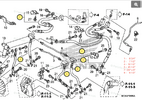
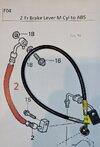
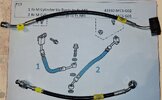
Some photos of them identified alongside diagrams. The Diagrams are labelled with the Fiche number eg F05. The parts refer to the numbered part on that fiche - they are not the same numbers that @billo used on his diagrams.

The same number may be used on different fiches. #8 for example appears on Fiche F05 and also on F15. They are different parts.

I've used a labeller and each part is labelled with fiche and number. Eg F15 #8

Just opened:


HEL Lines - New in Box.jpg


F04 - Front Master Cylinder

F04 Front Master Cylinder .jpg

F05 - Front Caliper

6 lines The numbers correspond to the number on the fiche that I used.
Part #7 and part #11 are instantly recogniseable.
Part #5 is the only one with a banjo fitting at each end.
Parts #4 and #8 have rubber protective sleeves for where they pass through clamps #8 has 2 sleeves , #4 has one.

F05 Front Calipers.jpg

F13 - Rear Master Cylinder

One hose feeding to the rear centre, one feeding to the front centre (eventually), both via pipework.

Part #1 came without a plastic block (bottom hose in the picture). Something that @billo also mentioned. This is probably because the bolt doesn't fit through the block on the original, it fits through a bracket attached to the block. I'll contact them and ask. But I am not going to replace these two lines at present - access up behind the right hand side footrest 'step' is awkward for big hands, and I don't really want to take the step off just yet. It will wait.

F13 Rear Master Cylinder.jpg

F15 - Rear Caliper

Parts #3 and #6 look identical on the diagram and out of the box. For me, these two can wait for now.
Parts #5 and #8 are different lengths - one for the centre piston, one for the outer.

F15 Rear Caliper.jpg

The pdf file containing the coloured diagrams is attached.

Thanks again @billo for posting the original. What did you do for the missing mount on for F13 part #1 ?
 

Attachments

Last edited:
Could it be that the block assembly is separated here and stays with the bike? (I'm thinking not)
NOBLOCK.png

My bike is non ABS. I was missing a tab but no blocks were missing.
 
Last edited:
I discovered four things from Hel today

1. The Part #8 on Fiche F05 - comes with a nylon block attached - but the block doesn't fit the bolt hole. It needs a piece of metal as a backing plate that can be bolted trhough the hole on the nylon block and secured (perhaps with glue as well), and another hole to bolt to the frame. They cannot provide a nylon block or the plate.

2. Hose #1 on Fiche F13 - comes without a nylon block at all. They recommend using a P clip to secure the ferrule / nut to the frame.

3. The angle of some of the banjos was odd, and the lines do not twist. But the banjo is designed to twist inside the line and the crimped ferrule. It is stiff, and requires pliers with a protective rag, but they do twist.

4. They do not have a recommended torque for the gland nuts that press against the flare of the metal pipes. 2 gland nuts that I removed slackened off at only 10Nm. - Using a torque wrench with a crowfoot spanner head. I need to work out whether or not the reading with that attached is accurate. Others took way more effort than that - but there was some white corrosion/contamination on the threads. I don't think it was thread locker, but it felt like it when unscrewing.

Honda lists 17Nm in the general info section of the manual (at the start).
 
For part #8 Fiche F05 would adding an aluminum tab work like I did in this photo -

IMG_0257.jpeg

That bolt with the nylock nut has a square shoulder. We call them carriage bolts, AI says they are also known as plow bolts or step bolts. The tab has a square hole and keeps the bolt from turning during and after installation. I drilled, then filed the hole square. I used the original bolt to attach to the frame.
It wouldn’t be a crime to use a new OEM hose for the one missing a block. It can’t be seen anyway.
I turned one or two terminations to relieve tension and no leaks. Just a little scary.
 
Last edited:
For part #8 Fiche F05 would adding an aluminum tab work like I did in this photo -
1761997419320.pngYes - that is what I was checking out yesterday before I phoned HEL, I'd found some aluminium strip exaclty the right thickness and width - sheer coincincence, good fortune - and cut and drilled it just before I phoned. The chap at HEL said - you shouldn't have to do that, we should provide it so that it fits.

Anyway we had another phone call. Apparently not. He's relatively new to the team and had assumed. As did I since their website says very clearly:

The HEL Performance Honda ST1300 Pan European ABS braided brake line kit has been manufactured in-house, assembled, and machine-crimped directly onto high-quality stainless steel braided hose ensuring an exact match to your standard brake hoses. Each HEL brake line kit arrives complete with every essential component, resulting in a smooth and straightforward installation.

They don't do that piece, so my make-shift fitting would be the next best option.

The glue is currently setting to keep the aluminium in place on the back of the nylon block. The bolt that clamps them together will be loctited and tightened before fitting. I used the same high strength flexible polymer glue that I use on the brake pad chrome retainer clips. UHU Max Repair Power. It seems to have similar properties to the recommended ThreeBond 1521. We shall see. The mounting bolt and the ground recess in the frame will hold it all firmly in position. The glue is really to make sure it doesn't shift when tightening.


A similar issue exists for the one for the rear master cylinder - Part #1 Fiche F-15. They recommend a P clip. I wouldn't recommend a P clip, and I won't be using one. The idea is to hold the nylon block absolutely stationary relative to the joining pipe. A 'P' clip would allow it to vibrate. Not good on a brake pipe joint. It'll be a while before I get round to doing that particular section of pipe. I think I might need to remove the rear suspension to get to it, and that isn't possible without taking both steps off - and it really needs an empty upper tank in order to get to the top suspension mounting bolt without dropping it and the suspension out. The rear subframe also needs supporting from the roof, or by propes from the ramp floor. I'd probably cut my losses and by the OEM pipe.

The OEM pipes are about 50% more expensive than the HEL lines - but at least they fit exactly**, they have the anchors to stop the Banjo bolts rotating when being tightened and there would be no pratting around wondering whether the hydraulic joints mate up properly or having to fabricate something that clamps the lines to the lower fork brace, or ensuring that the hose is held rather than slides. The OEM lines also have the protective sleeves. And that cost is reducing if I have to buy original lines for the two that HEL do not provide with the proper fitting. Those two lines would cost £142.72+pp from Honda - so the difference is reducing to £150.
**Im not saying that the remainder of the HEL lines will not fit exaclty. I had my doubts, but now I know that the banjo bolts can be rotated, that a good fit is looking more probable. I am not at that stage yet, but at least two of the lines do not match witht he company's claim (that it) - arrives complete with every essential component, resulting in a smooth and straightforward installation.

But OEM lines rust at the crimps on the calipers - but have lasted 73,000 miles / 12 years so far.

Lets hope that the feel at the brake lever and pedal is worth it.

Can I ask please @billo - having had your HEL lines fitted for about 2 years now - are you completely happy with the end result ?
 
Last edited:
Rock solid on mine, with a light touch and very good feedback. Not to worry.
Thank you - that answers my later edit ! I was toying with the idea of sending them back - not as advertised. But if they are worth the hassle, I'll stick with it.

I'd got worries about the mating surfaces inside the joints, but I've just been out to test old pipework against HEL lines and they mate quite nicely. And I never give a second thought about the 6Nm torque setting of the bleed nipple on the calipers. Tight enough is tight enough.
 
Last edited:
Update on my HEL lines fitting.

Unfortunately, my progress is not so good. There are 4 lines with nylon block fitting that secure to the fixed pipes - 2 on each side of the headstock.
One line on the left fitted Ok. One did not have the mounting bracket, so one had to be made. There is no room for a nut on rear of the plate, but there is room for a blot head - but I had to grind down of the the ‘flats’ of the hex head in order for it to fit. This effectively makes it a captive bolt, so tightening the nylon nut onto that was easy.

The right hand side has pipework for the abs. These are short lengths secured midway with a rubber sleeve inside a metal clamp to the frame. There is a mm or two of flex available in the pipe. @billo ’s non-abs model has a short pipe which is essentially a U shape that simply connects one hose block to the other.

The nylon block on the HEL lines have mounting holes which are centred. The original block have off centre holes. This means that when the gland connector to the brake pipework is secured finger tight, the hole in the mounting block does not align with the hole on the frame. It is about 3mm out of position. Fitting is impossible.

HEL have already told me that these are the blocks that they have, and were not able to provide the mounting hardware for the one on the left for which a backing plate had to be manufactured by me.

The only solution is to elongate the hole in the HEL mounting block. I don’t have a pillar drill, so this has to be achieved with a 6mm drill inserted in the existing hole and using sideways pressure to make the perfectly round hole into a not so perfect oval. Refit it to the bike, check the elongated hole for being able to see the threaded hole on the headstock. Mark, remove and modify. Repeat. Eventually these fitted without putting any strain on the pipework.

So now onto the front right caliper. The short line from the Delay valve to the middle piston of the right caliper. Put side by side with the original, this looks to be spot on. But the angle that the pipe leaves the banjo is slightly different, so in most combinations it is too short.
The Banjo bolt fittings on HEL lines can be rotated in their sleeves and I eventually managed to get it to fit. But it is tight and at present that appears to have an effect on how easily the caliper can move on its sliders. And in its current position, access to the bleeder valve is not possible.

There are similar issues with the line on the left side that has the double-piped banjo which connects the SMC inlet with the centre piston banjo on the caliper. As of last night, I have been unable to make this fit. It seems as though the centre banjo with two hoses attached has been fitted upside down, but that should be fixed by rotating the other fittings.

I’ll spend another hour on it this morning, because I was getting rather negative about it last night, but really, this is not looking good. I offer the original lines in the same position and it all falls into place. I’m beginning to think this was a really bad purchase, and even if I get it fitted, I’m going to be worried about the tightness of fit and the compromises, and will they still work the next time that I apply the brakes.

I suspect that by the end of the day I’ll have ordered OEM lines, and see what HEL have to say on Monday.

:frown:
 
Last edited:
Right - we have an answer.

HEL seem to have assumed that their kit for ST1300ABS was suitable for all year models. I had told them when ordering that mine is a 2009 model. I assumed that they had done the checks to make sure the lines fitted all - so I thought no more about it. I do know that the calipers, pistons, brake pads, pad springs, caliper bracket, SMC, bracket for ABS sensor, master cylinder and lever had all changed design for 2008 models. But it is difficult to tell just by looking at them. One tell-tale sign is the calipers are one piece - not two pieces bolted together. This means that when popping them out with an air gun, they can hurtle across the garage without hitting the other side of the caliper).

The upshot of this is that 3 of the brake lines that attach by Banjo bolts to the front calipers will 'link up', but to say that they 'fit' would be stretching the meaning of the word - as well as the brake hose.
And I am pretty sure that the line emerging from the banjo union is not supposed to prevent access to the bleed valve. I've never seen it written, but I just sort of assumed.

HEL brake lines are manufactured so that you can pivot the Banjo Fitting inside the hose. But that hose that goes from the left fork leg to the SMC inlet and then on to the left hand centre piston. It's coupled with an extremely short hose. Well, It looked nothing like the OEM line that I took off. The hoses were branching off at different angles for a start. I rotated each fitting by 180 degrees within its hose and tried again. That is 8 different combinations and trials. None of them worked. So that is a year number issue - nothing to do with ABS.


1762789924171.png1762789757251.pngThen there are the two blocks that attach hoses to metal brake pipes on the right hand side of the head stock.
See the 2nd closeup photo.

Those bolt heads are DELIBERATELY off centre in the OEM metal blocks.


The HEL nylon bolts have holes which are drilled centrally - which moves the nylon block to the left.
The point at which the two pipes mate in the OEM block is deeper inside the OEM block than it is in the HEL block.

This means that after joining the pipes together and fastening the gland nut finger tight, there is no hole available for the mounting bolt. The right hand edge of the hole can just be seen, but the hole needs to be about 4mm to the left.

This isn't a pre-2008 / post-2007 difference. This is an ABS/non-ABS thing.

The two Original lines involved are shown in the photos. The first shows the metal pipes connected to the ABS unit. You can just see the metal joining blocks in the top right corner. the second is a more detailed look at those two OEM blocks, metal brake lines to the ABS on the left, flexible hoses fitting emerging on the right.

Top Block: - the hose on the right is from the front right handlebar master cylinder. The pipe on the left goes to the front brake ABS channel.

Bottom Block: the pipe on the left comes from the ABS unit (providing pulsed pressure), and joins the hose down the fork leg to the front outer pistons in both front calipers.

That pipe work to/from the ABS and entering the two blocks is rigid. It is short, secured at the ABS end, and secured in the middle - you can see the clamp with its rubber sleeve. There is a small amount of flex - pulling gently away from the headstock, but no movement at all towards to the left or right. When the nylon HEL block is mated with the fixed metal pipes, it is impossible to secure the block to the headstock. The threaded hole is not in line with hole in the nylon block. M
1762790684893.pngSo why didn't @billo have this problem ?

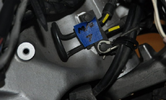
Well - I checked on his posts. He has a 2007 (probably an A6 model), non-ABS. So there is a simple linkage pipe that joins the brake lever at the top to the brake calipers at the bottom. The link pipe is not held in place by anything except the gland nut into the block. So for @billo and non ABS bikes, the problem never occurred. That is @billo 's photo with the blue sticky label.


I would have solved this by mounting a milling bit into a pillar drill and guiding the block along a pre-defined path to make a nice neat oval extending to the rear (left) of the existing hole. That is if I had such tools - which I don't. Instead, I put a 6mm HST drill bit in my hand-held drill and put it into the nylon hole with some sideways pressure so that it slowly shaved away the nylon to make a hole which can best be described as oval-ish.

This is a trial and error approach - one bit at a time. Take it back to the bike, get my massive hands into the small gap and mate the two parts together, and then with a third hand gently rotate the gland nut and hope that the threads meet up at some point before my fingers drop off with cramp.

Then check the holes. Do they line up. No they don't. Undo it all and repeat. And repeat. Eventually I can see the entire threaded hole in the headstock through the nylon oval hole with my superbright flashlight.


But anyone wanting to fit lines to any model ST1300 with ABS, will have this issue. Solvable, but not ideal.
There is also the issue of two of the blocks needing a backing plate to be manufactured. Again - solvable, but another hurdle to overcome.

Anyone wanting to use HEL lines with a model from 2008 onwards - well, they will probably have to send their original brake lines in. - but they have no solution for the mods required to the nylon blocks.


A diagram of the lines that needed attention when I tried to fit my ST1300 kit to my ST1300A9

1762792081221.pngThe front of the bike is pointing to the bottom left corner. The two white pipes are the ones that go across the mudguard.

Basically, anything coloured Red needs some attention or doesn't fit.

Right hand (Brake lever side) lines

2 Front Brake lever to (R) Headstock. Nylon block needs hole elongating.
5 Delay Valve to (R) Centre Piston. Very tight. Restricts movement of caliper in and out.
11 (R) Headstock to Front Right Centre Piston. Fits on delay valve OK. Line is tight to the caliper and may interfere with access to the bleed valve.
4 From Rear Master Cylinder to Front Right Centre Piston. This fits OK.

Left hand (Clutch lever side) lines

8
SMC Outlet to R Headstock. Nylon bracket needs to be mounted on a backing plate. Nylon block bolted to backing plate. Backing plate bolted to headstock. Simple solution, but took a while to get right. (nb One rear brake line has the same issue. I didn't try to solve this, but @billo had no problem devising a solution.
13 Front Outer calipers. I had this fitted OK, but it was tighter than I would have liked.
7 Rear Brake line (from right hand side delay valve mount) to SMC Inlet and Front Left Centre piston. This would not fit at all. No matter how I twisted the banjos round, they could not be made to fit - not even tightly. This is not surprising because it is joining one device that has changed shape (SMC) to another device that has changed size.


I am not saying that this is a bad kit to get. From what @billo says in this very detailed description, it is pretty good, and offers good performcance and feel.

HEL will make lines if you provide them with the originals. I didn't want to do that.


For Any ABS bike the two red nylon blocks will need to have their mounting holes elongated.
For any bike, part 8 nylon block will need a mounting plate to be made. (Simple rectangle with two holes).
for any bike, one of the flexible hoses to join the pipe at the front right of the swinging arm will need to be secured. HEL suggested a P Clip and didn’t provide a nylon block.

For ST1300A8 and later, Parts 5, 7, 11 and 13 will need to be built by HEL from your old lines. Whether or not the bike has ABS. The nylon blocks on these worked very well, and were perfectly adequate substities for the OEM blocks.

I talked with HEL about all of this, this morning, and they offered a full refund, which I accepted. I've already ordered some new OEM lines - just the ones on this page and two rear lines. They should be here the second week of December.

I offered to send my old lines to HEL as a pattern later in the year, if they want them. But I have an MOT at the end of November, I think I might need some brake lines on it before then, so the original ones are going back on for now.

It's fun having a motorbike, isn't it ?

Oh - the red numbers. Lines shown with red numbers on my diagram have a different OEM part number for the 2008 models and later. These all end R11 at present, as opposed to the Pre-2008 models which have G01 or G02 at the end.

 
Last edited:
They are pre-mounted on the hose. But they are smaller, tubular with a lip at each end. They slide freely up and down the lines. They will mount inside the clamps - I never found out whether they were clamped, but once the clamp is closed, they eould not escape easily. The OEM lines are not stuck on - the rubber blocks split down one side, so they are one piece and open up to wrap around the hose. But the OEM has external sleeves protecting the brake lines, which the HEL lines do not have. Those external sleeves have gaps in them for the OEM rubber mounts, so the cable cannot slide far.

I was going to wrap some rubber adhesive tape around the hose to prevent them from sliding in the clamp. I THINK that is important - if they can slide, then it is possible for the tension to change position - and that would pull on the mounts on the headstock. Thats what I thought at firts - but in fact the HEL lines are not as flexible as the OEMs so they would have difficulty moving about too much. They certainly aren't going to take a tighter line, they spring open into a gentle curve.

Yes they were preinstalled during assembly. They will not slide off the ends. If they were on the original when they created the template, then they are on the HEL line..

It was quite easy to marry up the HEL lines to the original. I thought it would be awkward. But there are banjo fittings, straight unions, angled unions in nylon blocks, straight unions, etc.

So by the time you have paired them up accoriding to the type of ends that they have, there wasn't much else to sort out.
 
Last edited:
I should add. These brake lines are excellent quality. They look smart and feel stiffer than normal lines, but they are much thinner. By holding the crimped ferrule with protected pliers, the end piece - eg the Banjo fitting - can be turned through 360 degrees to get it intot he position that you want. I really wanted to make them work. Had I had a bit more time, I'd have sent my front pieces off to have them copied. But I don't have the time for messing around like that. The week was much longer than I had wanted to spend. I just thought - while I've got the forks off ...... !

@billo's kit worked extremely well - which is what made me want a set. My old lines were looking very tired. But as I said - there were issues with my particular model. I was working a bit at a time, but it must have take all week to get the lines modified to fit, and when the front 4 lines were too tight, I gave up. Today the original went back on. It took me all afternoon, but it was like putting on a pair of comfy slippers. Everything just lined up as it should.
 
Back
Top Bottom