How do you know this, Andrew? Do you have any statistically significant information that says many people swap out their iridium plugs before they need to? Is that a majority of the folks who buy these plugs, or only a fraction of the folks? Or are you basing that statement on some anecdotal evidence that John Doe posted in a thread and echoed by Al Smith?Except that many people who buy them do not use them for any where near 5 times as long so they are not benefiting from that benefit if it exists, which was one of my points in my earlier post. I have many times read of people who install iridium spark plugs in their ST1300 because they desire what they perceive as a superior spark plug and the increased change interval that they offer. They then replace them them at 24,000 mile intervals happy that they have extended the Honda recommended change interval by 50%.

You are using an out of date browser. It may not display this or other websites correctly.
You should upgrade or use an alternative browser.
You should upgrade or use an alternative browser.
Iridium spark plugs ST1300
- Thread starter ST1
- Start date

Andrew Shadow
Site Supporter
No, I didn't do a survey on the subject. I made no mention of any percentage, or made any claim that it was most people, or that it was the majority of people, or anything of the kind. I simply stated many people. By that I mean it was more than a couple but certainly not all. I also included that came from posts that I have read on this very site- see below. I have also had this discussion with people whose vehicles I have serviced who intended to do this.How do you know this, Andrew? Do you have any statistically significant information that says many people swap out their iridium plugs before they need to? Is that a majority of the folks who buy these plugs, or only a fraction of the folks? Or are you basing that statement on some anecdotal evidence that John Doe posted in a thread and echoed by Al Smith?
I have many times read of people who install iridium spark plugs in their ST1300 because they desire what they perceive as a superior spark plug and the increased change interval that they offer. They then replace them them at 24,000 mile intervals happy that they have extended the Honda recommended change interval by 50%.
Last edited:
Andrew Shadow
Site Supporter
I do not dispute that there is benefit. My point is that there is no benefit if the change interval remains very low.the benefit exists. Iridium has much higher resistance to spark erosion than standard plugs.
If people choose not to run them for as long as is technically possible, the benefit still exists, they just chose to not take advantage of it.

Of course not, nobody would dispute that from a purely logical perspective, but it doesn't really have anything to do with the differences between plugs. I could say "all plugs are the same if you never start the engine", which is also logically true, but not very relevant.My point is that there is no benefit if the change interval remains very low.
Last edited:

ST Gui
240Robert
When I bought Ir plugs for my previous Hondas there wasn't the premium on them there is now. Or maybe I don't recall it. But they were always the last plugs I installed. They'd only be replaced if inspection showed them failing. It never did. And the electrodes cleaned up nicely at high RPM. When I need plugs for the ST I'll consider them.
I know someone who said he changes his oil at 2000mi. He was told it was unnecessary by me and someone who changes his oil at 3000mi. Whiskey Tango F. RTFM?! Apparently not. "Cheap insurance" was the reason and response. It was dino oil. SMH.
I know someone who said he changes his oil at 2000mi. He was told it was unnecessary by me and someone who changes his oil at 3000mi. Whiskey Tango F. RTFM?! Apparently not. "Cheap insurance" was the reason and response. It was dino oil. SMH.
My st13 wears plug electrictrod down at a Very slow rate (not all engines do).I say check regap maybe around 45,50 thousand miles and they last probably till 70,000 mi same way with my gl1800 -my Buell 1125 around 13,000 plugs worn down
Andrew Shadow
Site Supporter
One of the biggest differences and reasons for using iridium plugs that I most often see cited is their expected extended service life. As this claim is what I was challenging when I wrote that I don't believe that the benefit of this difference is realized if the change interval is not amended to take advantage of it, that point seems very much about the difference between plugs.Of course not, nobody would dispute that from a purely logical perspective, but it doesn't really have anything to do with the differences between plugs. I could say "all plugs are the same if you never start the engine", which is also logically true, but not very relevant.
In a scenario where the engine is never started all spark plugs are the same. They are all performing pretty much the same function to the same level of efficacy, which is nothing more than plugging a hole. I definately wouldn't spend money on iridium plugs in this scenario.


- Joined
- Sep 3, 2006
- Messages
- 422
- Age
- 70
- Location
- Richland Center, Wisconsin
- Bike
- 20 R1250RT
- 2026 Miles
- 012785
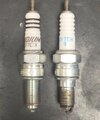
The machinist in me has to say. Unless the threaded port for the spark plug is not counterbored to accept the unthreaded portion of the plug on the right. That plug is not going to seal and also damage the lead threads when you tighten it. I will say I never looked to see if my 1300 was counterbored or not. When I did go to Iridiums, they were still to spec at 100,000 miles and put back in. So I saved money.Genuine question how would that work?
Aren’t the distances from the shoulder to the electrode the same?
ST Gui
240Robert
I'm not sure what this is supposed to say.The machinist in me has to say. Unless the threaded port for the spark plug is not counterbored to accept the unthreaded portion of the plug on the right. That plug is not going to seal and also damage the lead threads when you tighten it.
The plug with the unthreaded portion is purported to be a configuration of the factory recommended plug with the unthreaded portion claimed to be required by Honda for the ST1300. It follows that the spark plug hole is counterbored because the washer does seal and there is no damage to the threads.
The other plug shown without the unthreaded portion will work because there is no shoulder so it passes through the 1300's counterbore and seals the same as "required" plug. Another bike designed to use a "shoulderless" plug wouldn't accept the "Honda" plug since the shoulder is larger in diameter than the threaded bit.
There's still no definitive explanation as to what the shoulder accomplishes or reference to the documentation that it's required.


I found out exactly why the ST spark plugs have an unthreaded shoulder on them. This come from an engineer at NGK.
The reach is deep enough that the gradient in heat from combustion chamber to mounting surface is extreme.
The shoulder of the steel plug has less surface contact with the aluminum of the head than a fully threaded one. But, it has SOME. This manages the temperature differential and helps to keep the plug from seizing in the threads.
Installing a fully threaded plug will work-but a bunch of threads will not be engaged-thus having no heat exchange between plug body and head in that area. This will alter the effective heat range of the plug and also create an air gap under the sealing ring of the plug.
The reach is deep enough that the gradient in heat from combustion chamber to mounting surface is extreme.
The shoulder of the steel plug has less surface contact with the aluminum of the head than a fully threaded one. But, it has SOME. This manages the temperature differential and helps to keep the plug from seizing in the threads.
Installing a fully threaded plug will work-but a bunch of threads will not be engaged-thus having no heat exchange between plug body and head in that area. This will alter the effective heat range of the plug and also create an air gap under the sealing ring of the plug.
The shoulder of the steel plug has less surface contact with the aluminum of the head than a fully threaded one. But, it has SOME.
I think I get the general idea, but wanted to ask for clarification.Installing a fully threaded plug will work-but a bunch of threads will not be engaged-thus having no heat exchange between plug body and head in that area.
In the first quote I think you're implying that IF the head itself had a longer threaded area (equivalent to the fully threaded plug length) that design would be #1 in heat transfer capability, but since the head isn't threaded that way (threads are shorter than fully threaded plug threads), this is just theoretical.
Then, given the way the head is threaded, the plug with the shoulder makes a little additional head contact, (along the circumference of the shoulder taper?) which provides SOME additional heat transfer capability.
Finally, given that the fully threaded plug diameter is smaller than the head opening in the area just above the head threads (filled by the shoulder of the OEM plug), that part of the plug has no heat transfer capability at all because there's no metal-to-metal interface there.
One other question that I don't think has been answered yet, does the plug ultimately seal at the crush washer, or is the taper on the shoulder sufficient to seal everything where it contacts the head?
From what I understand the gasket does the sealing, the unthreaded shoulder does not seal anything. It sounds basically like they are balancing the heating down the length of the plug by adjusting how much heat is transferred. The plug threaded area will be hotter nearer the combustion chamber and cooler towards the gasket area of the plug.I think I get the general idea, but wanted to ask for clarification.
In the first quote I think you're implying that IF the head itself had a longer threaded area (equivalent to the fully threaded plug length) that design would be #1 in heat transfer capability, but since the head isn't threaded that way (threads are shorter than fully threaded plug threads), this is just theoretical.
Then, given the way the head is threaded, the plug with the shoulder makes a little additional head contact, (along the circumference of the shoulder taper?) which provides SOME additional heat transfer capability.
Finally, given that the fully threaded plug diameter is smaller than the head opening in the area just above the head threads (filled by the shoulder of the OEM plug), that part of the plug has no heat transfer capability at all because there's no metal-to-metal interface there.
One other question that I don't think has been answered yet, does the plug ultimately seal at the crush washer, or is the taper on the shoulder sufficient to seal everything where it contacts the head?
That's what I'd expect, otherwise they probably wouldn't bother putting the crush washer on at all.From what I understand the gasket does the sealing, the unthreaded shoulder does not seal anything.
So, does the unthreaded shoulder have any direct metal-to-metal contact with the head, or does its slightly larger diameter just put it closer to the head, but not touching it? If there's no contact, then it seems like its heat transfer capability wouldn't be all that much different than the fully threaded one. It would be slightly better, but I don't know by how much. Seems like using the full threaded one wouldn't be catastrophic, but IDK.
In the original post (30) @bdalameda said the unthreaded shoulder has some contact ('some' highlighted by you). How we interpret this word is up for grabs unless we were to get a more detailed explanation from that engineer. This explanation would have to describe manufacturing tolerances for spark plugs (the smooth shoulder diameter) as well as the diameter of the spark plug hole. Since Honda is satisfied that the heat transfer is sufficient to maintain the expected heat performance of the plug (i.e. maintain its expected heat range) whatever contact is made between the shoulder and the cylinder satisfies that criteria.That's what I'd expect, otherwise they probably wouldn't bother putting the crush washer on at all.
So, does the unthreaded shoulder have any direct metal-to-metal contact with the head, or does its slightly larger diameter just put it closer to the head, but not touching it? If there's no contact, then it seems like its heat transfer capability wouldn't be all that much different than the fully threaded one. It would be slightly better, but I don't know by how much. Seems like using the full threaded one wouldn't be catastrophic, but IDK.
yeah, I'm not seeing how the shoulder would make contact on the sides (you'd hear/feel grinding while threading in), so I thought maybe it makes contact at the base. But that would cause a "race" between the base seating into the head and the crush washer sealing above, unless they both engage at exactly the same time. Since the crush washer deforms over a small distance and the base is fixed, I don't see how that could work, so the explanation that the sealing is done by the washer alone makes the most sense. Maybe the dimensions are such that when the crush washer deforms, then the base of the unthreaded portion makes contact with the head, but that seems unlikely to require that level of precision on a plug.In the original post (30) @bdalameda said the unthreaded shoulder has some contact ('some' highlighted by you). How we interpret this word is up for grabs unless we were to get a more detailed explanation from that engineer. This explanation would have to describe manufacturing tolerances for spark plugs (the smooth shoulder diameter) as well as the diameter of the spark plug hole. Since Honda is satisfied that the heat transfer is sufficient to maintain the expected heat performance of the plug (i.e. maintain its expected heat range) whatever contact is made between the shoulder and the cylinder satisfies that criteria.
That leaves us with two plugs, neither of which has any direct metal contact in the region of interest, but one has a slightly larger O.D. That means the only difference is the air gap between the head and plug is smaller for the unthreaded plug than for the fully threaded one. That doesn't seem like that big a difference, but maybe it is.
edit: maybe much ado about nothing, here's the Iridium version that has the unthreaded portion.
Last edited:
I know I tend to overthink stuff. It is encouraging to see that others do too.edit: maybe much ado about nothing, here's the Iridium version that has the unthreaded portion.


I agree that the plug thread designs are different and the CR7EH solid shoulder below the crush seal is the ST1300 Honda designated design so Kevin the head bore MUST have a counter bore for the CR7EH-9 plug to work. I don't think there is any contact of this bored area to the plug, it's a plug designed for the heat sink abilities somehow. Mine show no signs of contact and this could be proved if anyone wants to measure the head plug hole counter-bore with a telescope gage. I'm not digging mine out.
NGK has the iridium in that CR7EH design (but in an 8 heat range) so I would think that is the correct iridium to use like the CR8EHIX-9 plug. As many have proved (Kevin) the CR7 works too even with a different thread cut design. (I'd just use an 8)
Regardless I ran "cooler" plugs being the NGK CR9EH-9 always. I have an old set right here on my desk. The 9's are a cooler plug than the 7's so 7's are supposed to burn off more carbon and not foul as quick. 9's transfer heat to the cylinder head quicker thus a cooler running plug and possibly a cooler engine but doubtful.
Per my records the regular non iridium plugs last a long time in the ST1300 so I always bought the regular (cheaper) non IR plugs.
My records show CR9EH-9's installed at:
298,325 miles
364,598 miles, 66246 miles of usage
current mileage is 432,623 so another set used up to 68,021 miles and counting...
YMMV for sure but I'd use the design with the "metal band above the threads just below the crush seal" cuz Honda ya know.
NGK has the iridium in that CR7EH design (but in an 8 heat range) so I would think that is the correct iridium to use like the CR8EHIX-9 plug. As many have proved (Kevin) the CR7 works too even with a different thread cut design. (I'd just use an 8)
Regardless I ran "cooler" plugs being the NGK CR9EH-9 always. I have an old set right here on my desk. The 9's are a cooler plug than the 7's so 7's are supposed to burn off more carbon and not foul as quick. 9's transfer heat to the cylinder head quicker thus a cooler running plug and possibly a cooler engine but doubtful.
Per my records the regular non iridium plugs last a long time in the ST1300 so I always bought the regular (cheaper) non IR plugs.
My records show CR9EH-9's installed at:
298,325 miles
364,598 miles, 66246 miles of usage
current mileage is 432,623 so another set used up to 68,021 miles and counting...
YMMV for sure but I'd use the design with the "metal band above the threads just below the crush seal" cuz Honda ya know.
Andrew Shadow
Site Supporter
No, there is no contact.So, does the unthreaded shoulder have any direct metal-to-metal contact with the head ......
I tried to find an answer to why this unthreaded section is there years ago. I only came up with two things that made sense to me based on assumptions, not from any explanation from a credible source. One is that it served as a larger heat sink to protect the internal portion of the centre electrode, the other is to provide an increased volume for the materials that are used for internally sealing the spark plug.
Given that the difference in the amount of material between a spark plug that is threaded in this area and one that isn't can't be that much as the difference is only the amount of material removed to create the threads over a fairly short length I have to wonder how much of a difference it can make in heat dissipation. Maybe it does.
There are seals made of various materials inside a spark plug to make it airtight to prevent any combustion pressure from escaping. They also serve to help insulate the section of the centre electrode that is inside the spark plug from excessive heat and thermal expansion. These gaskets are often made of various compounds that fill the void and then are baked at high temperature causing them to harden. The materials used create an airtight seal but they can also be used to help conduct heat away from the part of the centre electrode that is not exposed. I have wondered if this area is unthreaded to allow for a larger internal void to increase the volume of this sealing agent to create a more robust seal or to allow for better temperature management in that specific area, or both. At the same time I have to wonder if the difference in volume created by not cutting threads in this area is enough to make a difference. Again, maybe it does.
Modern spark plugs rely less on these internal seals for temperature control because of the newer materials being used for both the electrode and the ceramic insulator. The ST1300 is old now and this may just be a case of the design neccessities of that era based on the materials available then. Maybe the iridium spark plugs simply do not need this additional heat dissipation to protect the internals of the spark plug from heat and thermal expansion and threading them all the way allows for more flexibility as this shell can then be assembled in to more different spark plug part numbers.
I never found a good explanation of why this area is sometimes threaded and sometimes it is not. I gave up looking.
its a reaction to underthinking something in the past, then seeing something go wrong in a way that in retrospect you probably could have predicted with a bit more thought.I know I tend to overthink stuff. It is encouraging to see that others do too.
That sounds a lot like 'hindsight is 20/20.its a reaction to underthinking something in the past, then seeing something go wrong in a way that in retrospect you probably could have predicted with a bit more thought.