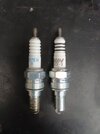
Iridium spark plugs ST1300

No, there is no contact.


Given that the difference in the amount of material between a spark plug that is threaded in this area and one that isn't can't be that much as the difference is only the amount of material removed to create the threads over a fairly short length I have to wonder how much of a difference it can make in heat dissipation. Maybe it does.


I never found a good explanation of why this area is sometimes threaded and sometimes it is not. I gave up looking.
Maybe that extra girth is just for extra material strength? I'm not sure.

I see that the correct term for the ST1300 thread style plugs are called "half threads" and the NGK link below does have them designated as an EH thread reach. EH = two thread reach lengths, 19mm overall length and 12.7mm "half thread reach".

A great site for everything sparkplugs and lots of page links to click on that might not be apparent like on the overview page click in the black box for iridium IX type plugs.

https://ngk.com.au/products/spark-plugs/
 
Last edited:
Interesting thread and OP question about this. I recently wanted to change my plugs and in Canada, the CR7EH-9 is crazy priced, or generally unavailable to me locally.

Here is some info from my "research", though I use that word lightly since it's all hearsay, rather than experience.

FWIW: Some folks say that blow-by carbon can seize the upper (non-engaged) threads in the fully threaded plugs. The half thread plugs don't "wedge" in the un-threaded portion of the spark plug like the threads can because they are smooth in the upper half. I have no direct experience with this, but my research into the IX plugs says that the above denniskirk link is the closest to the OEM design and probably the best choice if you are concerned about that. However it is one level "colder" as it is an 8 rather than a 7 heat range.

I am not confident that I buy the blow-by explanation but I think I will avoid that potential, as well as possibly inadvertently "tapping" a thread into the smooth bore of the top part of the pretty soft aluminum hole.

Too many potential (perhaps mythical) downsides to take the risk for me.
 
Here is some info from my "research", though I use that word lightly since it's all hearsay, rather than experience.

FWIW: Some folks say that blow-by carbon can seize the upper (non-engaged) threads in the fully threaded plugs. The half thread plugs don't "wedge" in the un-threaded portion of the spark plug like the threads can because they are smooth in the upper half.
I think you better rethink your thoughts.

Blow by carbon above the threads? It's an empty cavity above the head threads in the head (a counterbore probably just a straight drilled hole). Ain't nothing blowing around up in there between the threads and the plug seal ring. And my half thread plug is all shiny and new looking after 60,000 miles in the non threaded area. It would blow up there too and carbon up if it were possible.

Seize? We're talking the space above the head threads of the plug. It won't seize because it's not even used as you said, non engaged, no contact with anything to lock against. We're backing the plug out of the hole so the threads mated to the head would be the only area that could seize. Either design mates to the head threads.

I think either will work (it's been proved already) but one is closer to correct as designed.

This seems appropriate now: (that horse don't even look dead)

:beatdeadhorse:
 
I agree nothing should get by the plug seal ring. However, the plug seal ring is above both the thread and the half non-thread. I can't recall ever pulling a plug where the threads were squeaky clean. Whether that is from the heat cycles, galvanic effects, or something else, I don't know. Regardless, I wasn't espousing a position, only providing some possible downsides.
 
as well as possibly inadvertently "tapping" a thread into the smooth bore of the top part of the pretty soft aluminum hole.
That's not going to happen unless you are some heretofore unknown really shady-tree wrench. Look at the difference in diameter of the threaded portion of the plug vs the smooth portion. You'd have just as much of a chance putting the plug in sideways.

I can't recall ever pulling a plug where the threads were squeaky clean.
Same. There was always oil on the threads up to the crush washer and carbon on any part of the plug that extended indo the combustion chamber. I'd say it was a combination of capillary action and the compression. And nothing that I could attribute to a galvanic reaction.

that horse don't even look dead
No but I think he's neighing "Kill me now".
 
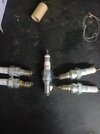
New spark plugs arrived Today, all fitted and ready for a run out tomorrow. I chose iridium CR8EHIX-9 the original plugs are the four surrounding the new one.
20260815_201439.jpg20260815_204112.jpg
 
Last edited:
Barring possible internal damage the other four plugs look to be a really good shape. I could be wrong but it looks like it's about 0430 BST [London] for you. I don't know if the UK is in one time zone like Japan. For me it's 2030 PDT/DST. So when I wake tomorrow I hope to see a ride report. :)
 
Standard or copper spark plugs start to degrade at about 10,000 miles
Iridium have more benefits than just last longer.
Iridium spark plugs offer exceptional durability, lasting up to 100,000–120,000 miles. Their ultra-fine center electrode design requires less voltage to fire, creating a concentrated, powerful spark that improves combustion efficiency, throttle response, cold starts, and overall engine smoothness compared to standard copper plugs.
 
After a 170 mile round trip to the Elan Valley, the bike performed well I was experiencing slight miss fire from start from a junction. This has all but disappeared apart from this it is hard to notice any difference.
20260816_113202.jpg20260816_115507.jpg
 
Back
Top Bottom