I have a new set of Dunlop Roadsmart 3s coming into a shop that will install them for me. How do y'all support the bike while taking your wheels off? I'd like to do brakes and tires while they're off. The center stand is great for the rear wheel but the front remains a problem, and I don't think my typical Pit Bull front stand is compatible at all with the 1100. Share your methods!

You are using an out of date browser. It may not display this or other websites correctly.
You should upgrade or use an alternative browser.
You should upgrade or use an alternative browser.
New Tires
- Thread starter ejf012
- Start date

Uncle Phil
Site Supporter


Scissors jack with a board across the oil pan.
Raise up until the rear wheel just touches the floor.
After a half million miles on ST1100s, I've done a few tire changes ...
A note on the rear -
Sometimes the spider gear gets caught in the rear chunk and puts you in a mess.
I always prop up the rear, remove the axle, remove the rear caliper and then reinsert the axle.
That way if that happens you can see it and take appropriate action rather than be left in a mess.
In theory it should not happen but in practice it can.
Raise up until the rear wheel just touches the floor.
After a half million miles on ST1100s, I've done a few tire changes ...
A note on the rear -
Sometimes the spider gear gets caught in the rear chunk and puts you in a mess.
I always prop up the rear, remove the axle, remove the rear caliper and then reinsert the axle.
That way if that happens you can see it and take appropriate action rather than be left in a mess.
In theory it should not happen but in practice it can.
Could you elaborate on that issue? I've only seen the final drive to change the gear oil, I'm not so familiar. I also think I might recall something about a special tool for the rear wheel, but I can't for the life of me remember what.Scissors jack with a board across the oil pan.
Raise up until the rear wheel just touches the floor.
After a half million miles on ST1100s, I've done a few tire changes ...
A note on the rear -
Sometimes the spider gear gets caught in the rear chunk and puts you in a mess.
I always prop up the rear, remove the axle, remove the rear caliper and then reinsert the axle.
That way if that happens you can see it and take appropriate action rather than be left in a mess.
In theory it should not happen but in practice it can.
Uncle Phil
Site Supporter
When you move the rear wheel to the left for removal with the axel out, the rear wheel drive flange sometimes hangs up in the final drive.
It pulls out or almost out of the wheel and then you can't get it back in and you can't get the wheel out.
If it happens it can take quite a bit of time and effort to get it sorted.
The rear wheel drive flange just slides into the rear wheel - it is not bolted in.
By reinserting the axle, when you slide the wheel to the left you can see if this is going to happen or not.
If it does, everything is still lined up, so you can slide the wheel back to the right.
The Honda Manual shows using the handle of the pliers in the tool kit to pry it out.
You just need a curved or bent tool to pry the flange loose.
Once it is loose, you can slide the wheel to the left, remove the axle and all is well.
Some will say that if everything is in good condition it should never happen.
Great in theory, no comfort in practice when it happens.
And obviously Honda thought it could happen or they would not mention it in their manual.
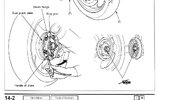
It pulls out or almost out of the wheel and then you can't get it back in and you can't get the wheel out.
If it happens it can take quite a bit of time and effort to get it sorted.
The rear wheel drive flange just slides into the rear wheel - it is not bolted in.
By reinserting the axle, when you slide the wheel to the left you can see if this is going to happen or not.
If it does, everything is still lined up, so you can slide the wheel back to the right.
The Honda Manual shows using the handle of the pliers in the tool kit to pry it out.
You just need a curved or bent tool to pry the flange loose.
Once it is loose, you can slide the wheel to the left, remove the axle and all is well.
Some will say that if everything is in good condition it should never happen.
Great in theory, no comfort in practice when it happens.
And obviously Honda thought it could happen or they would not mention it in their manual.
Excellent method - I've always been lucky, but that would ensure there would be no problem separating the wheel from the drive.I always prop up the rear, remove the axle, remove the rear caliper and then reinsert the axle.
That way if that happens you can see it and take appropriate action rather than be left in a mess.
In theory it should not happen but in practice it can.

ST1100Y
Site Supporter
... an indication of worn hub-dampers and aluminum bushings/inserts...... the rear wheel drive flange sometimes hangs up in the final drive.

Uncle Phil
Site Supporter
Yes, and sometimes you don't catch it until the flange hangs in the wheel when it's right at that point.... an indication of worn hub-dampers and aluminum bushings/inserts...
Or it just decides to come out just because it's one of those days ...

As Uncle Phil advised, scissor jack and a board under the oil pan.
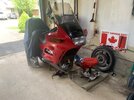
I use a piece of 2"x4", which is cut to fit between the exhaust pipes at the forward end of the oil pan, just behind the drain.
I use a piece of 2"x4", which is cut to fit between the exhaust pipes at the forward end of the oil pan, just behind the drain.
Uncle Phil
Site Supporter
I use the same method reinstalling the wheel.
Leave the caliper out, install wheel with axle in.
Slide wheel to the right into gears.
Prop the bottom of the wheel so it doesn't drop.
Remove axle, insert caliper, reinsert axle.
Someone put me onto one of these (air shim) -
https://www.amazon.com/dp/B09F34QGB6?ref=ppx_yo2ov_dt_b_fed_asin_title
It allows you to hold the tire in place, adjust it up and down, etc.
Makes the whole tire process a lot easier as I do end up doing a lot of tires.
Leave the caliper out, install wheel with axle in.
Slide wheel to the right into gears.
Prop the bottom of the wheel so it doesn't drop.
Remove axle, insert caliper, reinsert axle.
Someone put me onto one of these (air shim) -
https://www.amazon.com/dp/B09F34QGB6?ref=ppx_yo2ov_dt_b_fed_asin_title
It allows you to hold the tire in place, adjust it up and down, etc.
Makes the whole tire process a lot easier as I do end up doing a lot of tires.
Last edited:

As Uncle Phil advised, scissor jack and a board under the oil pan.
I use a piece of 2"x4", which is cut to fit between the exhaust pipes at the forward end of the oil pan, just behind the drain.
Ditto. To position the board even further forward, I made a notch in the board for the oil drain protrusion so the whole weight of the bike is supported by the three vertical sidewalls of the lower engine case. FWIW
John

Mophead
Site Supporter
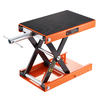
Your shop is incomplete without one of these and the air pad kit mentioned by UP.

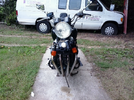
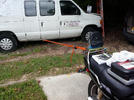
A suggestion to the absent minded: disconnect the orange strap before going on an emergency electrical service call.
A suggestion to the absent minded: disconnect the orange strap before going on an emergency electrical service call.