
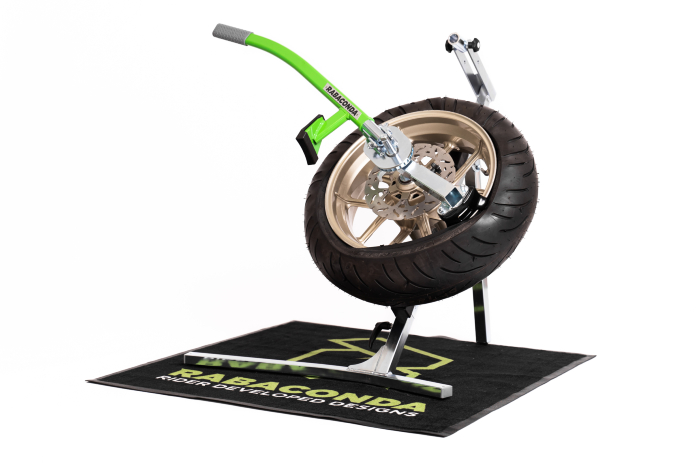
Rider RSS Rabaconda Street Tire Changer Review

Joined
Dec 1, 2004
Messages
1,622
Age
62
Bike
'21 RT / '24 GSA
2026 Miles
000088
Rabaconda Street Tire Changer
If you thing changing motorcycle tires is a hassle, the Rabaconda Street Tire Changer will make your life easier.

“Build a better mousetrap and the world will beat a path to your door,” goes the classic axiom about the power of innovation. Change “mousetrap” to “motorcycle tire changer,” and you have a fitting slogan for Rabaconda. I don’t think you’ll need to put out refreshments for the entire world if you get a Rabaconda Street Bike Tire Changer, but whether you ride a touring, cruiser, sport, or ADV bike, it makes swapping tires or properly patching a flat so easy you should be prepared to make some new friends.
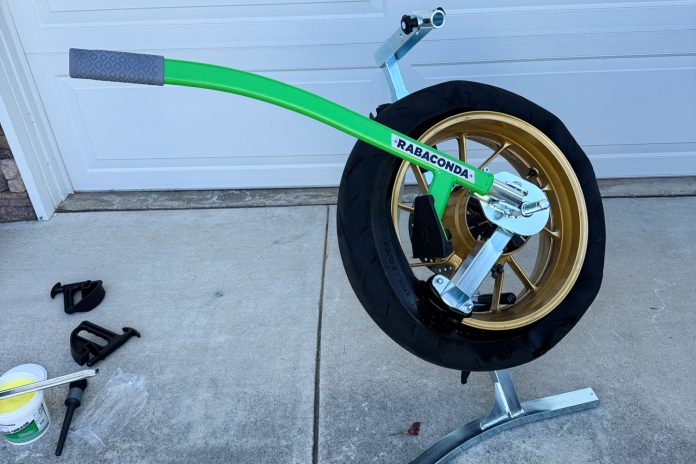
Rabaconda Street Tire Changer
Using the Rabaconda Street Tire Changer to change a Dunlop Roadsport 2 on a cast-aluminum wheel from a Suzuki GSX-8TT. (Photo by the author)

Rabaconda started out with its innovative Dirt Bike Tire Changer, which quickly became the go-to for off-road racing teams and dirt riders the world over for its effectiveness and light, compact size when broken down. Its new flagship product is the Street Bike Tire Changer reviewed here, which works best on cast, wire spoked, or forged street and ADV bike wheels that need extra rim protection, but it can also change dual-sport and dirtbike tires.
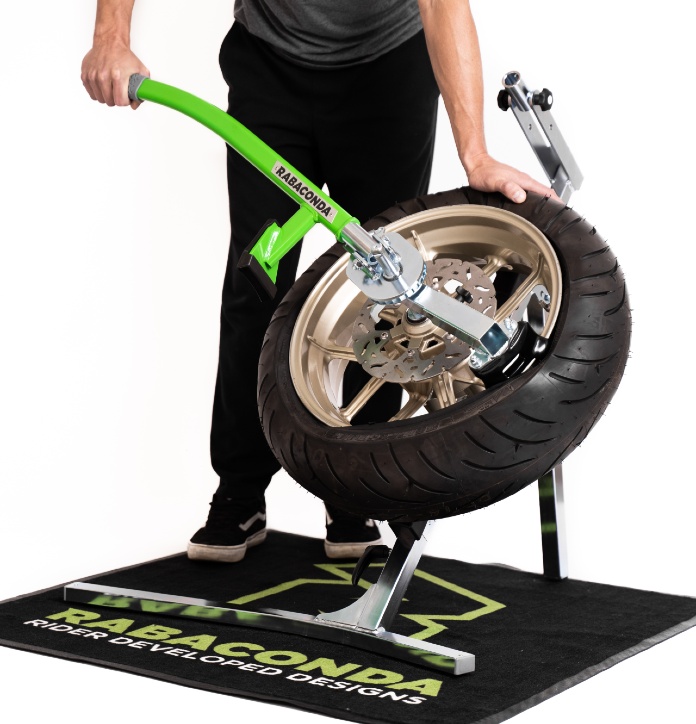
Rabaconda Street Tire Changer

The keys to the Rabaconda Street Bike Tire Changer’s effectiveness are numerous, but chief among them are its smart design features. It provides a sturdy stand for the wheel and tire well above ground level that allows you to break the bead and spin the wheel easily. Instead of struggling with tire irons that can mar rims and pinch tubes to pry the tire off, the Street changer’s non-scratch duck head ratchet system slides around the tire bead and rim like a powered pneumatic tire changer, smoothly lifting the tire off or pushing it onto the wheel. Unlike other “portable” changers that need to be mounted to a platform or trailer hitch, the Street Bike Changer stands solidly on its own and breaks down and packs into a roomy 29x11x10-inch reinforced bag, which weighs 37 lb loaded with everything. It stores readily when not in use and is easy to transport to events – or the homes of all your new friends.
Rabaconda Street Tire Changer

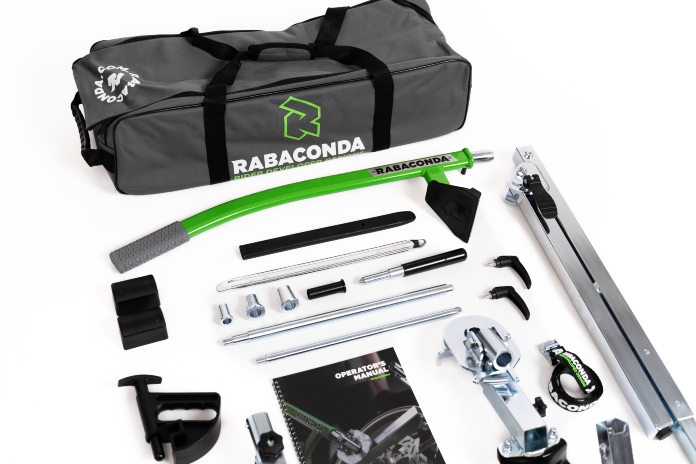
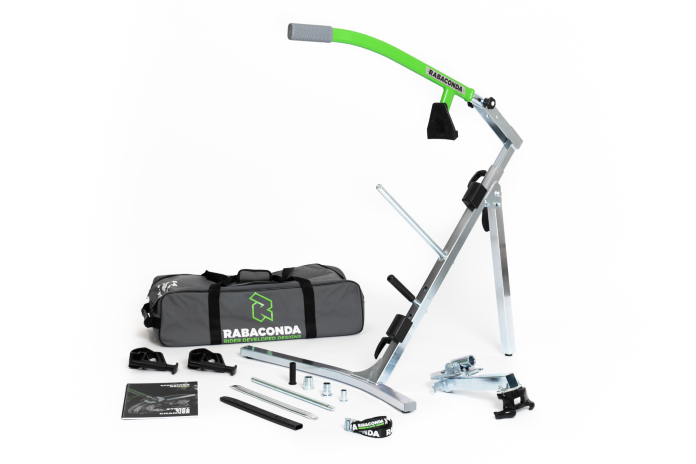
The Street changer sets up in seconds. The main components are a steel four-piece main stand assembly, bead breaker handle, and duck head ratchet system. The basic kit also includes both 15mm and 20mm steel center spindles (axles) that fit most wheels with 15-32mm hubs, a pair of drop center tools, a 16-inch tire iron with protective cover, wheel stopper post and strap, magnetic wheel supports with separate riser brackets (for wider hubs), and a nice wire-bound, full-color instruction manual.

For a few bucks more, the Ultimate kit that Rabaconda sent us adds a special duck head for cross-spoke tubeless wheels (which have spoke heads on the outside rim edge), universal big hub and BMW shaft-drive hub adapters for 33-68mm hubs, bead grease, and a brush. Everything conveniently fits in the travel bag. I highly recommend adding the grease and brush ($25), even if you don’t need the rest of the Ultimate accessories – the extra slick, non-toxic, and biodegradable bead grease makes installing a stiff tire much easier and safer.
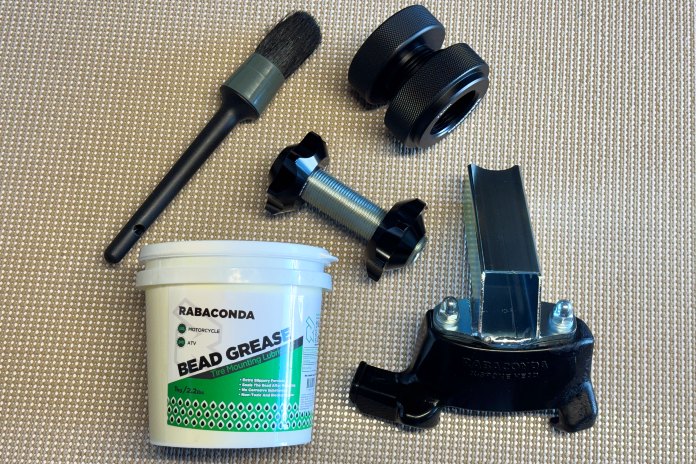
Rabaconda Street Tire Changer
The optional Ultimate kit. (Photo by the author)

The Street Bike Changer handles cast or spoked wheel sizes from 12 to 21 inches and wheels from both double- and single-sided swingarms (with an adapter). It also works with tube-type and tubeless tires (up to 250mm wide) with or without rim locks (as long as you’re not running tire balls or a mousse insert; that is the Dirt Bike Changer’s territory).

I recommend watching a Rabaconda video or two online that applies to your particular wheel/tire combo, as the dismounting/mounting process is easy but can get detailed if you have TPMS sensors, rim locks, inner tubes, etc. The first step is to clean the wheel, tire, and Rabaconda components and check that all surfaces are smooth and free of nicks or burs that can cause further damage to the wheel or tire changer.
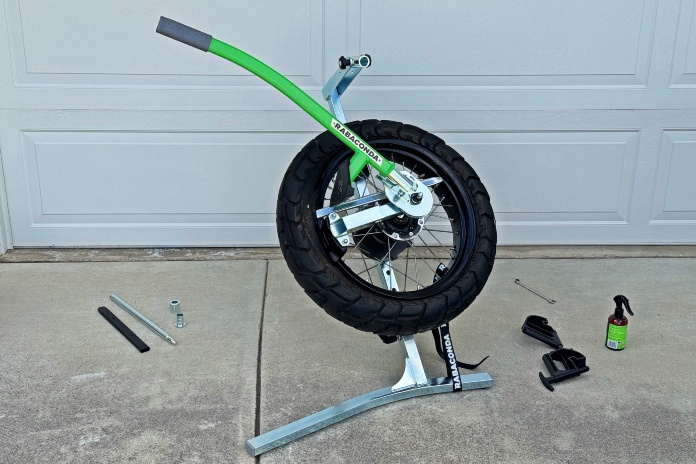
Rabaconda Street Tire Changer
Using the Rabaconda Street Tire Changer to change a Dunlop TrailMax Mission a spoked rim. (Photo by the author)

The process goes like this: You slide the wheel over the appropriate center spindle, adjust the positions of the non-marring wheel supports underneath, and slide one of the included stepped bushings over the spindle and into the wheel hub if needed to minimize free play. Brake rotors do not need to be removed. Adjust the position of the bead breaker on the tire and push down on its handle to break the bead, then flip the wheel over and do the same on the other side. Now the duck head system goes over the spindle and onto the rim, and (while pushing the tire down on the opposite side with the bead breaker) the tire bead is lifted over the duck with the single tire iron, which hooks into the ratchet. The wheel is kept from spinning with the stopper tool or strap (on spoked wheels), and the bead gets lubed up with grease or soapy water. Remove the bead breaker handle from its socket above with a simple 90-degree turn and insert it into the duck head ratchet, then begin levering the duck head around the rim. The ratchet system lets you make short swings down with the handle, raise it, and repeat, like pumping a well, so you can stand in one position behind the changer.
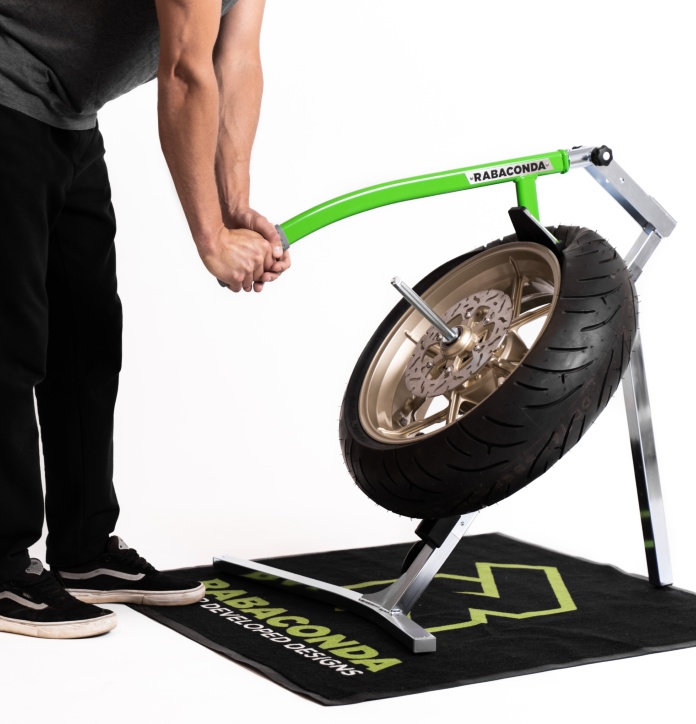
Rabaconda Street Tire Changer
Breaking the bead.

When the first bead is off, you can perform a flat repair if needed and then reverse the process to reinstall. Use bead grease on the bead and duck head when installing. Or to fully dismount the tire, poke the tire iron through to the other bead, lever it over the duck head, and ratchet away.

The usual rules apply. Warming the tire first will make it much easier. Keep the bead in the drop center of the rim opposite where you’re mounting or dismounting, with the drop center tools and/or bead breaker as needed. Use plenty of lube, and if the tire has a marked light spot on the sidewall, orient it beneath the valve stem. If the tire is directional, make sure the arrow is pointing the right way.
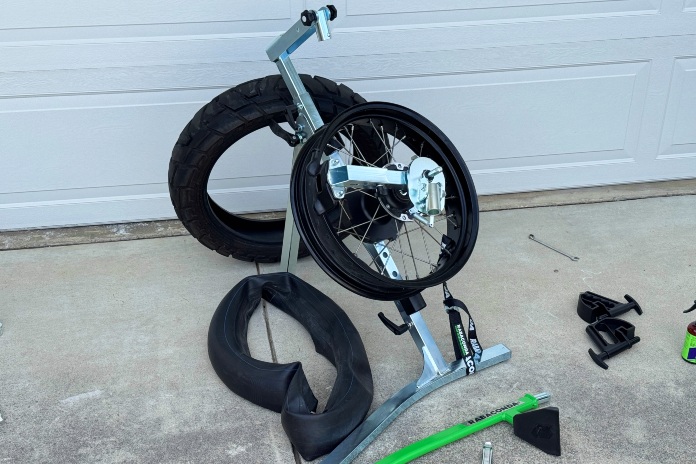
Rabaconda Street Tire Changer
A little extra care is required when using the Rabaconda Street Tire Changer on tires equipped with tubes. (Photo by the author)

I tried out the Street Bike Changer on a Dunlop Roadsport2-X 180/55-ZR17 mounted on the cast back wheel from a new Suzuki GSX-8TT. It was so easy the tubeless tire practically jumped off the rim on its own. Same with putting it back on – I almost did it again just for fun. There’s just no comparison to the sweaty agony of using tire irons, rim shields, and bead holders on the ground or a five-gallon bucket, and that’s after you break the bead somehow. Just remember to position the magnetic wheel supports so that they are only touching the wheel and not the tire, otherwise the wheel can rock on the spindle.

For a greater challenge, next I tackled the notoriously stiff Dunlop TrailMax Mission 150/70-18 tire and tube on the back of my Africa Twin. Though it certainly required more effort, it really wasn’t much different or more difficult than changing a tubeless tire. I learned to leave a little air in the tube to give it form when mounting and dismounting, or it can get caught under the duck head. After the first bead is off, remove the valve stem from its hole as usual, but with the Street Bike Tire Changer you leave the tube in the tire until it’s completely dismounted. The manual doesn’t cover how to deal with tubes, but this info is easily found online. The magnets that hold the wheel supports to the main upright are really, really strong. It’s easier to tap them up or down with a plastic mallet than to remove and reposition them by hand.
Rabaconda Street Tire Changer

In addition to the Street Bike Tire Changer, Rabaconda offers its famous Dirt Bike Tire Changer, Mini Tire Changer, and a nice wheel balancer, as well as tons of useful accessories like wheel weights, tire irons, drop center tools, and replacements for the wear items on its changers. At $739 for the base Street Bike Tire Changer kit and $868 for the Ultimate package, this Rabaconda changer sounds expensive at first. However, with the addition of free shipping in the U.S. and Canada, a lifetime warranty, and six-month money-back guarantee, considering what you have to pay at a shop or dealer for a tire change, it will pay for itself pretty quickly. Even more so if you insist that all those new friends bring some refreshments for afterwards.

For more information, visit Rabaconda’s website or its YouTube channel.

Shop for Rabaconda Street Bike Tire Changer

The post Rabaconda Street Tire Changer Review appeared first on Rider Magazine.

Continue reading...
 
Joe.
Thats a pretty impressive sales pitch for that product. You have me sold. And I figure I would make a bunch of friends in the neighbourhood pretty quickly. The unit would obviously take a couple of seasons here in the north to pay for itself. Myself in particular would have to source an adapter for balancing.
Thanks for posting this.
Dave
 
I do have one and like it but the RSS feeds are automated.
For doing a couple of tire changes a year (at most) how do you like this compared to the other sub $1000 options? I've been looking pretty hard at doing tire changes myself given the cost of them recently. Plus my dad fixes up old bikes in his free time so he'd get some use out of it as well.
 
For doing a couple of tire changes a year (at most) how do you like this compared to the other sub $1000 options? I've been looking pretty hard at doing tire changes myself given the cost of them recently. Plus my dad fixes up old bikes in his free time so he'd get some use out of it as well.
I like that it packs away in it's own duffel when not in use.

But, if I had more garage space to permanently mount it to the floor, the no-mar/cycle hill options are cheaper and just as good.
 
I like that it packs away in it's own duffel when not in use.

But, if I had more garage space to permanently mount it to the floor, the no-mar/cycle hill options are cheaper and just as good.
I remember when they first started marketing the Rabaconda one of its selling points was that it could be mounted to a wall and therefore not consume any floor space.
 
For doing a couple of tire changes a year (at most) how do you like this compared to the other sub $1000 options? I've been looking pretty hard at doing tire changes myself given the cost of them recently. Plus my dad fixes up old bikes in his free time so he'd get some use out of it as well.
I would carefully look into how many tire changes you and your dad might do a year, and then seriously consider a powered unit like @Uncle Phil has. Most of us are getting older and tire changes are not easy, especially the touring tires that bigger bikes wear. From my pov, any manual tire change is hard work and any way to ease it would be worthwhile. Were I in the market for such an item, I'd canvass friends to see if anyone wanted to go in with me on the purchase. Fifty years ago, three of us did this and bought a hydraulic jack. Thirty five years ago a friend and I bought a long heavy duty extension ladder. Cooperative buying of expensive tools makes a lot of sense.
 
I would carefully look into how many tire changes you and your dad might do a year, and then seriously consider a powered unit like @Uncle Phil has. Most of us are getting older and tire changes are not easy, especially the touring tires that bigger bikes wear. From my pov, any manual tire change is hard work and any way to ease it would be worthwhile. Were I in the market for such an item, I'd canvass friends to see if anyone wanted to go in with me on the purchase. Fifty years ago, three of us did this and bought a hydraulic jack. Thirty five years ago a friend and I bought a long heavy duty extension ladder. Cooperative buying of expensive tools makes a lot of sense.
Yeah, the manual ones are still a bit of a struggle - ignore the videos - I think they uses play-doh tires... But, they probably do tires all day long so the technique is 2nd nature for them.

The Rabaconda is nice because if you only change tires a couple times a year it stores away nicely.

I had a no-mar previously bolted to the garage floor and did several hundred tires on that but since it was next to a wall you can run out of space trying to demount/mount a tire if it starts spinning on the rim and you have to reposition or start over. The Rabaconda allows you to reset using the ratcheting mechanism but doesn't mean you won't still just start over if you don't get it right the 1st time.

The hydraulic tire machines are nice but you still need a place in your garage to house it and it's there all the time but definitely would be great to have.
 
Yeah, the manual ones are still a bit of a struggle - ignore the videos - I think they uses play-doh tires... But, they probably do tires all day long so the technique is 2nd nature for them.
I watched a No-Mar demonstration at one of the Progressive MC shows here in Clebug. I could not believe how easy it was for the guy to mount the tire. Not long before this demo, I had beeping struggled to mount my brand new Pirelli Angel GTs on my ST1300's wheels. Admittedly, I was using a piece of junk Harbor Fright tire changer (souped up with a $150 seater and yellow thing) but it was a struggle that I would pay handsomely to not experience again. Had I filmed the epic, you guys would be guffawing for half an hour. I used wood blocks, clamps, tire irons, etc., and it was a wonder that I succeeded.

I watched the demo a second time and realized the guy was using a floppy wet noodle of a tire that I could probably have mounted bare handed. I think they must have soaked the tire in a special solvent to soften it, and they probably changed the bead to a flexible spring (just joking), Seriously, no matter how good the No-Mar is, and I believe a lot of folks think they are great, mounting my Pirellis would still be work.
 
I have had a modified Harbor freight. It worked once I got the NoMar bar. I then was gifted a NoMar from @Mondo. It too worked but has a few quirks, like the wheel wanting to rotate while mounting. Wrapping a strap around an arm and spoke fixed that. Stiff tires were a chore and some Batlax needed tire irons to finish.

I now have the Rabaconda. Small foot print, steady and after your first couple of changes, easy to use and very leverage assisted mounting of stiff walled tires with little problem when using. Like all tire changers, lube is your friend. Last set was RS IV's. Known to be stiff. Used Sprayway window cleaner as my lube as suggested by @The Dan. Easiest mounting ever. Don't knock it if you have not tried it. Yes the videos might be using a tire that has been mounted and dismounted several times making it look easy, but I can say it has the leverage to make it easy.
 
I watched a No-Mar demonstration at one of the Progressive MC shows here in Clebug. I could not believe how easy it was for the guy to mount the tire. Not long before this demo, I had beeping struggled to mount my brand new Pirelli Angel GTs on my ST1300's wheels. Admittedly, I was using a piece of junk Harbor Fright tire changer (souped up with a $150 seater and yellow thing) but it was a struggle that I would pay handsomely to not experience again. Had I filmed the epic, you guys would be guffawing for half an hour. I used wood blocks, clamps, tire irons, etc., and it was a wonder that I succeeded.

I watched the demo a second time and realized the guy was using a floppy wet noodle of a tire that I could probably have mounted bare handed. I think they must have soaked the tire in a special solvent to soften it, and they probably changed the bead to a flexible spring (just joking), Seriously, no matter how good the No-Mar is, and I believe a lot of folks think they are great, mounting my Pirellis would still be work.
There is a huge difference between easy tires and hard tires. I recently mounted a Michelin Road6 practically with no tools, but blew several internal gaskets doing the same with a Bridgestone T33 (where my only tools are levers, rim protectors, sweat and bad language).
 
I have a Olmaxmotors tire changer which I can floor mount on demand (drop in anchors n the garage floor)- this issue is that you’re kneeling when doing the tire change. I’m getting older too so I don’t love tire changes- the changer works well enough but I do struggle at times. I bought a ‘Mojo Lever’ and that works even better than the duck head getting the old tire off (pretty effortless actually). It’s a bit of finesse to get the new one on, but I’ve watched my brother do it with his old Harbor Freight machine (he put Delrin on all the surfaces that contact the wheel) and he does his tire changes easily. I wish I could mount tires without a lot of swearing (and I don’t really have space for a powered machine). The issue is I like to put my wheel on the balancer without the tire, determine the heavy point then make the dot match that. A garage won’t take that level of time and likely will just put it on any old way (meaning the valve isn’t always the heavy spot on the rim)- one set of tires I did my way required only 1/4 oz to balance it.
 
There is a huge difference between easy tires and hard tires. I recently mounted a Michelin Road6 practically with no tools, but blew several internal gaskets doing the same with a Bridgestone T33 (where my only tools are levers, rim protectors, sweat and bad language).
That's the way I did mine initially. Much has to do with your technique. Keep the bead that's on the opposite side you're working on down in the center and it actually isn't "hard". Every time I began to struggle and fight with the tire, I stopped, sat back, and told myself "go back to the basics." But I eventually decided to move on.

I first bought a beadbreaker. It worked well enough, but tires were getting stiffer and I was getting ...old. :)

I have a Olmaxmotors tire changer which I can floor mount on demand (drop in anchors n the garage floor)- this issue is that you’re kneeling when doing the tire change. I’m getting older too so I don’t love tire changes- the changer works well enough but I do struggle at times.
I finally picked up a Rabaconda on sale one year. It makes changing tires incredibly easy. Because I don't do it every year, I go back to YouTube to get a refresher.

I was impressed with the Rabaconda from the beginning. When I was working my way through college, I worked a few years at a service station. I did hundreds of tire changes, so I'm pretty familiar with the "normal" tire changers. Rabaconda took a fresh look at what needed to be done and made a tire changer that makes it easy on the body.

Chris
 
That's the way I did mine initially. Much has to do with your technique. Keep the bead that's on the opposite side you're working on down in the center and it actually isn't "hard". Every time I began to struggle and fight with the tire, I stopped, sat back, and told myself "go back to the basics." But I eventually decided to move on.

I first bought a beadbreaker. It worked well enough, but tires were getting stiffer and I was getting ...old. :)


I finally picked up a Rabaconda on sale one year. It makes changing tires incredibly easy. Because I don't do it every year, I go back to YouTube to get a refresher.

I was impressed with the Rabaconda from the beginning. When I was working my way through college, I worked a few years at a service station. I did hundreds of tire changes, so I'm pretty familiar with the "normal" tire changers. Rabaconda took a fresh look at what needed to be done and made a tire changer that makes it easy on the body.

Chris
I did tyre repairs at a service station during my university years too, and also helped out in the pits at a few motorcycle production endurance races on a tyre machine. I understand the basics well, but some tyres are just harder than others. You are 100% correct that keeping the bead in the well on the far side is the key, also plenty of lube. I just find the Bridgestone's to be 10x harder than the Michelins as the latter have much more pliable cases and don't try and fight their way out of the well all the time. I bought myself a set of clamps that keep the loose bead in the well which help. Its nearly enough to make me want to spend the extra on the Michelins...
 
Michelins have the softest sidewalls, Bridgestones the stiffest in my experience. Set them out in the sun or get a tire warmer. Be sure to lube the drop center of the wheel as well as the rims. I use woodworking clamps to keep the bead down into the drop center. I have the Cycle Hill changer made by Nomar and a mojolever knockoff.

Currently considering adding an arm and duckbill.

 
I've been fortunate to have a couple of friends with a NoMar, and that can make most tire changes stupid-simple.
However, occasionally I will change tires manually just to stay familiar with the process, as I like to ride off pavement. Chances are (current flat excepted), when I have a flat tire it will be far away from a garage and tire changer, so I'll need to tough it out with what I have on the bike.
On the trails is not the best time to learn how to change a tire or repair a tube.
 
I have a Olmaxmotors tire changer which I can floor mount on demand (drop in anchors n the garage floor)- this issue is that you’re kneeling when doing the tire change. I’m getting older too so I don’t love tire changes- the changer works well enough but I do struggle at times. I bought a ‘Mojo Lever’ and that works even better than the duck head getting the old tire off (pretty effortless actually). It’s a bit of finesse to get the new one on, but I’ve watched my brother do it with his old Harbor Freight machine (he put Delrin on all the surfaces that contact the wheel) and he does his tire changes easily. I wish I could mount tires without a lot of swearing (and I don’t really have space for a powered machine). The issue is I like to put my wheel on the balancer without the tire, determine the heavy point then make the dot match that. A garage won’t take that level of time and likely will just put it on any old way (meaning the valve isn’t always the heavy spot on the rim)- one set of tires I did my way required only 1/4 oz to balance it.

I’ve got the Olmaxmotors changer as well. I have mounted mine on a fairly low bench (steel desk actually) so it stays put when in use. I find it a breeze, and do use the duck head which came with it.

I think the biggest solution for floor mounted changers is making sure they stay put without requiring you to put your body weight on it while you are trying to move the changer arm in a circle around it.

Before getting it I would only buy Michelin’s because as others have said, they are so soft and easy to mount by hand. Now that is not a consideration.
 
Back
Top Bottom