Sanity Check

Joined
Jan 14, 2026
Messages
25
Age
26
Location
Central NJ
Bike
93 Pan
Hey everyone,

I have a couple thousand mile trip that I leave for tomorrow morning (!) down the East Coast and had two questions from my hourish ride today that I just want a sanity check on.

A) How hot is normal for ST's? I've had a slew of cooling problems, which I have resolved, for the record; now, when I ride, my temp gauge never gets above halfway. It's almost always sitting around 1/3. However, this is still hot enough that I can feel heat from the engine on me, especially on my knees. I get pushed forward by the sitting position on my Sargent seat which pushes my knees against the pocket plastics, which I notice get observably warm after the bike warms up. Have y'all experienced this? My rubber heat shield thing on top of the block is also significantly torn, so that may be letting through more heat than is ideal.

B) What is y'all's clutch behavior like? I know it's pretty normal for ST's to disengage the clutch around the furthest 1/4 of the lever action. Mine, however, is more like the furthest 1/10: I barely have to pull it in to get in the friction zone, which leads to my clutch hand starting to hurt after a half hour or hour of slower moving. I'd love if I could adjust it in a little bit but that may not be possible.
 
Normal on a ST1100 is about 1/4 from the left.
But as long as it is not getting all the way to the right, you should be okay.
As it approaches the right limit, your fan should be kicking in.
The ST1100 will get warm but not as hot as a ST1300! ;)

The ST1100 clutch is usually pretty close to an off/on switch.
Where it engages/disengages can be affected by the bushing in the lever and the condition of the clutch slave cylinder.
You can also look at aftermarket adjustable clutch levers - IIRC there was one from a early year VFR that worked.
 
It is kicking on (that has historically been an issue!). The fan switch is changed out for one that shorts at 85C, just touchy about actually feeling engine heat. Thanks for always responding to my threads Uncle Phil ;)
Normal on a ST1100 is about 1/4 from the left.
But as long as it is not getting all the way to the right, you should be okay.
As it approaches the right limit, your fan should be kicking in.
The ST1100 will get warm but not as hot as a ST1300! ;)

The ST1100 clutch is usually pretty close to an off/on switch.
Where it engages/disengages can be affected by the bushing in the lever and the condition of the clutch slave cylinder.
You can also look at aftermarket adjustable clutch levers - IIRC there was one from a early year VFR that worked.
 
I’m not clear from your description what is happening: "I barely have to pull it in to get in the friction zone".

Nevermind - let me explain :

When the lever is out, the clutch is allowing the engine to drive the rear wheels. The clutch friction plates are firmly together.
When you pull the lever in to the bar, the clutch friction plates are separated, there is no connection between engine and rear wheels. The bike should not creep forward.

There should be a little ‘play’ in the clutch lever - ie free movement before it starts to feel resistance as it disengages the clutch friction plates. Not much, but some.

After that as you squeeze the clutch lever towards the bar the plates begin to separate and the drive to the rear wheel can be controlled so that the bike will move forward, but not as fast as it could do when the clutch is fully engaged - ie when the lever is fully out / released. That 'in between position' gives you clutch slip - the sort of thing that you might do if you are wanting to hold the bike from slipping backward on a hill and you don’t want to touch the brake. (Not a good idea, it wears out the friction plates). And you also use it every time you set off so that you feed the power from the engine to the back wheels gradually.

If the clutch is disengaging at the very first part of the movement, or there is no free play at the lever, then suspect that the brass bush in the lever is fitted incorrectly. It has a hole in one side and the plunger of the master cylinder piston should fit inside that hole, not pushing on the side of the cylinder. If that is the case then you may end up with clutch slip or no drive at all as the engine gets hotter.

If the clutch lever pulls nearly all the way back to the bar before the engine disengages, or you find gear changes difficult when setting off or changing down, or the bike is wanting to creep forward when the bike is in gear and the clutch lever is pulled in, then the clutch lever isn’t separating the friction plates fully. This might be an issue with: the clutch itself; or the seals in the clutch slave cylinder (front of crankcase); or with the clutch master cylinder (handlebar lever/reservoir). But the cheaper answer is that there is air in the hydraulic lines.

Get rid of air by bleedingit is important to pump, pump, pump the clutch lever a few times to build up pressure and hold the lever in on the last pump. Undo the bleed valve slightly and let the fluid/air out until just before it stops flowing, and tighten the valve again. Release the clutch lever, wait for a fraction to let the fluid recuperate, and then repeat. This technique keeps the clutch slave cylinder piston pushed in, and it is the the slave piston that pushes the fluid out when you slacken the bleed valve. Otherwise air gets trapped around the slave.

But you’ll be enjoying your 2000 mile trip now, hopefully on the bike and not in a recovery vehicle !
 
Last edited:
If the clutch is disengaging at the very first part of the movement, or there is no free play at the lever, then suspect that the brass bush in the lever is fitted incorrectly. It has a hole in one side and the plunger of the master cylinder piston should fit inside that hole, not pushing on the side of the cylinder. If that is the case then you may end up with clutch slip or no drive at all as the engine gets hotter.

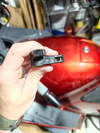
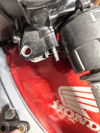
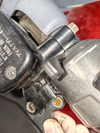
Ok I just finally got around to checking on this - my trip did go fine, no issues with the bike. Never even broke out the toolbag. I just went through and looked at the bushing, because the former is the case (quoted), the lever action is right at the start of the movement. However, the bushing seems fitted fine- it's in the right orientation, spins to match the plunger when I move the lever around, etc. Squeaky after reinstalling though. Any other ideas I could give a try?
1785377325757.png1785377332123.png1785377337656.png
 
Since its a '93, possible that the friction plates are on their last legs...
Any service history?
Unfortunately, not in the only service log I have from the previous owner (2018!), and I definitely haven't touched it yet. Not the answer one wants to hear! 😬 I wonder, though, wouldn't worn plates imply the opposite symptom? Being difficult to pull the plates apart with the lever?
 
To ensure we talk about the same thing here:

Worn plates: the clutch engages on the very last bit of movement when releasing the lever...
Good plates: the clutch engages in the upper middle 1/3rd of movement when releasing the lever...
Yep, my issue is the clutch engages in the first like 1/4 to 1/6 of the movement. Right at the start. This might be a nonissue it's just quite different from what I've felt on other bikes and wears on my clutch hand a little during traffic
 
Engaging early/close to the handlebar would indicate an issue with the hydraulics (MC and/or SC), as well as possible mechanical issues like worn clutch lever, brass bushing and push-rod...
No, I thought we just clarified this. It engages far from the handlebar, at the very start of the lever movement. Early, I'd call close to the handlebar late
 
Back
Top Bottom