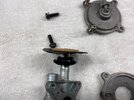
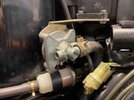
Article [11] ST1100 - How to do an emergency bypass of the fuel valve

I suspect a slight hole in the diaphragm on the fuel shut off valve of Matron. Or maybe in the diaphragms in the carbs. This is a really useful roadside fix that I'll use as a quick check for the shut off valve. The symptoms I get are limited performance, and fuel smell after shut down. At 70-80mph she just becomes gutless and has nothing left to give/struggles to maintain speed on inclines. Don't really have the space to go into the carbs (for me this would be a multi day job as I steadily work my way though), so fingers crossed this is the culprit. If it is, I expect I'll rebuild/replace the valve.
just to add a little info to what the others have already said about this not likely being the cause of your problem. When I removed mine and took it apart to see what had happened there was a thin tear in the diaphragm probably about 20-30mm long. I bet I rode it for a few years before it fouled the plug enough to matter, the fuel smell after shutoff had been around for a long time with no other symptoms, the bike performed perfectly normally up until the plug fouled. It eventually led to slightly decreased fuel economy, which is what caused me to investigate further when I noticed the fouled plug.
 
just to add a little info to what the others have already said about this not likely being the cause of your problem. When I removed mine and took it apart to see what had happened there was a thin tear in the diaphragm probably about 20-30mm long. I bet I rode it for a few years before it fouled the plug enough to matter, the fuel smell after shutoff had been around for a long time with no other symptoms, the bike performed perfectly normally up until the plug fouled. It eventually led to slightly decreased fuel economy, which is what caused me to investigate further when I noticed the fouled plug.
Long(ish) story short; the issue was that the fuel filter had probably never been replaced. She's a lot happier with a flushed filter (new one on way). The fuel shut off valve is in working order, though I found the little one way valve in the side casing was a little bit sticky. It will stay off until new lines arrive (I'm not the first to remove it and the refit by the last person wasn't ideal). I found that the sub filter was disintegrated, I'll be looking for threads with experiences and opinions regarding this.
 
Man, I do a lot of long distance riding where I'm miles from home. I REALLY appreciate topics like this that give me a heads up to potential problems and how to fix them. This will be the first mod I make and will remove mine as soon as I take the bike out of cold storage. One less thing to go wrong...go wrong...go wrong.
 
Mega thx Michael for sharing that bypass procedure; outstanding pics!....I'm paying the price for not already knowing this before mine failed 37 mi so of KC,MO last week. If I had known this, I would have likely made it to Denver as planned. I also lacked the hex key needed to remove the tank cover when it failed, so I was stuck(5 hours, 95 degree heat, waiting on AAA tow to arrive). I have already ordered replacement petcock, but can see here I'm better off to just by-pass the thing completely...thinking I'll install the a 2nd filter in it's place and just plug that vacuum line....this forum is priceless!
 
A few rides ago, I noticed my gas mileage seemed to be dropping. Normally I've always gotten close to 50 mpg. Last week I barely got 170 miles out of a tank of gas, instead of the 300 that I'd been getting. So I removed the vacuum fuel valve then took a 235 mile ride from Vernal over Wolf Creek pass towards Kamas and back. When I got home, I filled it up again. Took 4.3 gallons to do the 235 mile round trip. 54.6 miles per gallon.
 

Attachments

  • 0622221252b.jpg
    0622221252b.jpg
    256.1 KB · Views: 5
greetings all, wanted to add my valve removal story to this thread. it was indeed easy to bypass the valve, and the st started right up,
but now i have a new fuel leak(?) under bowl of carb that has that odd idle adjustment cable connected to it.....i may have caused the leak pulling on hoses bypassing the valve...i had to replace existing hose with slightly longer hose to reach between fuel filter and pump outlet...I'm wondering if maybe just a choke overload issue and not a real leak, fuel getting into vacuum lines like others have seen....
plan to do a little digging in the manuals and take another swing at it tomorrow. I did seal off that small vacuum hose per the procedure to replace valve, but got a lot of other vacuum lines disconnected after removing the airfilter/housing to locate that leak(overflow?)......no way i'm putting that weird petcock thing back on....i did rebuild it, I got about 1000 miles out of rebuild....maybe ethanol not so good for seals in petcock, who knows, but the design is flawed and the bike runs better w/o it, so it's in the can already.

happy trails!
 
Great informative thread even though the links have been deleted. We are approaching 2026 with rapid steps, is there really no negative experiences by Bypassing Vacuum Fuel Valve so you recommend «to do» ?
 
Great informative thread even though the links have been deleted. We are approaching 2026 with rapid steps, is there really no negative experiences by Bypassing Vacuum Fuel Valve so you recommend «to do» ?
I have replaced two split diaphragms in my vacuum valve. If I wasn't so intent on keeping my bike stock as possible, I would remove it. At that point it would be no different than most carbureted bike engines of the time.
 
I have replaced two split diaphragms in my vacuum valve. If I wasn't so intent on keeping my bike stock as possible, I would remove it. At that point it would be no different than most carbureted bike engines of the time.
Thanks for the info, I'm like you there... everything on my bike is like when it was new "original" except for the heated handlebars.
 
... is there really no negative experiences by Bypassing Vacuum Fuel Valve so you recommend «to do» ?
Well, Honda put it there for a reason... (even bikes with tank over engine and manual fuel petcock feature an additional vacuum operated valve...)
With a full tank + heat from engine/sunlight, expanding vapor could force fuel through; add a leaking float needle or fuel line to the scenario and you've a flooded cylinder/pool of combustible liquid under the bike...
I for one wouldn't like to have pure gasoline seeping into a cylinder and through the rings, diluting the engine oil, etc...

Testing the auto valve annually and replacing the diaphragm if required isn't that hard... the added safety outweighs the efforts by far...

 
Well, Honda put it there for a reason... (even bikes with tank over engine and manual fuel petcock feature an additional vacuum operated valve...)
With a full tank + heat from engine/sunlight, expanding vapor could force fuel through; add a leaking float needle or fuel line to the scenario and you've a flooded cylinder/pool of combustible liquid under the bike...
I for one wouldn't like to have pure gasoline seeping into a cylinder and through the rings, diluting the engine oil, etc...

Testing the auto valve annually and replacing the diaphragm if required isn't that hard... the added safety outweighs the efforts by far...
Sensible and logical thinking, thanks :thumb: I read somewhere here on the forum where someone dismantled the fuel tap for inspection and lubrication (lubricated with what?) but maybe it's just as easy to replace the membrane right away …
 
I read somewhere here on the forum where someone dismantled the fuel tap for inspection and lubrication (lubricated with what?) but maybe it's just as easy to replace the membrane right away …
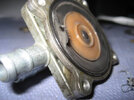
I diagnosed the one shown here on my '94 ST1100 before it even had any impact on engine performance under max throttle (but it certainly had an impact on carb syncing...)

Img_1789 6x45.jpg

Annual test is simple:
remove carb sided vacuum hose with a piece of from the shelf, place other end between your lips, draw vacuum and plug hose with the tip of your tongue...
If it holds -> diaphragm OK, if not -> replace with repair kit.

Like with O-Rings I apply a slight smear of silicone grease on the rims of the new diaphragms to ease sealing...
 
Last edited:
Hmmm...have noticed a strong fuel smell lately in the garage after shutdown of my '01. I think I know what my next bypass mod is going to be! I'll replace the fuel filter at the same time because why not. I appreciate the bump ST1100Y to bring this back in view.
 
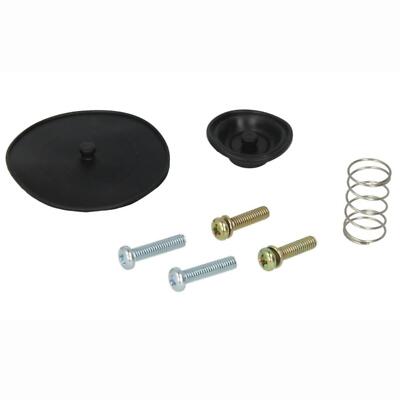
Which repair kit is recommended for the vacuum fuel tap for the ST1100 …
You don't need the fully assembly... way too expensive...
The cheapest one I came up with:


You can as well search for "GL1500 fuel petcock repair kit" as they're identical...
 
Well, Honda put it there for a reason... (even bikes with tank over engine and manual fuel petcock feature an additional vacuum operated valve...)
With a full tank + heat from engine/sunlight, expanding vapor could force fuel through; add a leaking float needle or fuel line to the scenario and you've a flooded cylinder/pool of combustible liquid under the bike...
I for one wouldn't like to have pure gasoline seeping into a cylinder and through the rings, diluting the engine oil, etc...

Testing the auto valve annually and replacing the diaphragm if required isn't that hard... the added safety outweighs the efforts by far...
Correct. Automatic (usually vacuum operated) fuel shut-off valves were added when sealed fuel systems were introduced to meet emissions standards that required that the fuel vapours produced by the fuel tank and carburetors be captured and stored. Because the fuel system was no longer open to the atmosphere the pressure in the system could increase due to environmental factors enough to cause fuel to be forced past the carburetor needle valve allowing liquid fuel to be released. The automatic fuel cut-off valve is intended to keep the fuel system sealed while at the same time preventing this.

Many people remove or bypass the vacuum valve and never have a problem so this is seemingly a low risk modification on the ST1100. At the same time, escaping raw fuel has happened in cases where the valve was present but defective so it is reasonable to assume that this possibility is also present if the valve has been removed or bypassed.
 
Good thread, I choose to be ahead of the curve :thumb:

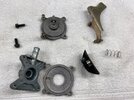
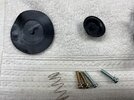
The vacuum-controlled fuel tap on the Honda ST1100 can, when the rubber membranes start to get old, stop working while driving. Should this happen, it is possible to "by-pass" the tap temporarily to get on. However, to gain access, the seat and some fairing covers must be dismantled.

Therefore, it may be wise to be ahead of the curve and replace the old rubber membranes before problems arise. Once the fairing parts are dismantled, it is not a big job, provides increased operational reliability and safer driving.

IMG_0897.jpeg

IMG_0900.jpeg

IMG_0901.jpeg

IMG_0902.jpeg
 
Hmmm...have noticed a strong fuel smell lately in the garage after shutdown of my '01. I think I know what my next bypass mod is going to be! I'll replace the fuel filter at the same time because why not. I appreciate the bump ST1100Y to bring this back in view.
On hot days & long rides after sitting for a bit the gas tank purges excess pressure. The noise has been described as a buzz and there will be a slight smell of gas, completely normal. The fuel cut valve will not do that. Fuel cut valve leaks, depending how bad the leak is, can cause hard starts because it's flooded, poor gas mileage and stalls.
 
Correct. Automatic (usually vacuum operated) fuel shut-off valves were added when sealed fuel systems were introduced to meet emissions standards that required that the fuel vapours produced by the fuel tank and carburetors be captured and stored. Because the fuel system was no longer open to the atmosphere the pressure in the system could increase due to environmental factors enough to cause fuel to be forced past the carburetor needle valve allowing liquid fuel to be released. The automatic fuel cut-off valve is intended to keep the fuel system sealed while at the same time preventing this.

Many people remove or bypass the vacuum valve and never have a problem so this is seemingly a low risk modification on the ST1100. At the same time, escaping raw fuel has happened in cases where the valve was present but defective so it is reasonable to assume that this possibility is also present if the valve has been removed or bypassed.
If a carbureted bike with a manual shut valve in the on position tips over fuel will leak till the tank reaches a certain level or the bike is upright again. A vacuum shut valve prevents the fuel from the tank from leaking out in a tip over or a crash situation.


  • Fire Hazard Prevention:
    In the event of a crash or tipped vehicle, a vacuum petcock ensures that fuel does not continue to leak out, reducing the risk of fire.
 
Back
Top Bottom