Article [13] ST1300 - Brake Bleed Procedure [VIDEO]

  • Thread starter Thread starter Mayhemmarty
  • Start date Start date
With my aging eyes, I can't tell what number on the wheel your at etc.
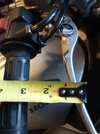
But with the wheel set to position #1, you should only get 3/4 of an inch movement before the lever is solid and unable to be pulled in further.
I just measured mine, and another bike I just flushed the brakes on, and using your measurement method (mid-lever to the edge of the grip) I'm getting 2 3/4 inches instead of 2.
Of course your lever could be adjusted differently, or your pads could be worn down etc.
Aahhhhhhh good point - my lever is on 5 ( closest set in) here is another with it set on ,1,.
 

Attachments

  • IMG_20220416_173143971.jpg
    IMG_20220416_173143971.jpg
    82.7 KB · Views: 31
It’s safer to keep the lever out away from the grip on the first position because it allows you more control, and you won’t trap your fingers on the throttle in a panic stop etc.
Your lever looks good.
 
Last edited:
Thanks for posting this. Great stuff.


With the the PCV bleed valve open, the SMC can be pumped easily - a bit like a handlebar lever - squeezing it with my fingers around the forks and the SMC in the crook between my thumb and forefinger. It's important to do this to ensure that all of the old fluid in the SMC is sluiced out through the lines.


I think you may be confusing the Proportioning Control Valve with the delay valve ???

The PCV is a unit that sits in the rear brake line between the SMC and the rear caliper outer pistons. Its purpose is to limit the amount of pressure that can be applied to the rear brake by the SMC. Physically it is mounted just forward of the PCV bleed valve. It contains a spool / small hydraulic piston which (like a caliper piston) is affected by the pressure of the fluid. However, it is held in place by a strong spring. Under normal braking, the pressure that is applied by the SMC rocking forward is applied to the rear outer pistons, and the spring in the PCV is strong enough to keep the spool / piston in place. But there is a danger that under heavy braking at the front, too much pressure is applied by the SMC and that the rear brake will lock up - especially as the rear will get lighter. So what happens instead is that the extra pressure overcomes the strength of the strong spring. The spool/piston yields, creating space in the PCV unit which releases the pressure of the fluid to the rear outer pistons. This system is there whether or not the bike has ABS fitted.

(When the bike is stationery / in the garage, the SMC would not normally operate as the front wheel isn't moving. But the rear pedal has a line to the SMC, and the pressure passes through the SMC from behind the primary seal and on to the rear caliper outer pistons - so in these circumstances the PCV spool may felt to operate as the pedal pressure increases. It would be hard to distinguish it from the action taking place in the delay valve though.)

The Delay Valve:

The rear pedal operates the rear centre piston and the two front centre pistons. The delay valve is a device which controls the amount of pressure that is applied to the front right caliper centre piston. When the rear pedal is first applied, only the front left centre piston and the rear centre piston are activated. The front right centre piston will move only when the pressure on the brake pedal is increased. You will probably be able to feel this additional dip in the pedal if you increase the pedal pressure gradually.

This behaviour is to help prevent the dip in the forks when using the brake pedal to steady the bike in slow manoeuvres.

Wow! great explanation!
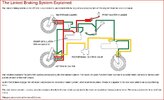
I'm sure you're the one to posit this question to: I couldn't find an earlier post the stated the front and rear brake hydraulic circuits are separate. If this is the case, are there 2 circuits going through the ABS unit?
and Yes, i'm being lazy and asking you instead of trying to sort through the manual... :giggle:
 
Hydraulically separated but they operate as one system as they are mechanically linked.
There are two separate ABS circuits with two individual ABS modulators, one for the hand operated hydraulic system and one for the foot operated hydraulic system.

ST1300 Linked Brakes_ABS.jpg
 
Hydraulically separated but they operate as one system as they are mechanically linked.
There are two separate ABS circuits with two individual ABS modulators, one for the hand operated hydraulic system and one for the foot operated hydraulic system.

ST1300 Linked Brakes_ABS.jpg
Wow! You guys are amazing!
 
Late replying, but I will anyway….

Yes - the front brake system is completely separate from the rear brake system.

Let me qualify that …..

The front brake lever operates the 2 outer pistons of each of the front calipers. Once steps 1 and 2 of the bleeding process have been completed there is no need to do those steps again. Move on to steps 3,4,5,6 and 7 and repeat those.

But the rear brake pedal does operate the centre piston in both front calipers using fluid from the rear master cylinder reservoirs.
And of course, applying the front brakes causes the rear brakes to be applied due to the movement of the SMC on the front left caliper bracket - but there is no hydraulic link between the two.

You may occasionally feel a dip in the front brakes causes lever when applying the rear brake pedal. Or fell a dip in the pedal when applying the front brakes.

This is not due to hydraulics. Eg gently applying the rear brakes will move the front pads to the disc using the centre piston. Applying the front brakes harder will move the front pads towards the disc even more - greater force and two pistons. The emphasis on the pressure on the outer pistons relieves the load applied to the centre piston (ie the pads are moved (minutely) away from the centre piston and this can be felt sometimes as a dip in the brake pedal.
 
Back
Top Bottom