Thanks for posting this. Great stuff.
With the the PCV bleed valve open, the SMC can be pumped easily - a bit like a handlebar lever - squeezing it with my fingers around the forks and the SMC in the crook between my thumb and forefinger. It's important to do this to ensure that all of the old fluid in the SMC is sluiced out through the lines.
I think you may be confusing the Proportioning Control Valve with the delay valve ???
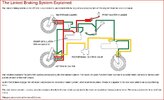
The PCV is a unit that sits in the rear brake line between the SMC and the rear caliper outer pistons. Its purpose is to limit the amount of pressure that can be applied to the rear brake by the SMC. Physically it is mounted just forward of the PCV bleed valve. It contains a spool / small hydraulic piston which (like a caliper piston) is affected by the pressure of the fluid. However, it is held in place by a strong spring. Under normal braking, the pressure that is applied by the SMC rocking forward is applied to the rear outer pistons, and the spring in the PCV is strong enough to keep the spool / piston in place. But there is a danger that under heavy braking at the front, too much pressure is applied by the SMC and that the rear brake will lock up - especially as the rear will get lighter. So what happens instead is that the extra pressure overcomes the strength of the strong spring. The spool/piston yields, creating space in the PCV unit which releases the pressure of the fluid to the rear outer pistons. This system is there whether or not the bike has ABS fitted.
(When the bike is stationery / in the garage, the SMC would not normally operate as the front wheel isn't moving. But the rear pedal has a line to the SMC, and the pressure passes through the SMC from behind the primary seal and on to the rear caliper outer pistons - so in these circumstances the PCV spool may felt to operate as the pedal pressure increases. It would be hard to distinguish it from the action taking place in the delay valve though.)
The Delay Valve:
The rear pedal operates the rear centre piston and the two front centre pistons. The delay valve is a device which controls the amount of pressure that is applied to the front right caliper centre piston. When the rear pedal is first applied, only the front left centre piston and the rear centre piston are activated. The front right centre piston will move only when the pressure on the brake pedal is increased. You will probably be able to feel this additional dip in the pedal if you increase the pedal pressure gradually.
This behaviour is to help prevent the dip in the forks when using the brake pedal to steady the bike in slow manoeuvres.