Starter Valves Sync, Valve Clearances and Fuel Economy

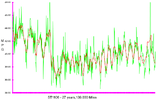
Reading through this I have a few bits to add. I currently ride a ST1300, and still have (currently broken) my ST1100. I put 140,000 miles on my ST1100. Over 520 times I've filled the tank, recorded almost all of them (a few mistakes). 3320 Gallons and average 41.54 MPG. A lot of commuting miles, with a shorter commute the mileage isn't as good. High 30's, on Trips low 40's. But I live in California and we have summer and winter fuel. You can clearly see it on the attached graph, up and down each year. Also about 25% through the graph my commute changed from mostly two freeways to an expressway with 30 stop lights.

I got my ST1300 (used with 18K miles) in 2017. I was disappointed with the mileage immediately. As well as the size of the tank.

Various articles I read implied it was larger than the ST1100, and 7.7 gallons. I have run out of fuel 5 times (once or twice a deliberate test, twice actually managed to coast into a gas station, once I had to cal my wife...) I never ran on (by accident) on the ST1100 and much prefer the gauge on it. I have marked down 7.65, 7.15, 7.28, 7.12 and 6.85 for the size of the fill. I now believe the 7.65 and 6.85 are clearly wrong. I would usually get over 250 miles per tank with some trips into the 300's.

Mileage has been very disappointing, and I believe some of that is due to the short commute that has been more a part of this bike, as well as the Thermostat is broken. Living where I do it rarely matters warming up as it doesn't get too cold (though I do ride year around). My average is 35 MPG over 25,000 miles, with some warming day trips getting into the high 38's (and it might have done better if I were driving slower, and my wife wasn't on the back). I usually only get ~220 miles per tank. As high as 250, but some under 200. I am just now working on a lot of back maintenance and replacing the thermostat (or of the reason for reading the forums tonight) so I do expect to see a nice increase in MPG.

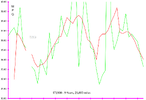
I've attached the same graph for the ST1300. It has a few more gaps and errors (not as diligent at record keeping). For both the Red line is the MPG on the tank, the green is averaged over 7 tanks. As I am now retired the bike gets far fewer miles and the yearly change with the California summer/winter fuel is not as obvious to fuel mileage. I don't have time right now to calculate things in Kilometers, sorry.

 
Reading through this I have a few bits to add. I currently ride a ST1300, and still have (currently broken) my ST1100. I put 140,000 miles on my ST1100. Over 520 times I've filled the tank, recorded almost all of them (a few mistakes). 3320 Gallons and average 41.54 MPG. A lot of commuting miles, with a shorter commute the mileage isn't as good. High 30's, on Trips low 40's. But I live in California and we have summer and winter fuel. You can clearly see it on the attached graph, up and down each year. Also about 25% through the graph my commute changed from mostly two freeways to an expressway with 30 stop lights.

I got my ST1300 (used with 18K miles) in 2017. I was disappointed with the mileage immediately. As well as the size of the tank.

Various articles I read implied it was larger than the ST1100, and 7.7 gallons. I have run out of fuel 5 times (once or twice a deliberate test, twice actually managed to coast into a gas station, once I had to cal my wife...) I never ran on (by accident) on the ST1100 and much prefer the gauge on it. I have marked down 7.65, 7.15, 7.28, 7.12 and 6.85 for the size of the fill. I now believe the 7.65 and 6.85 are clearly wrong. I would usually get over 250 miles per tank with some trips into the 300's.

Mileage has been very disappointing, and I believe some of that is due to the short commute that has been more a part of this bike, as well as the Thermostat is broken. Living where I do it rarely matters warming up as it doesn't get too cold (though I do ride year around). My average is 35 MPG over 25,000 miles, with some warming day trips getting into the high 38's (and it might have done better if I were driving slower, and my wife wasn't on the back). I usually only get ~220 miles per tank. As high as 250, but some under 200. I am just now working on a lot of back maintenance and replacing the thermostat (or of the reason for reading the forums tonight) so I do expect to see a nice increase in MPG.

I've attached the same graph for the ST1300. It has a few more gaps and errors (not as diligent at record keeping). For both the Red line is the MPG on the tank, the green is averaged over 7 tanks. As I am now retired the bike gets far fewer miles and the yearly change with the California summer/winter fuel is not as obvious to fuel mileage. I don't have time right now to calculate things in Kilometers, sorry.

I knew I was going to forget the graphs...
 

Attachments

  • ST1100 MPG.png
    ST1100 MPG.png
    205.9 KB · Views: 7
  • ST1300 MPG.png
    ST1300 MPG.png
    111.6 KB · Views: 7
So, I have decided to do the dreaded valve clearance measurements and, if necessary, shim changes, while I have the Bike stripped down for starter valves synchronization. I am looking at the HOTCAMS Shim kit; HCSHIM01. Would that be the correct kit for my 07 ST1300? Are there any worthwhile/quality alternatives?
 
So, I have decided to do the dreaded valve clearance measurements and, if necessary, shim changes, while I have the Bike stripped down for starter valves synchronization. I am looking at the HOTCAMS Shim kit; HCSHIM01. Would that be the correct kit for my 07 ST1300? Are there any worthwhile/quality alternatives?
I had everything open but I decided not to bother with the Starter Valve Sync. Seems to run fine and from what I read it only matters at Idle. So you might smooth idle out a bit, if it's bad. Just a note on the valves. I just checked the ST1300 for the first time at 45,000 miles and they are all in spec. With my ST1100 I checked them many times, but didn't need to adjust them until 70,000 miles. I did check them at 3,000 and two intakes were at .008, I didn't touch them, by the 16,000 mile check they were .007 and within spec. The intake valves finally wore down to .008 at the 70,000 mile check. I didn't have to adjust them again until 137,000 miles. The Shim and Bucket design seems very reliable and sturdy. My older V65 Sabre, with the screw adjusters always needed adjusting. That interval was 8,000 miles and I think I adjusted some every single time. They wear badly compared to shim & bucket.
 
I had everything open but I decided not to bother with the Starter Valve Sync. Seems to run fine and from what I read it only matters at Idle. So you might smooth idle out a bit, if it's bad. Just a note on the valves. I just checked the ST1300 for the first time at 45,000 miles and they are all in spec. With my ST1100 I checked them many times, but didn't need to adjust them until 70,000 miles. I did check them at 3,000 and two intakes were at .008, I didn't touch them, by the 16,000 mile check they were .007 and within spec. The intake valves finally wore down to .008 at the 70,000 mile check. I didn't have to adjust them again until 137,000 miles. The Shim and Bucket design seems very reliable and sturdy. My older V65 Sabre, with the screw adjusters always needed adjusting. That interval was 8,000 miles and I think I adjusted some every single time. They wear badly compared to shim & bucket.
Very intersting.
 
So, I have decided to do the dreaded valve clearance measurements and, if necessary, shim changes, while I have the Bike stripped down for starter valves synchronization. I am looking at the HOTCAMS Shim kit; HCSHIM01. Would that be the correct kit for my 07 ST1300? Are there any worthwhile/quality alternatives?
The kit I have is the HCSHIMM02. This kit works for both the1100 and 1300.
 
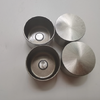
The HCSHIMM02 kit is 9.48mm diameter and the ...01 is 7.48mm diameter. 7.48mm shims are listed for both the 1100 and 1300. I know I needed 9.48 in my VTR1000F but all my VFRs etc use 7.48mm.
 
I had everything open but I decided not to bother with the Starter Valve Sync. Seems to run fine and from what I read it only matters at Idle.

It’s possible to read a lot of incorrect information on the internet. I had the same comment from a Honda workshop manager.

You balance the starter valves at idle, but the effect is felt all the way through the rev range. Smooth and responsive. You won’t believe the stupid grin that you will have on your face after doing it.
 
I usually fill up before the single bar light begins to flash. at that point it will report between 45-50 miles left to ride and it will adjust that according to the live fuel consumption rate. But there’s a catch. After it has gone to a single flashing light, fuel can still slop around and activate the normal fuel sensor - so going up and down hill, putting it on its side stand etc will make it go back to two bars. It will then go back to one flashing bar and it will think that it has a full lower tank and report 45-50 miles left again. It is now lying and if you believe it, you will run out of fuel.

Best thing to do is note the mileage when the single bar starts flashing and note how many miles it reckons. Use your odometer or reset your trip and believe that rather than the gauge. I would regularly get a theoretical 290 miles per tank - based on how much fuel I had put in and the distance covered - and then working that out for the 29litre tank. Consumption was usually a tad under 10 miles per litre on long runs (45mpg Uk). 8-9 on runs through the Dales’ narrow, twisty, hilly roads which would be a theoretical 230-260 miles per tank. But I never started worrying until I’d done 240 miles since the last fill up.

And yes, it did improve after a starter valve synch. I haven’t recorded by how much but I remember seeing about 9.3 miles/litre on the average readout before the synch and often saw 9.9 and 10 after the synch. Not very scientific - just an observation.
 
It’s possible to read a lot of incorrect information on the internet. I had the same comment from a Honda workshop manager.

You balance the starter valves at idle, but the effect is felt all the way through the rev range. Smooth and responsive. You won’t believe the stupid grin that you will have on your face after doing it.
It’s technically impossible to affect the fuel/air mixtures across the entire rev range with the starter valves. Any perceived improvement would probably be placebo effect.
 
Back
Top Bottom