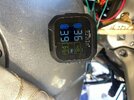
TPMS recommendations

I have this system and it does indeed go to sleep in about a minute after I get off the bike. Bumping it or closing the top box is enough to wake the system up if it has gone to sleep.
The numbers you see when it wakes up (or you power it on) are the last readings it had before it went to sleep or got shut off. You should be able to tell by the temperature readings next to the pressure readings.
Mine wakes up and I get front tire readings just backing the bike out of the garage. The back tire takes about 100' of riding to show up. That is if went to sleep.
If I shut if off (usually for charging the display) then turn it back on it will take 5 to 10 minutes to get both tires to show up. My front shows up within a few minutes but my back will take 5 minutes at least before it does.
I shut mine off and take the display into work to charge it. It turns on during charge but won't show any pressures or alarms as long as it's charging. Once back on the bike I have to turn it on manually and it will beep at me until both pressures show up again.
I do like that it's loud enough that I can just hear it in my helmet with ear plugs while I'm riding. In the sunlight the flashing isn't very noticeable but at night it's really clear.
After setting it up out of the box I never turn it off.
 
LarryFine & others who said
the numbers my display unit shows me when it first comes to life upon shaking / moving the vehicle
are inaccurate OLD numbers that represent the last readings received not the then current readings ...

... you all are exactly right!

The temperature gives it away: I got in my car early this morning before dawn when the outside temperature was 48° and my TPMS monitor said my tire temperature was 60 in one and 58 for the other.
That might've been correct when I parked it yesterday .

But, The numbers changed after I drive less than one minute, maybe 1/4 mile, through my neighborhood.
 
BMW makes the best TPMS. My 2018 RT was dead on accurate. I set the low-pressure light to 34 PSI, and when it came on, sure enough, the inline gauge on my compressor confirmed it.

A few years ago, I left a Missouri campground and picked up a nail in the first 10 miles. My dash lit up suddenly with flashing lights, with the info page defaulting to the TPMS display, the digital readout rapidly showing I was losing air. Safely moved to the side and plugged it in. Rode another 6,000 miles to Montana and back.

Why this is not standard on every touring bike, I don't know.
 
My personal preference is for my FOBO. It's sensor data is accessed via smartphone. There is no external monitor. I'd like one to occasionally glance at just because it's there and I wouldn't have to query the app were I curious. I don't really need another display in the cockpit. I'm not driving a fast mover.

Accessing the display immediately shows current data without touching or moving the bike. I like this as I can check the pressure and top off before even moving the bike.

Audible alerts in my helmet let me know if anything is amiss. If so I pull over and check the phone. There's no PULL UP! PULL UP! PULL UP! verbal warnings or growler. But I can live with that.

Tire pressure increases due to road and air temperatures don't concern me. It's not like a ride with inflation at max pressures on 130º roads with friction driving temps even higher. There could be situations where i might need to be concerned about temperature induced pressures. But I doubt I'll ever see them.
 
My personal preference is for my FOBO. It's sensor data is accessed via smartphone. There is no external monitor. I'd like one to occasionally glance at just because it's there and I wouldn't have to query the app were I curious. I don't really need another display in the cockpit. I'm not driving a fast mover.

Accessing the display immediately shows current data without touching or moving the bike. I like this as I can check the pressure and top off before even moving the bike.

Audible alerts in my helmet let me know if anything is amiss. If so I pull over and check the phone. There's no PULL UP! PULL UP! PULL UP! verbal warnings or growler. But I can live with that.

Tire pressure increases due to road and air temperatures don't concern me. It's not like a ride with inflation at max pressures on 130º roads with friction driving temps even higher. There could be situations where i might need to be concerned about temperature induced pressures. But I doubt I'll ever see them.
FOBO? So, I can pair this with my Sena audible warnings? Link?
 
QUESTION:
For anybody else who uses TPMS where the sensors are in the valve stem caps, rather internally, is your back tire showing a much warmer temperature than the front?

Mine is, and I'm speculating that this may be due to engine heat. The exposed sensor is behind the engine and sandwiched in between two exhaust pipes.


IMG_4221.jpeg
 
I'm sure you're correct. The front is out there in the cooler air, an the rear carries a heavier load. I don't much watch the temp. What is normal temp anyway? What are you going to do about it? I'm sure they are designed to handle the heat.
 
FOBO? So, I can pair this with my Sena audible warnings? Link?

Yes. My FOBO app in the phone is paired to my Sena 20S.

https://my-fobo.com/product-family/FOBO_Bike_2

For anybody else who uses TPMS where the sensors are in the valve stem caps, rather internally, is your back tire showing a much warmer temperature than the front?

Mine is, and I'm speculating that this may be due to engine heat. The exposed sensor is behind the engine and sandwiched in between two exhaust pipes.

I'd say engine and exhaust heat might have some effect in various conditions. But I think the main factor in the delta is the fact that the rear tire is the driven tire where the front is "free wheeling" and might only see temperature increases in hard cornering that increases the load on the tire. Second or potentially more than that might be road temperature. I'd expect the delta to be smaller but still with a bias towards the rear tire.

I wonder of those riders who have TPMS with internal sensors see the delta we do. I think there would be some even if not as great.
 
QUESTION:
For anybody else who uses TPMS where the sensors are in the valve stem caps, rather internally, is your back tire showing a much warmer temperature than the front?

Mine is, and I'm speculating that this may be due to engine heat. The exposed sensor is behind the engine and sandwiched in between two exhaust pipes.


IMG_4221.jpeg
Yes, mine reads this way as well.I assumed the rear tire takes on more weight and that’s the reason for the higher pressure difference from cold and higher temp- never really thought about it, and I have these on all 3 bikes- all run the same way.
 
QUESTION:
For anybody else who uses TPMS where the sensors are in the valve stem caps, rather internally, is your back tire showing a much warmer temperature than the front?

Mine is, and I'm speculating that this may be due to engine heat. The exposed sensor is behind the engine and sandwiched in between two exhaust pipes.


IMG_4221.jpeg
Mine is the same. The front tire is constantly exposed to direct wind, whereas the rear is protected from it. Plus, the rear has the exhaust pipes near it. Mine do not appear to calculate temp from rising pressure as they do not increase in proportion to the indicated temperature. They both rise about the same amount as I am riding.
 
Back
Top Bottom