Article [13] ST1300 - Maintenance - Fitting Wheel Bearings - What the manuals don't tell.

left side

Where I wiped off the crud, semi dirty/greasy..
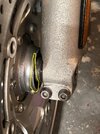
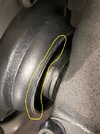
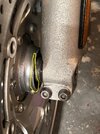
In all of your photos of the left side there also seems to be damage to the wheel hub that houses the bearing. It was rubbing against something at some point based on the photos.

IMG_5466.jpeg

IMG_5467.jpeg
 

Attachments

  • IMG_5466.jpeg
    IMG_5466.jpeg
    302.9 KB · Views: 3
That is good progress. Seals are toast.
Bearings - at 25000, they are probably ok. One test you did not mention is how smooth they feel when you jam your finger in the hole and rotate it back and forth.
I would probably replace them - but I have the tools and some experience.

DO NOT hold the wheel one finger in each bearing and spin the wheel. It may not turn out very well ! All you are feeling for is smoothness.

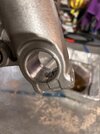
The spacer between the bearings - you will be able to feel it and it ought to be jammed tight, but it may drop down slightly and scrape against the bearing as you feel how smoothly the bearing turns. Check that that spacer is there - it is a long alloy tube that is a loose fit for the axle to slide through. I think I can see the end of it on the photo of the rhs with the seal removed. Use the axle from the other side to keep the spacer in place. If it is very slack, then the bearings are not properly seated. ask about that before trying to fix it .

That scoring of the hub on the left - that is odd. The only thing that I can think of is that the left hand spacer was not fitted at some point. The wheel would slide easily on the axle and that scored hub would collide with the bottom of the inside fork leg, above the axle hole. Take a look there to see if there is any damage/score marks.
 
Both bearing surfaces are glass smooth, if thats what you mean, however they turn slow and stiff, the outer one turns more stiff, this is the one against the backwards spacer.. but they do turn.
How freely or tightly should they turn? I wish I had a new one to compare.

The spacer is there and it’s not loose at all, but I didn’t go out of my way to loosen it.

As for the hub, I find no corresponding mark on the forks. To me it looks like hub damage from mishandling the wheel, that hub edge is the highest point on that side of the wheel, one or 2 slightly high setdowns on a garage floor would easily do that, besides it should be just cosmetic.

IMG_5493.jpeg
 
It's nice when we find some "problems" go back to the most basic issues.
There's some doggone smart ST folks 'round here!
I submit that your vague handling issues at um, ... elevated speeds will be subdued with replacement bearing (as needed), and just having the front wheel mounted properly.
Mechanics may be good or not so good, but there are common ST techniques that MUST be correct.
Not all "good" mechanics know this fine example of a motorcycle, as we have seen time after time.
The front wheel axle, pinch bolts and spacers must be done right, and the same for bleeding these brakes.
Glad you're here to learn the RIGHT way.
And thanks to @jfheath and @Andrew Shadow for jumping in with the correct observations.
 
Both bearing surfaces are glass smooth, if thats what you mean, however they turn slow and stiff, the outer one turns more stiff, this is the one against the backwards spacer.. but they do turn.
How freely or tightly should they turn? I wish I had a new one to compare.

The spacer is there and it’s not loose at all, but I didn’t go out of my way to loosen it.
Spacers should be tight up against the inner face of the bearing, so that is ok

However one bearing should not be stiffer than the other - but that is difficult to tell since the spacer and both inner races will likely turn together.m

I might have a spare bearing - I'll dig it out if I can (I haven't seen it for a while) and try to give you an idea of how easily they move. They are not loose, but they should move round smoothly with gentle finger pressure.
 
Last edited:
A new bearing, right out of the box and wrapper, will feel silky smooth with some resistance from the grease. With some use, the bearing will show less resistance from the grease, but it will still feel smooth. When installed in your wheel properly, there will be some (very little) side pressure on the inner races so the tendency will be for turning one to turn the spacer and the other bearing. You are looking for that smoothness while you turn either or both bearings. An old bearing might feel smooth, but make some noise because it is dry, or it might feel notchy as the round bearings roll over worn spots on the outer (or inner) race.

This kind of thing is probably as hard to communicate via the written word as it is to describe the taste of, say, chocolate to someone who has never tasted it. It would be easier to learn if you grabbed a new bearing or two and played with it for a while.
 
Totally agree, and what you said helps.. they do roll smoothly, but I feel they should be more free.. it takes quite abit twisting with 2 fingers to get it to move and your not going to get grip to turn it a full circle.

There’s a bike shop close by, been tempted to use them for other things but ended up doing myself or changed directions, I’ll take my wheel to them in the am and they should be able to check them out in seconds right?
Next question then is seeing how I am not counting on them to install my wheel, is this bearing replacement work pretty standard stuff that a good bike shop should have no issue or does this procedure have its own secrets you have to know?
As for replacement bearings.. I assume oem? If not is there a go to?
Thanks!!
 
Last edited:
Totally agree, and what you said helps.. they do roll smoothly, but I feel they should be more free.. it takes quite abit twisting with 2 fingers to get it to move and your not going to get grip to turn it a full circle.

There’s a bike shop close by, been tempted to use them for other things but ended up doing myself or changed directions, I’ll take my wheel to them in the am and they should be able to check them out in seconds right?
Next question then is seeing how I am not counting on them to install my wheel, is this bearing replacement work pretty standard stuff that a good bike shop should have no issue or does this procedure have its own secrets you have to know?
As for replacement bearings.. I assume oem? If not is there a go to?
Thanks!!
Standard stuff is depending on how mechanically inclined you are and what tools are at your disposal. You can't judge a bearing alone by how free you think it should spin. Failed bearing can spin very freely. IMO your bearings by your description sound perfect.
 
Back
Top Bottom