You are using an out of date browser. It may not display this or other websites correctly.
You should upgrade or use an alternative browser.
You should upgrade or use an alternative browser.
🤣 Funny!
- Thread starter docw1
- Start date

Let's not get hung up on particulars. I'm willing to bet that a majority of these funny concoctions are made up, either by AI or photo shopped. Go look at youtube where a lot of those 'fail' videos are staged. People cannot be so stupid as to do that stuff...well, yes they can*.You're correct, plus it's a tamper-resistant receptacle, suggesting the damage is fake, too.
*How about the nurse who went on a Carnival cruise. She and her friends each bought a ticket allowing 15 shots (alcoholic drinks) in 24 hours. She did all in 8 1/2 hours, fell down a flight of stairs and hurt herself. She sued and won $300K. Carnival will appeal. Judge said she bore 40% of the blame, but Carnival's bartenders bore 60% by allowing an obviously drunk person to continue ordering drinks.

Let's not get hung up on particulars.
Ha, with that kind of attitude it won't be long before you'll be suggesting that any brand of moly is as good as any other.
After 15 shots in 8.5 hours, I bet anyone would say all oils are as good as any other.Ha, with that kind of attitude it won't be long before you'll be suggesting that any brand of moly is as good as any other.


Uncle Phil
Site Supporter


After that, I'd say they would have a hard time saying anything that could be understood ...After 15 shots in 8.5 hours, I bet anyone would say all oils are as good as any other.


After that, I'd say they would have a hard time saying anything that could be understood ...
If those shots were 1 oz each (of typical 40% spirits), that's a total of 6 ounces of pure alcohol. That's about 10 beers. I might be feeling it, but I don't think I would be fall down drunk if I consumed them over an 8 hour period.
Not sayin' it's a good idea.
Uncle Phil
Site Supporter
Ah, but some folks can't handle their liquor if they don't have a lot of practice ...If those shots were 1 oz each (of typical 40% spirits), that's a total of 6 ounces of pure alcohol. That's about 10 beers. I might be feeling it, but I don't think I would be fall down drunk if I consumed them over an 8 hour period.
Not sayin' it's a good idea.
Ah, but some folks can't handle their liquor if they don't have a lot of practice ...
Right now, I'm trying to get out of practice. Sometimes too much practice is not a good thing


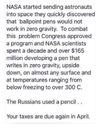
I'm sorry. I cannot let this stand or you'll start believing it. It's an internet myth I'm committing to quash at every opportunity.
The popular "Fisher Space Pen origin myth" claims NASA spent millions developing a zero-gravity pen, while Soviets used pencils. In reality, Paul C. Fisher developed the AG7 Space Pen using his own funds ($1 million+) to solve leakage issues, later selling them to NASA for $6 each. Fisher patented the pressurized, thixotropic-ink pen in 1966.
Wikipedia +3
- The Myth: NASA spent millions (often cited as $1 million to $12 billion) to develop a pen that works in space.
- The Reality: Paul C. Fisher invented the pen privately (1965–1966) and patented the technology. He marketed it to NASA after it was already developed.
- NASA's Role: NASA did not fund the development. NASA did, however, rigorously test the pen and approved it for the Apollo 7 mission in 1968 after finding that pencils created safety risks (broken graphite tips).
- The Costs: NASA purchased 400 pens at a cost of approximately $6 each in 1967 (and similar amounts for later missions), which was a much more cost-effective solution than developing one.
- Soviet Use: Contrary to the myth that only the US used the pen, Soviet cosmonauts also bought Fisher Space Pens for their Soyuz missions in 1969, abandoning wax pencils.
- The Inventor's Role: Paul Fisher did not initially set out to create a "space" pen, but rather a "universal" pen that wouldn't leak or dry up, with the design allegedly inspired by a dream.
The Space Review +5
Next you'll start saying Al Gore claimed to have invented the internet... (as I sit here with my small collection (3) of awesome Fisher Space Pens)
So it took a NASA study to determine that pencil lead is prone to breakage??? And, exactly what safely risk did that pose??
- NASA's Role: NASA did not fund the development. NASA did, however, rigorously test the pen and approved it for the Apollo 7 mission in 1968 after finding that pencils created safety risks (broken graphite tips).
What year were you born? You did learn of the Apollo 1 fire at some point. I'm sure.So it took a NASA study to determine that pencil lead is prone to breakage??? And, exactly what safely risk did that pose??
From Scientific American, December 20, 2006
Originally, NASA astronauts, like the Soviet cosmonauts, used pencils, according to NASA historians. In fact, NASA ordered 34 mechanical pencils from Houston's Tycam Engineering Manufacturing, Inc., in 1965. They paid $4,382.50 or $128.89 per pencil. When these prices became public, there was an outcry and NASA scrambled to find something cheaper for the astronauts to use.
Pencils may not have been the best choice anyway. The tips flaked and broke off, drifting in microgravity where they could potentially harm an astronaut or equipment. And pencils are flammable--a quality NASA wanted to avoid in onboard objects after the Apollo 1 fire.
its generally considered that the 100% oxygen atmosphere inside the capsule is what contributed to the Apollo 1 fire, not pencil lead.What year were you born? You did learn of the Apollo 1 fire at some point. I'm sure.
From Scientific American, December 20, 2006
Originally, NASA astronauts, like the Soviet cosmonauts, used pencils, according to NASA historians. In fact, NASA ordered 34 mechanical pencils from Houston's Tycam Engineering Manufacturing, Inc., in 1965. They paid $4,382.50 or $128.89 per pencil. When these prices became public, there was an outcry and NASA scrambled to find something cheaper for the astronauts to use.Pencils may not have been the best choice anyway. The tips flaked and broke off, drifting in microgravity where they could potentially harm an astronaut or equipment. And pencils are flammable--a quality NASA wanted to avoid in onboard objects after the Apollo 1 fire.
a quick google search says pencil graphite is generally non-combustible unless subjected to extreme temperatures in excess of 1000C. As an old-time drafting student, the term "mechanical pencil" generally meant a plastic pencil frame with a replaceable graphite core, so I'm assuming they were not concerned with the wooden part of the pencil being combustible. If they were plain old wood pencils, typically available for about 5 cents each at any American school, the fact that NASA paid $128.89 per pencil seems a bit odd.
But, al

ST1100Y
Site Supporter
But any small particle floating loose in micro gravity bears the risk of getting inhaled, ending in someones eye, floating uncontrollable on/into instruments/technical appliances...a quick google search says pencil graphite is generally non-combustible unless subjected to extreme temperatures in excess of 1000C.
OP
OP


A certain country was ruled by a dictator who was very paranoid. He rarely appeared in the public; he preferred to send one of his many doubles.
One day, enemy attacks the palace. The survival of the dictator is in question. The doubles await news, trembling in fear. If the dictator dies, they would be no longer useful, and with all the secrets they know, the new regime surely wouldn’t let them live.
Finally, they are called in a conference room. One of the dictator’s chief advisors enters.
“My dear doubles!” he says. “I have good news and bad news. The good news is that our beloved leader has survived the dastardly attack, and so, your services are still very much required.”
The doubles collectively sigh with relief.
Then a big man with an axe enters the room.
“Now for the bad news,” continues the advisor. “He lost an arm…”
One day, enemy attacks the palace. The survival of the dictator is in question. The doubles await news, trembling in fear. If the dictator dies, they would be no longer useful, and with all the secrets they know, the new regime surely wouldn’t let them live.
Finally, they are called in a conference room. One of the dictator’s chief advisors enters.
“My dear doubles!” he says. “I have good news and bad news. The good news is that our beloved leader has survived the dastardly attack, and so, your services are still very much required.”
The doubles collectively sigh with relief.
Then a big man with an axe enters the room.
“Now for the bad news,” continues the advisor. “He lost an arm…”

Belisaerio
Ohio Valley Roadway Cervine Assassination Service.
Not to those of us who learned to speak cursive.After that, I'd say they would have a hard time saying anything that could be understood ...
good point, I hadn't considered the potential hazard to the eyes. That's what happens when you're used to having gravity around all the time I guess.But any small particle floating loose in micro gravity bears the risk of getting inhaled, ending in someones eye, floating uncontrollable on/into instruments/technical appliances...
ST1100Y
Site Supporter
... I can relate...
OP
OP