Brake and Clutch Fluid level check

Assuming that whatever bar riser was installed significantly changed the position/angle of the master cylinders relative to the position that they were in with the Honda OEM riser plate, it would seem logical that the position of the fluid level reference lines that are on the inside of the master cylinders will have changed by the same amount as the ones that are on the outside of the master cylinders. If the bar riser made a significant difference to the position of the master cylinders this should be considered regardless of which reference point is being used.
It is the Helibar HR01029. Hard to know now if it significantly changed the position wrt to the oem position. It did make a lot of difference in riding comfort.

As a next step I will open up the MC and make it as leveled as I can and then check if the fluid is level with the casting line on the inside. I have a feeling I might be a little over the casting line when levelled.
 
As a next step I will open up the MC and make it as leveled as I can and then check if the fluid is level with the casting line on the inside. I have a feeling I might be a little over the casting line when levelled.
If it was my ST1300 I would not go through the bother but if it satisfies a concern for you go for it, then you will know for sure. Built in to that lower level line that Honda put there is a sufficient amount of brake fluid for an adequate safety margin. I have never seen that riser installed so I really have no idea how much it changes the angle of the master cylinders but would be surprised if it changed the position enough to present a problem under normal operating conditions. If nothing unusual has been done like leaving a very low fluid level after installing new pads, or filling the master cylinder when worn pads were in place, I would have no concerns with what I see in the photos in your initial post.

Let us know the result of your experiment.
 
Assuming that whatever bar riser was installed significantly changed the position/angle of the master cylinders relative to the position that they were in with the Honda OEM riser plate, it would seem logical that the position of the fluid level reference lines that are on the inside of the master cylinders will have changed by the same amount as the ones that are on the outside of the master cylinders. If the bar riser made a significant difference to the position of the master cylinders this should be considered regardless of which reference point is being used.
If the top and bottom of the aftermarket risers are parallel, the displayed level of fluid inside relative to the sight glass will not be changed from stock. All they do is lift the reservoirs higher from the ground but do not change the relative position angle of reservoirs. The pictured risers are the HeliBar HR01029 risers on the OP's bike. It is easily seen the riser top and bottom are parallel. The fluid level display in window with these risers is still the same as stock.
 

Attachments

  • IMG_0508.jpeg
    IMG_0508.jpeg
    284.4 KB · Views: 10
Last edited:
Your method is just slightly off.
Let me explain, if a bike has handlebar risers, the level that appears in the window will be incorrect.
Do not use the lines outside of the master cylinder housing for the correct level of fluid.
INSIDE the housings, on the front wall, you will see an investment casting line across the housing, this should be used for the correct level fill indicator etc.
With risers, if you just turn the bars untll the MC is level, the sight glass should still be accurate.
 
If the top and bottom of the aftermarket risers are parallel, the displayed level of fluid inside relative to the sight glass will not be changed from stock. All they do is lift the reservoirs higher from the ground but do not change the relative position angle of reservoirs. The pictured risers are the HeliBar HR01029 risers on the OP's bike. It is easily seen the riser top and bottom are parallel. The fluid level display in window with these risers is still the same as stock.
No argument from me. I am of the opinion that this is one of those issues that is exaggerated, much ado about nothing as it were.
 
It is the Helibar HR01029. Hard to know now if it significantly changed the position wrt to the oem position. It did make a lot of difference in riding comfort.

As a next step I will open up the MC and make it as leveled as I can and then check if the fluid is level with the casting line on the inside. I have a feeling I might be a little over the casting line when levelled.
If it was my ST1300 I would not go through the bother but if it satisfies a concern for you go for it, then you will know for sure. Built in to that lower level line that Honda put there is a sufficient amount of brake fluid for an adequate safety margin. I have never seen that riser installed so I really have no idea how much it changes the angle of the master cylinders but would be surprised if it changed the position enough to present a problem under normal operating conditions. If nothing unusual has been done like leaving a very low fluid level after installing new pads, or filling the master cylinder when worn pads were in place, I would have no concerns with what I see in the photos in your initial post.

"Let us know the result of your experiment."
I finally got around to doing some due diligence last week and can share the following. While to some this may be elementary / old news, but it may be helpful to others.

Also, I stated in post 19, that the Service Manual does not have any of this information. I stand corrected. The manual does have the information, as pointed out below.

Clutch: Service Manual clearly states on page 9-7. Turn the handlebar to the right until the reservoir is parallel to the ground..... I verified this with a bubble test, and observed that this point is about when the handlebars are turned right at about 45 degrees. Contrary to what I had thought before, if the handle bar is turned all the way to the right the MC is no longer parallel to the ground, and the eye may not be able to perceive this.

Page 9-8: The service manual clearly states, "Fill the reservoir to the casting ledge". The manual should display this with a diagram with arrows. This is in line with what Larry (Igofar):thumbsup-2x:, mentioned in Post 8. With the handle bar turned to the right and the MC parallel to the ground, the casting ledge is a perfect indicator of the correct fluid level and fwiw, gets the fluid above the Lower level marks on the outside of the MC.
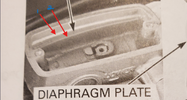
Brake: Page 17-7 in the Service Manual does state. "Turn the handlebar until the reservoir is parallel to the ground" ....... It should say which direction. Left in case of the brake MC. Same as for the clutch. If you go to much to the left the MC is no longer parallel to the ground.

Page 17-10: The Service Manual does state. "Fill the fluid reservoir to the upper level", ..... This is shown with a diagram and arrow on page 17-10. I have attached this diagram. The black arrow is from the diagram in the manual. The red arrows labelled 1 and 2 are mine. Looking for clarification, as to which line exactly the black arrow is referring to.

Summary: The Manual does have the directions, just had to read them carefully, although my fluid levels were always correct, based on the casting ledge. For clarification can someone point out which of the red arrows (1 or 2) in the attached diagram is pointing to the correct level. This is for the brake MC.

Thanks and hope everyone had a great 4th.
 

Attachments

  • Brake MC.png
    Brake MC.png
    1.1 MB · Views: 10
The Service Manual does state. "Fill the fluid reservoir to the upper level"
Manual states upper level, so my reference is your arrow #1.

Note: This is the fluid level that should be in the master cylinder when there are unused brake pads installed which are at full thickness. As the brake pads wear the fluid level in the master cylinder will drop as the brake pistons move further out in the calipers. This is normal and brake fluid should not be added.
 
Manual states upper level, so my reference is your arrow #1.

Note: This is the fluid level that should be in the master cylinder when there are unused brake pads installed which are at full thickness. As the brake pads wear the fluid level in the master cylinder will drop as the brake pistons move further out in the calipers. This is normal and brake fluid should not be added.
My questions were in regards to changing the brake flud during a routine annual or evry two year period. I would think in that case the fluid should be replaced to the upper level mark even if the pads are at 50% or 75% or 40 % remaining. That is what the manual is implying.

Also, "As the brake pads wear the fluid level in the master cylinder will drop as the brake pistons move further out in the calipers." Agreed

"This is normal (Agreed) and brake fluid should not be added." So you are saying that if someone wears down a set of new pads to half thickness in three months, due to agressive braking and the fluid level falls to below lower level mark it is wrong to add more fluid. I would think in this case or a simiar case the fluid level can be brought up tp the upper level mark as a proactive measure (no harm done.)
 
My questions were in regards to changing the brake flud during a routine annual or evry two year period. I would think in that case the fluid should be replaced to the upper level mark even if the pads are at 50% or 75% or 40 % remaining. That is what the manual is implying.

Also, "As the brake pads wear the fluid level in the master cylinder will drop as the brake pistons move further out in the calipers." Agreed

"This is normal (Agreed) and brake fluid should not be added." So you are saying that if someone wears down a set of new pads to half thickness in three months, due to agressive braking and the fluid level falls to below lower level mark it is wrong to add more fluid. I would think in this case or a simiar case the fluid level can be brought up tp the upper level mark as a proactive measure (no harm done.)
It just means that if one tops off the reservoirs with the pads worn to some point less than new and if the pads need replacement later and the pistons are pushed into the caliper the possibility exists fluid will overflow and be pushed out of the reservoir. It's a given that the upper level of fluid corresponds to new pads. Honda designed the system so that adequate fluid is in the system until the pads are worn out. Topping off with worn pads is not required and may spill fluid during pad replacement.
 
It just means that if one tops off the reservoirs with the pads worn to some point less than new and if the pads need replacement later and the pistons are pushed into the caliper the possibility exists fluid will overflow and be pushed out of the reservoir. It's a given that the upper level of fluid corresponds to new pads. Honda designed the system so that adequate fluid is in the system until the pads are worn out. Topping off with worn pads is not required and may spill fluid during pad replacement.
Ok. So if my pads are at 50 % and I want to do my annual flush. To what point should I fill the reservoir at this time.
 
Ok. So if my pads are at 50 % and I want to do my annual flush. To what point should I fill the reservoir at this time.
I don't know that there's a formula to follow, your primary goal is to fill it enough so that when your pads are at 5% you still have adequate fluid in the reservoir to operate the brakes effectively. I'd rather have too much than too little.

If you fill it too high now, just remember to remove some fluid prior to replacing the brake pads to avoid hydraulic lock when you pry the caliper pistons apart to accept the new pads.
 
is wrong to add more fluid.
Yes, it is wrong. If the system was properly bled of air and filled with fluid to the correct level when it last had new pads installed, and if there are no leaks, the system has the correct amount of fluid in it for the entire life of the pads. If you add additional fluid part-way through the life of the pads you will have to remove some fluid when you install new pads or you will have binding breaks.
 
Ok. So if my pads are at 50 % and I want to do my annual flush. To what point should I fill the reservoir at this time.
Simple. Put a piece of masking tape on the master cylinder and mark where the brake fluid level is. You can also measure down from the top of the master to the fluid level and make a note of the measurement if you prefer. Once you are ready to top off the system just fill the master to the same level.

Later on when you install new pads you will have the correct amount of fluid in the master as long as you started with the correct amount the last time that new pads were fitted.
 
Last edited:
If the system was properly bled of air and filled with fluid to the correct level when it last had new pads installed, and if there are no leaks, the system has the correct amount of fluid in it for the entire life of the pads. If you add additional fluid part-way through the life of the pads you will have to remove some fluid when you install new pads or you will have binding breaks.
I had no idea about this aspect of brake fluid level's relationships to pad wear. I don't recall ever seeing this discussed during my time here. It makes perfect sense reading this explanation.

Heretofore I would have just used the standard practice of "Level's low – top off to the mark".

With the reservoir lid screwed in place I see how the pistons/pads/brakes would bind. With the lid removed I can see the likelihood of excess fluid being pushed out of the reservoir onto who knows what. The masking tape is a great suggestion.

Information duly noted.
 
Simple. Put a piece of masking tape on the master cylinder and mark where the brake fluid level is. You can also measure down from the top of the master to fluid level and make a note of the measurement if you prefer. Once you are ready to top off the system just fill the master to the same level.

Later on when you install new pads you will have the correct amount of fluid in the master as long as you started with the correct amount the last time that new pads were fitted.
"Simple. Put a piece of masking tape on the master cylinder and mark where the brake fluid level is. You can also measure down from the top of the master to fluid level and make a note of the measurement if you prefer. Once you are ready to top off the system just fill the master to the same level."

That is one way of doing it, but not one that I would adopt or recommend. One should always fill to the prescribed level in the manual (casting mark as pointed out by Igofar) and in the case when new pads are being installed, be cognizant of the fluid levels in the mc's and the fact that the fluid level will rise during this time and make the necessary adjustments.
 
One should always fill to the prescribed level in the manual
Yes, when the pads are new and at full thickness.

There has to be a baseline point to reference against. The thickness of the pads directly affects the fluid level. Because of that the reference point for the fluid level is with new pads at maximum thickness. There is no practical other way to do it. Where would the reference point be- when the pads are 20% worn, 40% worn, or maybe 50% worn. Good luck with that.

I have no idea how worn your brake pads are and it doesn't matter. If you wish to fill the master to the line go ahead and fill it to the line, it is your motorcycle. Don't forget that you did this however, because you risk binding breaks and/or brake fluid squirting out all over the place if you do. This is only making a simple maintenance task hard for no benefit.
 
"Simple. Put a piece of masking tape on the master cylinder and mark where the brake fluid level is. You can also measure down from the top of the master to fluid level and make a note of the measurement if you prefer. Once you are ready to top off the system just fill the master to the same level."

That is one way of doing it, but not one that I would adopt or recommend. One should always fill to the prescribed level in the manual (casting mark as pointed out by Igofar) and in the case when new pads are being installed, be cognizant of the fluid levels in the mc's and the fact that the fluid level will rise during this time and make the necessary adjustments.
its not that big a deal either way. Given the number of owners some of these bikes have had, the primary caveat is the masking tape method is only reliable if you know the m/c was topped off at the last brake pad replacement. If you're not the owner who changed the pads and adjusted the fluid level, who knows where it should be set?

So, putting a little extra fluid in when you flush and replenish isn't that big a deal, use a turkey baster or similar to suck the excess fluid out at the next pad change.

Let's not over-complicate something that's pretty simple to begin with.
 
I had no idea about this aspect of brake fluid level's relationships to pad wear. I don't recall ever seeing this discussed during my time here. It makes perfect sense reading this explanation.
Learned "the hard way" as a teen during my apprenticeship days...

Our main working tool were small 70ies/80ies FIAT 147 vans, ideal for the city, but based on the same platform as their 'civil' Fiat 127 compact car, the brakes wore fast with the payload we hauled...

So, a coworker reported his 1st gen FIORINO (which was at the shop for annual tuneup just the week before!!) makes grinding noises upon pushing the brake pedal...
One look through the wheel spokes/holes, ah-ja, pads down to the steel carrier... 🙄
And his schedule is full, there is no time to bring it back to the shop...

So I jack the car up, front wheels off, first changing the LHS side, all fine, attempt to change the RHS, pushing the piston in... <SPASH!> (brake) fluid all over the firewall... 😧
Yanking out the garden hose to wash that off ASAP before it eats away all the paint... :cautious:
Yeah, instead of replacing the already worn pads, those grease-monkeys at the shop had simply 'topped off' the master reservoir...
which also explained why the warning light (the screw on lid of the reservoir holds a float actuating a switch) never came on!!! :mad:

On the ST (pretty much any motorcycle with hydraulic brakes) we've a view-glass... the fluid level getting visible is the indication that the pads are due...
 
On the ST (pretty much any motorcycle with hydraulic brakes) we've a view-glass... the fluid level getting visible is the indication that the pads are due...
Which is a built-in quick-check convenience and early warning safety indicator that is part of my pre-ride check that is lost if the system is overfilled and the fluid level is no longer representative of the amount of brake pad wear.
 
Back
Top Bottom