Need advice from the collective about multimeters

What model of Klein do you have? Time saving features are a big 👍 with me. Is the pictured circuit tester from Amazon? I was planning on purchasing one of these as well as some additional probes for the meter.
Mine is a MM6000, now discontinued. A google search turned this up: "The Klein Tools MM6000 Electrician's/HVAC TRMS Multimeter is a professional-grade, auto-ranging True RMS digital multimeter designed for heavy-duty electrical and HVAC troubleshooting. It has been discontinued by the manufacturer and replaced by newer models like the Klein Tools MM720 Digital Multimeter." Mine is well over 20 years old, bought from my favored electrical supply house.

That AI suggested MM720 can be bought from a number of vendors. It sells for $100 (ok, 99.97) from Hopot and Amazon, and comes with probes and a temp sensor (which I've used once to see if it worked, and never again.) The magnet is optional as are alligator clips, but the probes do have a plastic (easily lost) dohickey that covers most of the metal pick (see Amazon's picture).

Yes the auto test light was from amazon - just search for auto test light.

I've been accused of overthinking tool purchases (usually because I don't want to spend the big bucks for the best if it won't be an often used tool). For something like this, I'd compare several brands that caught my eye, then as I narrowed it down, I'd look at various models from one or two manufacturers. Yes, price would be a major criteria. I tend to like name brand mfrs, and Klein tools have stood up to heavy use for years. I admit I lusted after Fluke meters, but could not justify spending 3 to 5 times the price for something that could easily be broken. Back when I was working, Fluke had a reputation for very nasty customer service. No idea what that is like today.
 
Auto-ranging isn't really necessary for a meter you'll use for a given, known voltage range.

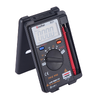
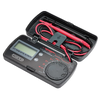
I suggest a meter that is meant to be portable. Look for 'pocket multi-meters'. Examples:

1794095347304.png1794095358894.png
 
I bought one like this about 25 years ago and its still going strong (I have another newer Fluke and a HP 5.5 digit meter to compare it against). These were typically bought by various companies who did work for the US gov't and then sold as surplus over the years after they got a bit old. The specs on them are impressive, they're bulletproof mechanically (I think they're MIL-STD rated) and fly under the radar when people are looking for multimeters so they're dirt cheap. They are getting a bit old now, but the one in this link is returnable, so no big risk if it turns out to not be working as expected.

 
Nothing wrong with Harbor Freight DVMs...
yes and no.

I've owned a few of the really cheap ones they gave away for free years ago, that are about $7 or so now (Cen-Tech maybe??). On DC volts they are accurate enough, usually within one count when compared to my better meters. But when the battery gets low, they lose accuracy by a LOT, and as I recall it was even before the low battery indicator turned on to warn me. So they aren't very reliable unless you know its always got a fresh battery in it, but they're cheap enough to throw in a bag for roadside diagnosing and not worry about what happens to them.

I've never owned the more expensive models that HF sells, so I can't comment on those, but I'd suspect they're going to work well enough. DC volts for automotive work is the least demanding measurement on a multi-meter, so there's not a lot of variation between meters in that mode. And you're usually not measuring to several decimal places anyway. Measuring low resistances like coil windings may show differences between more and less expensive meters, curious what others have found because I haven't had to do that all that often so I don't have any first-hand experience on that.
 
One good example when a test light is the better choice is troubleshooting a non-operational starter. There are several switches in both sides of the starter relay circuit.

You would obviously clip the tester’s wire to a ground when testing for +12v, but you can also clip it to the battery + terminal when testing for points that should be at ground.

For a starter, if the relay doesn’t pull in, you would see if the coil’s ground-side terminal is at 0v, and then see if +12v is reaching the hot terminal when the start button is pressed.

Once you determine which half of the circuit is the problem, you would then test each switch, interlock, or other device to see which is not completing the circuit, bypassing it as a test.

Knowing the specific voltage is not necessary for this type of malfunction, and a test light is cheaper, easier to handle and read, is less fragile, needs no battery, and is auto-ranging. 😉
 
Last edited:
Back
Top Bottom