Renewed fork seals ,now handles different

Joined
Jul 1, 2020
Messages
7
Age
65
Location
somerset u/k
Bike
ST 1300
Renewed leaking front fork oil seals , first trip out i noticed the steering feels as if it wants to turn in / tighten up in a turn.
Almost as if it wants to snatch.
Correct oil level.
Top caps are level with yoke.
Brake not binding.
Top yoke bearing is smooth.
Any Ideas ?
Tia
 
Did you follow the procedure for tightening the axle bolts, bounce the bike, etc? Did you Torque the fork pinch bolts properly? Sounds to me like a lower axle problem or alignment problem w/ the forks. (Just a guess).
 
Did you follow the procedure for tightening the axle bolts, bounce the bike, etc? Did you Torque the fork pinch bolts properly? Sounds to me like a lower axle problem or alignment problem w/ the forks. (Just a guess).
Yes, I followed the Haynes manual with torque settings .
I did notice when I took it apart to do the job the lower fork clamp bolts were almost finger tight ,no effort to undo them at all.
Maybe I got used to riding with that feedback feel with loose clamps , now it`s different !
 
I'll assume you drained the old fork oil and gave the forks a good rinsing inside. Did you find gray sludge in the bottom? New oil is clear and all your damping passages are now clear..... bound to react differently. Did you use a different fork oil weight than was original?
 
Yes, I followed the Haynes manual with torque settings .
I did notice when I took it apart to do the job the lower fork clamp bolts were almost finger tight ,no effort to undo them at all.
Maybe I got used to riding with that feedback feel with loose clamps , now it`s different !
Larry has posted that he has found loose clamp bolts, too. Since he is a mechanic and sees more bikes in a year than most of us will in a lifetime, that carries a lot of weight. We (all of us) should probably check those bolts every year or two (say when we flush the brake and clutch systems).

Going back to your first post, preload (and therefor the height of the rear of the bike) will affect the bike's handling. IIRC (and I'm not sure if I DO remember correctly) raising the rear quickens the steering, which is what you reported.
 
Larry has posted that he has found loose clamp bolts, too.
The motorcycle is delivered from Honda without the front wheel installed, it is installed by the dealer. My guess is that it is usually done by the newest hire who has little experience and is largely unsupervised as this is considered to be a simple task, so it often is not done correctly. When I bought my ST1300 new three of the four fork pinch bolts were loose- I could turn them with my fingers. The only one that was tight enough to do anything was left side outer one. The axle nut was also loose enough to be turned by hand. The only thing that was keeping the front axle from going awol was one pinch bolt. Wheel fitment should always be checked when any motorcycle, new or used, is accepted in to our possession.
 
I'll assume you drained the old fork oil and gave the forks a good rinsing inside. Did you find gray sludge in the bottom? New oil is clear and all your damping passages are now clear..... bound to react differently. Did you use a different fork oil weight than was original?
Yes, Drained the black gunge out , cleaned them and the bushes, used a medium /recommended oil
 
The motorcycle is delivered from Honda without the front wheel installed, it is installed by the dealer. My guess is that it is usually done by the newest hire who has little experience and is largely unsupervised as this is considered to be a simple task, so it often is not done correctly. When I bought my ST1300 new three of the four fork pinch bolts were loose- I could turn them with my fingers. The only one that was tight enough to do anything was left side outer one. The axle nut was also loose enough to be turned by hand. The only thing that was keeping the front axle from going awol was one pinch bolt. Wheel fitment should always be checked when any motorcycle, new or used, is accepted in to our possession.
I gave it a good test again , worst nightmare for me is doing 60+ and the forks fold back in , Problem is i have a phobia of blood ,especially mine !
 
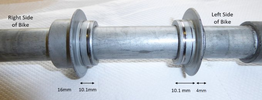
Check the axle spacers both sides. Note that the spacer on the left (clutch side) sticks out from its flange only 4mm.

See my recent post #36 in this thread for pictures https://www.st-owners.com/forums/th...ings-what-the-manuals-dont-tell.157453/page-2

Take no notice of the photos in the post above my post in that link - they are wrong !!

Then slacken everything off - 4 pinch bolts, and main axle bolt. Redo it:

Push the axle in from the left so that the end is just about flush with the axle hole on the left fork.
Hold the axle bolt with the correct size allen driver **, and tighten the front axle to the correct torque.

** If you haven't got the hex driver, then temporarily tighten the left hand (clutch lever side) axle pinch bolts to prevent the axle from turning while you torque the axle bolt. Then slacken the left hand side (clutch lever) pinch bolts again.
Tighten the two right hand (brake lever side) pinch bolts to 22 Nm. Tighten both to 20Nm first, then tighten them both to 22Nm and repeat, alternating from one to the other. That is because when you tighten one, it removes the load from the other and it becomes slack.

Now bounce the forks. The left hand fork should sit so that the axle is flush with the axle hole in the fork leg. If it isn't, manoeuvre the fork leg so that it is. If it is a long way out - then something is wrong. Find out what it is.
Tighten the left hand fork pinch bolts in the same way that you did with the right hand side.

Check the clearance where the brake disk passes through the caliper bracket. It should be at least 0.7mm on both sides.
If it isn’t, then something is seriously wrong. After bouncing the forks, my left fork is always flush with the end of the axle bolt - that is its natural position.

I’ll post my animation link here as well. It’s a bit of fun, but it illustrates the point. Best viewed in full screen mode.

 
Last edited:
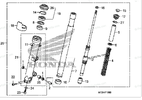
I had a dealer install my Racetech gold valves. Part #6 was installed under the cap instead of between part #'s 4 and 5.

FORK.png
Part 5 slipped over the spring on one side. The other side was offset enough to hold. There were other complications that made me tear them down for a look see. Yikes! It could have been disasterous. Hopefully that's not why your geometry is off. If bringing the oil level up to spec had decreased sag, the bike would have turned even in less, not more (just musing here). A puzzler alright.
 
That is a good call. Given that there is a big change to behaviour since replacing the fork seals, it makes it likely (but not certain) that the culprit is related to the work done. I went for wheel reinstall. @billo ’s suggestion has to be a possibility.

It might be worth taking a read through Michael’s detailed, very well written and illustrated account of replacing the seals and bushes. See if it picks out anything from memory of what you did. While my leg was out of action this last year, my bike was on its side stand and blew a seal, so mine had to be done. I have done it before but still remember puzzling about the order of replacement, the taper of the spring, getting the oil level right with or without the spring / metal tube in place.

Michael’s account, commentary and pictures was a godsend. Again.

https://www.st-owners.com/forums/th...-overhaul-an-illustrated-bibliography.167855/
 
Last edited:
That is a good call. Given that there is a big change to behaviour since replacing the fork seals, it makes it likely (but not certain) that the culprit is related to the work done. I went for wheel reinstall. @billo ’s suggestion has to be a possibility.

It might be worth taking a read through Michael’s detailed, very well written and illustrated account of replacing the seals and bushes. See if it picks out anything from memory of what you did. While my leg was out of action this last year, my bike was on its side stand and blew a seal, so mine had to be done. I have done it before but still remember puzzling about the order of replacement, the taper of the spring, getting the oil level right with or without the spring / metal tube in place.

Michael’s account, commentary and pictures was a godsend. Again.

https://www.st-owners.com/forums/th...-overhaul-an-illustrated-bibliography.167855/
Yes, Thinking about afterwards, All the work I done on the fork seals/legs was as per listed here except,, The wheel alignment and the axle bolt.
I`m sure I stacked on a carboard sheet in order and the correct way up so as to go back on as they came off.
I did not realize the way the forks have to be adjusted a certain way.
I basically slotted it back together , torqued the main axle/bolt then torqued the bottom pinch bolts.
The brake callipers seem lined up ok though and do not bind at all.
But I will take the wheel out again and go through the following the video that jfheath posted here.
Thanks
 
joner,
The tightening procedure eliminates excess stiction. As a quick check you can lift the bars and see if the forks settle back to normal or stay over extended. Conversely, push down on the forks and see if they pop back up to normal. Fingers crossed that is the problem.
 
The tightening procedure eliminates excess stiction.
The tightening of the axle bolt in the way described ensures that all of the components are drawn together and are firmly clamped to each other. The axle has a shoulder on the left hand side. Tighten the axle bolt and the shoulder pulls in the left distance collar, onto the left bearing. The left bearing, the spacer / tube and the right bearing should already be together. That assembly is then pulled with the the right distance collar against the right fork.

It is possible to get the distance collars the wrong way round or on the wrong sides. You've really got to try hard to do this, but it is surprising how many people manage to do it. If the axle pinch bolts are tightened too early in the sequence, the axle cannot move and the hub/axle components are not clamped together - which leaves the wheel free to slide around on the axle.

The bouncing of the forks encourages the forks and the axle to settle into their 'natural' position which is the bit that eliminates stiction - as you say. If everything else is OK and the axle is flush at the left hand end then the disc/caliper bracket clearance falls into place. But if the collars have been put in incorrectly, they wont - so the clearance is an important check. If @joner7777 sends us 2 photos of left and right side hub and collars taken looking square on to the axle from the front, it's pretty easy to spot a problem if there is one.

1773422479616.png
 
For me it seems as misalignment of the left piece of the fork. If it's not in its "natural" position it's easy for it to block both of them, it will be forcing both. That or the contents of them were filled not in order and the springs got inside the metal tubes... Going forward to know what was the problem! I'm really curious.
 
Almost sounds like you corrected an old issue (loose fasteners) rather than created a new one. Sharper handing will tend to feel as though the bike wants to fall into turns. This is normal when insufficient throttle is applied. I’ve noticed a similar phenomenon when new tires are fitted. Maybe you were unknowingly fighting it a bit before?
 
axle is flush at the left hand end
My first time, I actually took this description (it’s straight out of the service manual) too literally and attempted to line up the axle with the fork tube’s outer edge. The difference was only a couple mm. There was a lot of stiction. I inserted the axle until it stopped and the stiction vanished.
 
Back
Top Bottom