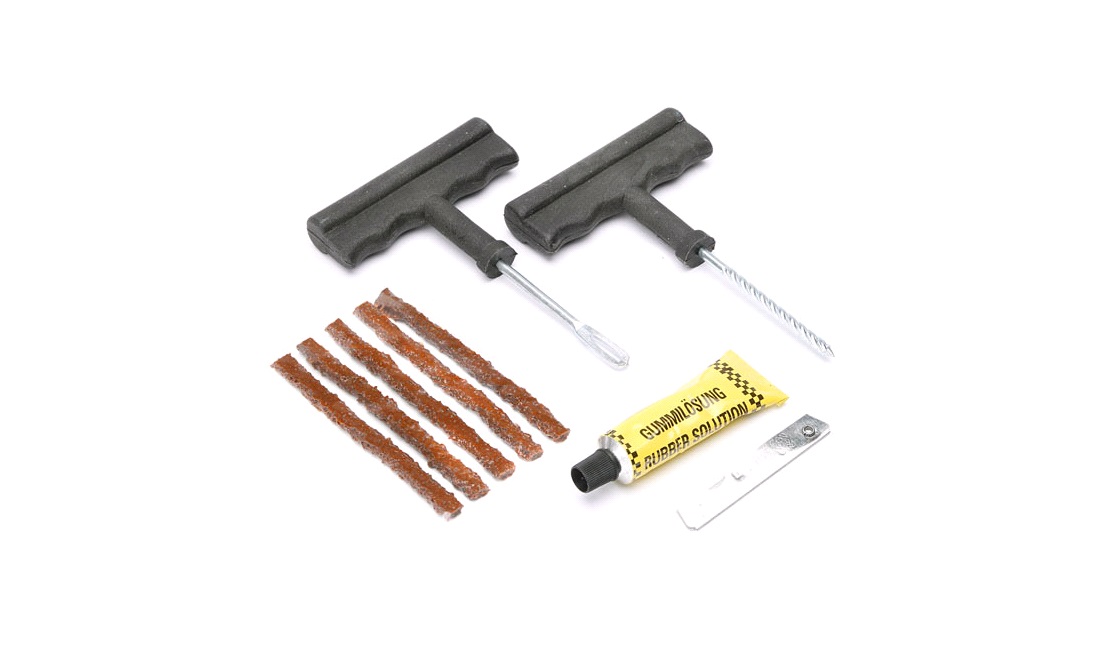
screw in tire plug ?

I can't help but wonder if a tapered "sheet metal" screw, made of aluminum for light weight, with no head but a slot cut in it for a tiny slothead screwdriver, wouldn't make an effective tire plug.


IMG_3770.jpeg
 
Last edited:
Some times the best thing to do is leave the screw/nail in the tire and pump it up, depending on how fast or slow of a leak. Myself I carry can of sealant/ worms and a small 12 volt compressor. But I have also fixed a tire with Ultra black Sealant by Permatex, waited a day before filling the tire with air. Tire held air till it wore out.
 
Some times the best thing to do is leave the screw/nail in the tire and pump it up, depending on how fast or slow of a leak. Myself I carry can of sealant/ worms and a small 12 volt compressor. But I have also fixed a tire with Ultra black Sealant by Permatex, waited a day before filling the tire with air. Tire held air till it wore out.
I wouldn't recommend anyone do that, get the screw out and plug the tire and you'll avoid any surprising situations.

IMG_4534.jpeg
 
Why I would leave a screw or nail in a tire would be when I'm in the middle of nowhere, first I will use my can of sealant,then keep it topped up with the compressor. Worms work okay at fixing a leak but can a be difficult to install when your outside in the cold in the middle of nowhere. Best repair is still a new tire, when you get back in town. The M.O.T. approved is a patch on the inside of the tire , screws don't always go in straight, a patch will seal and can't come out of the tire.
 
Last edited:
If you have discovered a leak and a screw that is stuck in the tire in the middle of nowhere, the last thing you want is several tire repairs one after the other because that is what you risk with a screw in the tire that has worked its way in so that the tire leaks air. If you plug a new tire that has been punctured, you can drive with the plug until it is worn out and needs to be replaced as this is a complete repair that I have carried out on both customer cars and my own motorcycles and cars many times. If you have pliers to remove the screw, tire plugs and tire spray plus maybe something to pump air with, you can't be left standing. If you don't find a leak, tire spray is a solution that will last until the tire is worn out. Good luck :thumb:
 
Good Judgement should always be used, I do agree ,get the leak fixed as soon as possible. OP asked if anyone has used a Amazon product. In the middle of nowhere is not a good place to try it out. Lack of air pressure is going to do more damage to a tire then the screw or nail left in till you get into town. Myself I don't like fixing stuff on the side of the road. Good reason to check tire pressure before every ride.
 
If you can plug it, remove the puncturing object, but if you can't, leave it in until you can plug it.

One extra step I do is re-ream the hole with glue on the reamer just before inserting the plug.
 
Good Judgement should always be used, I do agree ,get the leak fixed as soon as possible. OP asked if anyone has used an Amazon product. In the middle of nowhere is not a good place to try it out. Lack of air pressure is going to do more damage to a tire then the screw or nail left in till you get into town. Myself I don't like fixing stuff on the side of the road. Good reason to check tire pressure before every ride.
Though I agree with checking pressure before each ride, that does not protect you from a subsequent puncture during said ride. That’s why I run a TPMS. It gives an early warning of a puncture sustained in route.
 
Seriously been thinking about getting a TPMS for my bike, question is what brand and how accurate are they. Knock on wood, haven't had a nail or screw in the bike tires for a while now. Did have a blow out on the Dodge Van back in September 2022 , full tank of Gas ,load of roofing metal and trailer in tow , coming down a hill the Van got going faster than I wanted, and over heated the tire. Thankfully I did have a good Spare and tools to change the tire. Got into town and Replaced the rear tires .
 
Seriously been thinking about getting a TPMS for my bike, question is what brand and how accurate are they.

At this point accuracy to me is almost moot. Sure we want an accurate indicator but how do we know what's really accurate? Most of us don't have access to lab grade kit to compare it to. So unless a system was way out of the ballpark compare to an average of our perviously accumulated gauges we can't be really sure.

Barring a research/tested consensus from 'reliable sources' that a given brand is dodgy or worse I'm happy if it in some ball park and consistent. Some riders will know in short order if the tires are a pound or two off. That's not me. That why I use 42. It's what Honda recommends and coincidentally The Answer to the Ultimate Question of Life, the Universe, and Everything so how prefect is that!

Now this is where someone steps in to school me in excruciatingly boring detail how Honda's 42 is meant to be a recommendation only and varies with altitude and temperature and tire and speed and ad nauseam. Don't care. I'm tone deaf when it comes to tire pressure. But I know it's easier to get the bike on the center stand when at 42.

To that end my FOBO 2 system seems to be consistent. It's certainly convenient. These two factors work well for me. Other systems work well for other riders. I don't know if there's an inherently bad system on the market.

Most give you a wealth of information — more than I care about. In many decades of riding I've never given a thought to tire temperatures. Not once. It's 42 in the morning — go ride. It'll be 42 tomorrow too. If not act accordingly.

One of the key points I like about FOBO is a great app yes but that I can check the PSI (or kg/mm/whatever) without touching the bike. If your kitchen is close to the garage you can check while enjoying your bacon (the candy of meat) and eggs. Or muesli if that's how you roll. Or with a brief interruption of your YT dog and cat videos.

There are threads on the merits of various brands but some of that has changed over time. You might make a separate post about options with links. One thing to consider is that many of these are imported to the US. Tariffs may apply and be prohibitive.
 
I'll stick with Stop and Go plugs, and or Gummy worms.
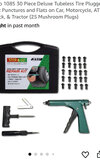
Can you tell me more about this Stop and Go product? I see there's a kit available on Amazon for under 50 bucks. I see that other sellers sell these mushroom shaped plugs in various sizes.
IMG_3789.jpeg


I have a piece of metal in my rear tire right now. It doesn't seem to be leaking badly just a couple pounds a week, but it could get worse. It looks like a very small nail (brad) or maybe a staple, and it went in at a 45° angle. It's pretty small diameter --kind of like a heavy duty office paper clip.

If I try to use a gummy worm plug on this hole, I would have to drill out / ream out the hole to make it 4X wider diameter before the gummy worm would fit.
 
Seriously been thinking about getting a TPMS for my bike, question is what brand and how accurate are they.
I agree with what STGui wrote above. Having an accurate TPMS is desirable but not the most important feature. Once you have determined the variance, it is more important that it be consistent in its indication. The consistency is what will allow you to know that something is wrong when what it indicates suddenly changes significantly and you know that you can trust that change in indication.

Below is an anecdote that illustrates how they can be useful. After I wrote the below others described similar situations where having a TPMS was an undeniable benefit.

TPMS
 
I left my Stop n Go kit in a rubbish bin at a roadside turn out after trying 3 times to plug a simple round hole in the middle of the tread. Luckily I had an old somewhat dried out gummy worm and tools as well. The dried out gummy worm fixed the hole on the first try.
I honestly don’t understand all the gimmicky newfangled plug systems they keep coming out with. Not only do they cost a lot more, but I find them harder to use, bulkier to pack, and less effective than tried and true gummy worms / ropes.
 
The dried out gummy worm fixed the hole on the first try.

Though I haven't tried any other method I had occasion where a nail punctured my tire at a 45º angle and a gummy fixed it first try as well. To this day I regret replacing a nearly brand new tire that a buddy plugged a few miles later out of fear the plug wouldn't hold. Lots of fresh glue and let it sit overnight and it hadn't lost any air. Who knew. I didn't.
 
Though I haven't tried any other method I had occasion where a nail punctured my tire at a 45º angle and a gummy fixed it first try as well. To this day I regret replacing a nearly brand new tire that a buddy plugged a few miles later out of fear the plug wouldn't hold. Lots of fresh glue and let it sit overnight and it hadn't lost any air. Who knew. I didn't.
Yeah, I’ve never replaced a plugged tire until it was worn out and needed replacement anyway. I had an incredibly bad run for a few years with multiple punctures in both my bike and our cars, I must have done 20 plugs over that period! One rear tire had four plugs in it by the time it was worn out. I’ve done just a few since and a few before.
Of all those plugs only one ever failed and it was a very slow leak. I just replugged it and carried on.
 
Back
Top Bottom