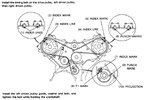
ST1100 Valve Clearance

Once I figured out the inch method,
This has been a mystery to me for decades.

Even back in the UJM days, with shim-over-bucket adjustments, (shims about the size of a quarter) the shims were always in 0.025mm increments. That hasn't changed since the 70s. I've never understood why the mfrs spec the valve clearances to 0.01mm resolution, when nobody makes metric feeler gauges in those sizes anyway, and the shims are in 0.025mm increments.

This has always been a job where 0.001" adjustment increments are the norm, even though the bikes are made in a metric-only country.

The only other thing I can think of, is if its possible to get an accurate 0.13mm measurement by stacking a 0.10mm and 0.03mm feeler gauge on top of each other. Even if that's a reasonable way to get the measurement, it still doesn't matter if you're off by 0.01mm because you're still stuck with 0.025mm adjustments anyway.
 
In spec, is in spec... even if it's right up against the edge, especially an older bike that's settled in.
Well, I'm also conservative and rather leave them on the "wide" side...
But with the proper tools, I can at least try to establish mid-range clearance... (chasing an annoying "ticks only when hot" on #1 for quite some time now ;))

Like John do I use angled SAE and metric feelers for the actual adjusting process (the full box of OEM shims is there and shall be used :cool:)
For "just checking" in between/once a year, the 5 pcs Wuerth set with the 0.10, 0.15, 0.20, 0.25 & 0.30 blades (actually sold in this configuration) does the job just fine...
 
Will the blades in a set of feeler gauge blades be able to be angled / bent at the desired angle or are they so brittle that they break?
 
Will the blades in a set of feeler gauge blades be able to be angled / bent at the desired angle or are they so brittle that they break?
The Würth ones took it without any issues; carefully bend by hand, left like this ever since as its perfect for any bike I've worked on...

The assorted (straight) blade universal kits are not really happy, and you've issues flipping them back into the holder...

Hence I bought the angled ones (SAE & metric) with the holder already angled, works nice...
I checked the SAE ones with my micrometer and labeled them (p-touch); now I've sufficient "in between" feelers to work with...
But as written in will 5 sizes do sufficient in 98% of the cases... ;)
The disadvantage of that generally so silent and oh so smooth V4: just one ticking valve starts to drive you nuts... like when you sit at a red light... tic-tic-tic... DAFUQ?!!!... :biggrin:
On a vintage engine that's already rattling like a bag of cloth-pins, you wouldn't care; as long as they're not in the "close" range you'd keep it rattling... ;)
 
Hope I have found the right shim here now for the intake on cylinder number 2, shim from Honda (195). Measured clearance is 0.070 mm, desired clearance on intake 0.160 and shim measures 2.050 mm

See pictures

14930-KT7-013 SHIM, TAPPET (1.925) 192
14931-KT7-013 SHIM, TAPPET (1.950) 195
14932-KT7-013 SHIM, TAPPET (1.975) 198

IMG_0392.jpeg

IMG_0394.jpeg
 
your math looks correct to me.

That valve is further out of spec than I've usually found on the ST1100, I'm surprised its that tight. That's 4 shim sizes adjustment, that's a lot.

Makes me wonder how tight they would have to get to cause valve issues. I think for intake there's probably a lot of tolerance beyond the specified range, for exhaust, not as much because of the heat.

Years ago I had a Yamaha sport bike where the first valve adjustment was at something like 27,500 miles. I had an intake at 0.002" or less, that was the thinnest gauge I had and IIRC even the 0.002" didn't fit. Even after that many miles, that far out of spec, I never had any issues with compression and ended up putting 118,000 miles on it before selling it.
 
That valve is further out of spec than I've usually found on the ST1100, I'm surprised its that tight. That's 4 shim sizes adjustment, that's a lot.

I agree with increasing’s (please share at least your firST name with us) math. And with Doug’s observations… that’s quite bit out of spec. What’s the mileage on that ST1100?

John
 
your math looks correct to me.

That valve is further out of spec than I've usually found on the ST1100, I'm surprised its that tight. That's 4 shim sizes adjustment, that's a lot.

Makes me wonder how tight they would have to get to cause valve issues. I think for intake there's probably a lot of tolerance beyond the specified range, for exhaust, not as much because of the heat.

Years ago I had a Yamaha sport bike where the first valve adjustment was at something like 27,500 miles. I had an intake at 0.002" or less, that was the thinnest gauge I had and IIRC even the 0.002" didn't fit. Even after that many miles, that far out of spec, I never had any issues with compression and ended up putting 118,000 miles on it before selling it.
According to previous owners (3), the last owner checked the valve clearances with his brother, I don't think they have been adjusted during the 105762 kilometers that the bike has been driven previously. No complaints about the engine, runs smoothly and nicely at idle with good performance while riding.
 
I agree with increasing’s (please share at least your firST name with us) math. And with Doug’s observations… that’s quite bit out of spec. What’s the mileage on that ST1100?

John
It's been driven total 105762 km. Need to increase the clearance on cylinder number 2. I can do a cylinder leak test to see if there's a leak at the intake valves :thumb:
 
Last edited:
I'm checking mine in thousands and I'm unsure what measurement to use. I end up with a 0.008 or 0.009. Both fit with some drag but I don't know if one is too tight or the other is too loose. I wish only one fit. Any suggestions how to distinguish which one is right?
 
I'm checking mine in thousands and I'm unsure what measurement to use. I end up with a 0.008 or 0.009. Both fit with some drag but I don't know if one is too tight or the other is too loose. I wish only one fit. Any suggestions how to distinguish which one is right?
Determining if the feeler blade is too tight during valve adjustment is a matter of feeling for the right amount of resistance, often described as “light drag.” If the feeler blade is stuck or requires a lot of force to move, it is too tight.
 
My first time I used feelers with some corrosion so I bought new ones and did it blindly, not knowing what feeler I was using. There was quite a difference so I did it a third time but still came up with two possible measurements. I think I’m influenced by knowing the tolerance range so I want it to be within range. I should probably go by the lighter feel of the two.
Is there a preference to being on the high or low end of the tolerance range when re-shimming?
 
Back
Top Bottom