Hi
@courtvfr
Welcome to the forum from West Yorkshire. Whereabouts in the UK do you live?
I have seen a photo of a VFR SMC and was surprised at how similar they look - but have no idea whether yours is the same version, or what the internal are like. Broadly speaking, they will be similar, since they do the same job and are manufactured by the same company.
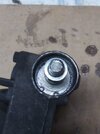
Check again for the relief port in the cartridge. On the one that I showed in the photos 3 posts back, the relief port is almost invisible. I've just gone to recover it from the garage and have taken a better photo:
The compensation port in the cartridge is in the centre of the red circle. It is a very tiny hole - way too small to get a pin through. The top E string of a steel strung guitar will just fit through it - and that is 0.25mm. The pin I just measures is 0.6mm. It is extremely difficult to see unless you know that it is there. Even then it isn't obvious.
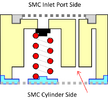
The large hole is the inlet port, and it is this that allows fluid to flow into the SMC, between the two piston seals, but the sprung valve - rubber stopper in this case - prevents fluid from flowing back.
There is another tiny compensation port in the bore of the SMC, and this can be seen most easily from the inlet port with the cartridge removed - again, shown in post #64, 3 posts back - circled in red. Both of these ports have to be clear. You cannot see if they are clear, you have to push a fine wire through them. A top E guitar string, or a primus stove pricker. They can become full of hardened gunge from old brake fluid if the fluid isn't flushed out properly and changed every two years at the very longest.
If you have had the cartridge out, make sure that it is replaced the correct way round. On my diagram, the valve / rubber faces outwards towards the fluid line.
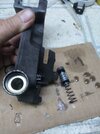
You had a rear brake lock up before you started looking at the SMC ? The compensation port is a real possibility, and I would seriously get a hand lens and a good light to try to find the hole in the cartridge. You cannot see it without taking the top or bottom off the cartridge. I've done it only once - on the photo you can see, and it came away cleanly - in fact I would be happy to reuse this one. The blue piece with the spring was the easiest side to get off. The other side having removed the O ring. I think I used a pin down the side as far down as I could get it and then levered it out gently - the pin bit into the side of the plastic. It deformed slightly and lifted out. I didn't care - it was a duff SMC, but in fact it came out quite cleanly.
But if you have read 'avoiding the pitfalls' you will know that there are other reasons for dragging brakes - front pads in the rear caliper, pad spring inserted the wrong way round, corroded pad pins, bent slider pins, too much grease on slider pins, corroded slider pins, pads not seating properly in the caliper at the tab end. Then at the front end - front left caliper dragging will cause the rear to drag. So pads that are too thick for he front caliper (eg adding a heat shield) will cause issues. The most common faults with the SMC is corrosion behind the circlip inside the bore, preventing the SMC piston from clearing the compensation port, an SMC that is no longer circular preventing the piston from moving properly - again, blocking the compensation port. But also, the front caliper has to be free to pivot, so if the needle roller bearings are not moving, it will not be able to move back.
Regarding this question:
I am not familiar with a ball bearing arrangement inside that cartridge in the SMC, but ball bearings are used in one way bleeding valves - I guess it is just an alternative to the little black top hat on mine. But it would not block the compensation port. The port has to be open all of the time when the SMC is not applying pressure - to allow expanding brake fluid an escape route and to allow contracting fluid to pull fresh fluid from the reservoir. Otherwise the brakes lock on.
There is also a compensation port in the master cylinder of the rear brake reservoir. If you try to push the pistons in by hand from the rear caliper (outer pistons), the fluid has to pass through a lot of brake line and through 4 compensation ports (I think). 2 in the SMC (1 in the bore, one in the cartridge) and again in the rear master cylinder. (I think the rear master has a cartridge, but I may be wrong about that - I have never looked).
Be very careful with the cartridge - the gauze is very fragile. In fact the whole thing is very fragile, and it is not listed as a spare component.
The compensation port and the inlet port both get their fluid from same banjo fitting, and the valve will act to stop any backflow from within the SMC bore. I can only hazard a guess as to why it is necessary. It will certainly help when bleeding the system - unless you like to fill the system from the bottom up using a syringe. That valve will stop the fluid from getting beyond the SMC !
But the reason it is there - I don't really know. I have a theory. It is a guess, and as such not worth the paper it is written on. So I'll write my guesswork in italics.
The inlet port to the SMC is also connected directly (via an extremely short hose) to the centre piston in the front left caliper. When the rear caliper outer pistons are activated it is as a result of the movement of the master cyclinder piston and/or the SMC piston. When the brake is released, the piston moves back to where it was - so in theory no fluid has to flow anywhere. Except after the brakes have been applied, the fluid is hotter, so there is a bigger volume of fluid, and it has to go somewhere.
Normally this would release slowly through the compensation port. First the SMC C port, then the master cylinder C port. Both very tiny holes. So I am guessing that in the SMC, if there is no safety valve, it could find a shortcut, and instead of waiting patiently for the master cylinder compensation port to relieve the pressure (up near the battery, past the Proportional Control Valve - which is also releasing pressure), it could return to the centre piston, pushing it out, applying the front brake, applying the SMC and activating the rear brake.
All hypothetical, and I don't know the answer. But that valve is there for a reason and it has been carefully thought out, and it works really well. Unless the servicing has been neglected. I certainly wouldn't want to drill it out.