Article [13] ST1300 - Brake Maintenance - Avoiding the Pitfalls

I'm glad that works for you. I believe I got an excellent bleed using my setup with vacuum, check valve, and lever and pedal pumping. My brakes are now rock solid.
Best
/r
B
 
The vacuum bleed method is pretty good for filling up the system in the first place, and it is also useful for dislodging air bubbles in bends and at joints. It leaves you hands free to go round tapping and flexing.
After that the vacuum sucks. Ie it sucks air from the outside past the threads on the bleed valve - so it isn't sucking enough fluid / air from the lines. ie it works well when there is a lot of air and not much fluid. It doesn't work well when there is only a little air in the lines.
To get really good brake feel, you have to push the air out using the brake lever or pedal as pumps.

But the last time I did it, I really couldn't be bothered getting the vaccuum pump out and I didn't miss it at all. I got pressure in the lines quite quickly and after that it was a case of chasing air bubbles. This was starting with a completely empty system - brake lines had been off. The brakes worked, but the levers didn't feel firm. I couldn't pull them back to the abrs, but I could pull them a long way towards the bars. That's no good for me.

There gets to be a point when the brakes work ok, but they do not feel tight - and you cannot get any more air out. That is time to weight the pedal down and tie the brake lever back and leave it over night. Use something that will take up the slack - a rubber guy on the front lever. I pump up the rear barake a few times to build up some pressure and then hang a heavy weigth on the pedal - left dangling.
Then bleed each valve in order the following day. At first it is clear, but then a whole cloud of milky white bubbles come out. This was from a system where I could not get any more air out the night before.

Pressure bleeders - that method pushes fluid back to the reservoir. The fluid cannot get past the primary seals, so it has to go via the compensation port. So all of the fluid that is behind the primary seal and behind the secondary seal, never gets changed. And that can be where the troubles begin.
 
Last edited:
I am known to occasionally be hardheaded.
Sometimes, it's most of the time.
For a while, I argued with Larry about using my MityVac while bleeding the brakes for the first time. He was rather patient, and eventually I found his way was easier, using the MotionPro one-way bleeder.
No point in arguing, and I understand some have a different protocol that works for them, and that's fine.
I will say, though, when the brakes on the ST1300 are bled properly (whatever works for you, meaning ALL the bubbles are gone), these brakes are really, really good at stopping forward motion.
Just do it right, whichever method works for you.
 
I'm glad that works for you. I believe I got an excellent bleed using my setup with vacuum, check valve, and lever and pedal pumping. My brakes are now rock solid.
Best
/r
B
While you believe you got an excellent bleed with your method, try this, put your lever on the first position, place your hand on the grip, and your index finger on the lever and pull.
If the lever moves more than 1/2 inch at the contact point where your finger is, your system still has air in it.
Not suggesting that you try my second test, but 40mph, grip tank with knees, two fingers on lever, grab lever….
I can lift the rear wheel off the ground and do stoppies even with ABS.
;)
 
Reverse bleeding does that, not pressure bleeding.
When I see 'pressure bleeding' - I have always assumed that people pump fluid up from the bleed valves.

I may be wrong - but I have never seen a device that applies pressure from the motorcyle reservoirs. Also the brake system master cylinder provides an effective means of forcing fluid down the lines from the top - although that is not continuous pressure, but it is effective - but no guarantee that it pushes the air bubbles with the flow.

I've seen a device that replaces the screw on cap for a car's hydraulic fluid reservoir, so that pressure can be applied - eg by a compressed air attachement - but have never seen something that does the same for a motorcycle.

So is there stuff here that I need to learn - how do people pressure bleed a motorcycle circuit from the top end ?
 
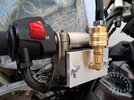
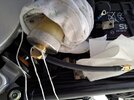
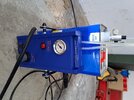
Quite simply.

Unfortunately, the Manotec website is only available in German.

Holm from Germany
 

Attachments

  • 20220417_122652.jpg
    20220417_122652.jpg
    124.9 KB · Views: 8
  • 20220417_122718.jpg
    20220417_122718.jpg
    138.7 KB · Views: 8
  • 20220417_122759.jpg
    20220417_122759.jpg
    139 KB · Views: 8
When I see 'pressure bleeding' - I have always assumed that people pump fluid up from the bleed valves.

I may be wrong - but I have never seen a device that applies pressure from the motorcyle reservoirs. Also the brake system master cylinder provides an effective means of forcing fluid down the lines from the top - although that is not continuous pressure, but it is effective - but no guarantee that it pushes the air bubbles with the flow.

I've seen a device that replaces the screw on cap for a car's hydraulic fluid reservoir, so that pressure can be applied - eg by a compressed air attachement - but have never seen something that does the same for a motorcycle.

So is there stuff here that I need to learn - how do people pressure bleed a motorcycle circuit from the top end ?
Pumping brake fluid through the caliper bleed nipples up to the master cylinder is commonly referred to as reverse bleeding here as the fluid flow is being reversed from its normal direction. Pressure bleeders pump brake fluid through the system in the normal direction from the master cylinder down to the calipers. They do it at a sustained elevated pressure and with a uniform high volume flow of brake fluid.

Pressure brake bleeders are a common tool in the automobile industry. My personal use of them, and what I have mostly seen in the places where I have worked, is that they are rarely used for regular bleeding of the hydraulic system. They are mostly used for flushing the hydraulic system, or flushing and refilling it if it had been opened and drained to accomplish a repair. They are many different adapters that fit over the master cylinder in place of its cover and they force brake fluid through the system at an elevated pressure. The one that I used operated at 30 P.S.I.. The biggest advantage that they have is the sustained high volume of fluid that they can run through the system, which does a good job of flushing things out. Afterwards it was standard procedure to do a final bleeding using the traditional method using the vehicles brake system to supply the pressure.

I have never looked for one but I would not be surprised if there is a pressure bleeding system that is marketed specifically for motorcycles. I am sure that one of the adapters that are used on automobile brake systems could be made to work as well.
 
Last edited:
Thanks @Andrew Shadow and @wizel .

A neighbour once gave me a kit for this - and it wouldn't work on the bike. The standard caps didn't fit the rear reservoir, and although I looked, nothing was readily available for the front. If I had decent metal workshop, it would be easy enough to farbricate something but I never bothered. The method I used was plenty good enough and it is even better now I have some fresh clear hose and 5 usable one way valve bleeders.

I never bothered with the syringe / reverse bleeding method - knowing that it would have to go through the tiny compensation ports and still wouldn't prevent air from getting trapped.
 
Back
Top Bottom