ST1100 Valve Clearance

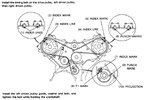
My Clymer manual indicates two separate procedures to remove the cams. Align the index line on the right driven pulley and remove the right cams then align the punch mark on the left driven pulley to remove the left cams. It’s the same procedure when installing the cams. It seems like some are removing all cams when #1 cylinder is at TDC and disregarding this two-step procedure.
 

Attachments

  • IMG_3470.jpeg
    IMG_3470.jpeg
    326.7 KB · Views: 4
I'm checking mine in thousands and I'm unsure what measurement to use. I end up with a 0.008 or 0.009. Both fit with some drag but I don't know if one is too tight or the other is too loose. I wish only one fit. Any suggestions how to distinguish which one is right?
One thousandth will make no difference at all as long as you are within the specified tolerance. When in doubt go looser (within spec). If the clearance is too low out of spec, the valves will not close on their seats and can result in a burned valve. I'm talking about 0 clearance between the cam and the bucket. As @increasing said his was tight and out of spec with no evident damage.

When the exhaust valve closes, it transfers some of the heat it picked up to the cylinder head. I've read that the valves will be glowing red at freeway speeds. If it does not seat, compression suffers and that heat is not dispersed - result is a burned valve.
 
Last edited:
I'm checking mine in thousands and I'm unsure what measurement to use. I end up with a 0.008 or 0.009. Both fit with some drag but I don't know if one is too tight or the other is too loose. I wish only one fit. Any suggestions how to distinguish which one is right?
there should be a noticeable difference in drag between the two, unless the actual clearance is bigger than both of them and you're just feeling the drag from residual oil.

I've found that sometimes you can shove one in that seems like it really doesn't want to go in, but with extra force it will. I note that as a "tight" (whatever gauge it is) in my notes. Anything smoother than that I call the number on the gauge. so if you're not having to really force the 0.009 in there, I'd say 0.009 is your clearance, but would also try 0.010 to make sure its no wider than 0.009. Usually what happens is one gauge will go in smoothly, and the next one that's 0.001 thicker won't go in at all. So I'd rule out 0.008 as your clearance based on your description.
 
Back
Top Bottom