Article [13] ST1300 - Water Pump Weep Holes

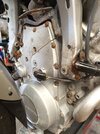
What people are calling the "square hole" is not a hole at all, but rather the edge of the front cover where it meets the front engine case.
I would NOT blow anything in this area, as you could damage the small rubber sealing O-ring, and make what ever leaks you have worse.
You may want to remove the water pump cover and replace the O-ring while your at this point to save you from doing everything twice.
;)
 
...I am in the process of finding and fixing some coolant leak from the V and I am wondering if it could be helpful to use compressed air to clean the drainage path?
Hi Jacques:

I agree with Larry (@Igofar ) - I don't think it is a good idea to use compressed air to try and clean that drainage path. It is unlikely you would gain any benefit from doing that, and as Larry pointed out, you could do considerable damage.

The pathway that leads down to the 'square hole' outlet is intended to allow water that might accumulate in the 'V' of the engine to drain out. About the only time I think you would get any accumulation of water in there is when you are washing the motorcycle with a hose and you squirt the water into the sides of the engine. Any water that might somehow get in there when you are riding will be evaporated very quickly once it lands on the hot engine case... so no need to worry about water accumulation when riding.

What you could do, if you so desire, is to deliberately shoot some water from the hose into the 'V' of the engine, then observe to see if water then drains out of the square hole. If you do see water drainage, that's a good enough result, it proves to you that the pathway is open. That means that if in the future, a coolant hose up in the V of the engine starts to leak, you will see evidence of coolant having leaked out of the square hole (dried green stains below the square hole).

If you squirt water up into the 'V' and nothing comes out of the square hole, that means the passageway is blocked... but personally, I don't think that keeping that passageway open warrants the massive amount of disassembly you would have to do to clean it out. Better to wait until you have the throttle bodies off for some other reason - that will allow you to check the entranceway to the drain passage and see if the entranceway is plugged up with something. Or wait until you have to work on the water pump and you have the smaller, right-hand portion of the cover on the front of the engine case off.

Michael
 
Well, it looks like I have some work to do. I have not ridden the bike for a few months. I have started it up every week or so and let it warm up on the side stand. I started it and moved it the other day. As I parked it, I saw a small pool of coolant, maybe 3 ounces, under the front of the bike. I removed the right side covers and saw that it had been coming from the SQUARE hole. I thought the pump seal must be bad until I came here and read this thread. So, I gather the leak is probably a hose to or from the T-stat. Argh! Anyway, I really appreciate this thread. The workshop manual misleads you in a way. Since this hole is under the water pump, your natural inclination is to look at that section of the manual, and I saw no discussion there of the square hole. I assumed the water pump shaft seal must be bad even though there is no further flow at this point running the bike on the side stand. I guess there's no way around removing the tank, airbox and throttle body to get to the T-stat and the valley this hole drains. Thanks.
Hello. I am facing the exact same thing today. Only clean coolant comes out of the square hole. If I understood from what you said, this is not a pump leak? Is it something more serious? Please help . I need to know before going to a technician. In my country, the technicians do not know this model at all. Thanks
 
Most likely it is a loose hose clamp. If you remove the air cleaner and the radiator you can get to most of the hose clamps. A lot has been written on this forum about these leaky clamps, a bit of searching will most likely be of great benefit.
 
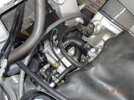
There are two 'weep holes' on a ST 1300 motorcycle. They serve entirely different purposes and have nothing to do with each other. Because the two outlets (the "round hole" and the "square hole") are located very close together, this sometimes causes confusion.

I'm not sure which hole you are talking about... your question suggests that you are asking about the "round hole" (the water pump drain), but that hole is very unlikely to get plugged up. The hole that is at greatest risk of getting plugged up is the "square hole".

Below you will find a series of photos that illustrates the path liquid travels before it drips out of either one of these holes.

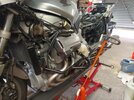
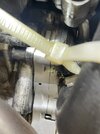
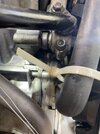
First, let's identify the two holes. The photo below is of a 2012 ST. Early production models did not have the metal elbow and rubber drain hose extension on this hole -they just had a round hole. I think the elbow and rubber hose were added at the beginning of model year 2007 or 2008 production.

Drain Holes
Coolant Drain Holes.jpg

The round hole (upper hole) is the simplest and easiest to understand. It allows engine coolant to drain out of the water pump if there is a failure of the seals within the water pump. The two photos below show you everything you need to know about the approximately two-inch long path from the innards of the water pump to the round hole outlet on the side of the engine.

Front View of Round Hole
The snowflake-shaped thing is the water pump.
Water Pump Weep Hole Outlet - front.jpg

Rear view of water pump
You can see the little molded channel leading from the inside of the water pump to the round drain hole - look at the 4 o'clock position.
Rear View Water Pump.jpg

That's all there is to the round hole. Very simple, very straightforward, a very short drainage path that serves one purpose only. If you discover coolant (or, God forbid, oil) leaking out of the round hole, the water pump will need to be replaced.

- - - - - - - - - - - - - - - - - - - - - - - - - - - - - - - - - - -

The Square Hole

The purpose of the square hole is to drain liquid from the 'V' between the two banks of cylinders. The 'liquid' could be anything - perhaps clean water from sources external to the motorcycle that gets into the V between the cylinders when you are washing the motorcycle, perhaps oil that leaks from somewhere (who knows where) into the V, or (most probably) small amounts of engine coolant that leak from hose connections in the 'V' area.

The next series of pictures will follow the path of liquid that drains out of the square hole, but in reverse. In other words, the pictures will start at the outlet of the square hole and work their way back until reaching the bottom of the V at the front of the engine.

Front of Engine (Water Pump Cover Removed)
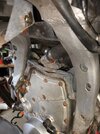
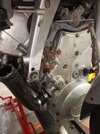
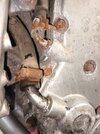
Here you can see the square hole outlet in the lower left, and the inlet to the channel leading to the square hole.
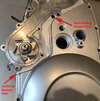
Square Hole 1.jpg

Same picture as above, but before cleaning things up
When the water pump cover is installed, it creates a square channel that allows liquid and debris (usually sand that gets thrown up into the V by the rear wheel) to flow out the hole at the top, down the channel, and out onto the ground.
Square Hole 2.jpg

The opposite side of the above photo
The hole at the tip of the arrow is the same hole as the upper hole in the picture above.
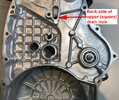
Square Hole 3.jpg

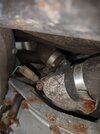
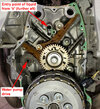
This photo is taken from the front of the moto, looking aft at the front of the engine, after the big cover in the three photos above has been removed.
Note that the liquid (and debris) enters from the hole at the top, drops down about half an inch, then exits via the hole shown in the photo above. This chicane creates a problem: if there is a large amount of debris, the drainage path will plug up at this point, and it is very difficult to clean it out without full disassembly.
Square Hole 4.jpg

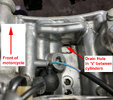
Finally, where it all starts
This photo shows the drain hole in the V at the front, top of the engine. It is the opposite side of the photo directly above.
Square Hole 5.jpg

If the drainage path between the hole in the V shown directly above and the square hole on the side of the motorcycle (shown on the first picture at the very top) becomes plugged, water will not drain from the V between the cylinder banks. The bottom part of the alternator may become submerged in liquid, and debris that accumulates in the V may be carried into the alternator by the liquid.

I hope this answers your question.

Michael

Excellent pictures. Big help.
Looks like the Honda manual fails to mention the fact that the crankcase cover needs to be removed too.
This post verified it. I thought I was missing something reading the service manual. Looks like I lost my mechanical seal as I can watch it drip while idling out of the round hole through the drain elbow and hose.
I have some work to do.
 
Excellent pictures. Big help.
Looks like the Honda manual fails to mention the fact that the crankcase cover needs to be removed too.
This post verified it. I thought I was missing something reading the service manual. Looks like I lost my mechanical seal as I can watch it drip while idling out of the round hole through the drain elbow and hose.
I have some work to do.
Yeah they got me too as they didn't elaborate about front cover and the parts lookup for water pump parts just shows only that if the cover was in the parts diagram it would have been obvious. Cause of a second parts order for gasket and the 2 o-rings also my observation order 2X 51486-087-711 (large pilot collars the o-rings go on) as both corroded and one stuck in block and kind of crucial in the whole oil coolant/ sealing. Just my 2 cents YMMV.
 
Thanks to breaking my ribs in a fall in January I'm about six weeks behind schedule for what I'd hoped was "just" the replacement of my bike's alternator. I flushed a lot of grit and muck out of the drain hole, which was nearly blocked up when I first got down that far. Everything went back together pretty well. I fired it up today and I have good voltage again, but now I've got to find where the engine is leaking coolant! It's a drip every few seconds so I can't ignore it. Given that it's coming from the square hole it's probably at the thermostat housing. I did all the hose clamps up nice and tight, and replaced some very rusted spring clips, so unless a hose has cracked – and I had a good look at them all – I've no idea where the problem lies just yet. I really can't face pulling the throttle bodies off again: that was a hell of a job.

Are Honda hoses still available to buy? About the best we can do here is Halfords which is overpriced at best, and at worst has little of use. Samco doesn't do a kit for the 1300 as far as I can tell.
 
Are Honda hoses still available to buy? About the best we can do here is Halfords which is overpriced at best, and at worst has little of use. Samco doesn't do a kit for the 1300 as far as I can tell.

Yes, you should be able to pick up what you need. Check David Silver Spares, in the UK

By removing the air box, you can peel the rubber sheet back to see most of your hoses without removing the throttlebody.

Anytime I remove any plumbing hose, I replace it. I don't trust them after they have been used.

DSC03738.JPG

Good luck in finding that leak!
 
There are two 'weep holes' on a ST 1300 motorcycle. They serve entirely different purposes and have nothing to do with each other. Because the two outlets (the "round hole" and the "square hole") are located very close together, this sometimes causes confusion.

I'm not sure which hole you are talking about... your question suggests that you are asking about the "round hole" (the water pump drain), but that hole is very unlikely to get plugged up. The hole that is at greatest risk of getting plugged up is the "square hole".

Below you will find a series of photos that illustrates the path liquid travels before it drips out of either one of these holes.

First, let's identify the two holes. The photo below is of a 2012 ST. Early production models did not have the metal elbow and rubber drain hose extension on this hole -they just had a round hole. I think the elbow and rubber hose were added at the beginning of model year 2007 or 2008 production.

Drain Holes
Coolant Drain Holes.jpg

The round hole (upper hole) is the simplest and easiest to understand. It allows engine coolant to drain out of the water pump if there is a failure of the seals within the water pump. The two photos below show you everything you need to know about the approximately two-inch long path from the innards of the water pump to the round hole outlet on the side of the engine.

Front View of Round Hole
The snowflake-shaped thing is the water pump.
Water Pump Weep Hole Outlet - front.jpg

Rear view of water pump
You can see the little molded channel leading from the inside of the water pump to the round drain hole - look at the 4 o'clock position.
Rear View Water Pump.jpg

That's all there is to the round hole. Very simple, very straightforward, a very short drainage path that serves one purpose only. If you discover coolant (or, God forbid, oil) leaking out of the round hole, the water pump will need to be replaced.

- - - - - - - - - - - - - - - - - - - - - - - - - - - - - - - - - - -

The Square Hole

The purpose of the square hole is to drain liquid from the 'V' between the two banks of cylinders. The 'liquid' could be anything - perhaps clean water from sources external to the motorcycle that gets into the V between the cylinders when you are washing the motorcycle, perhaps oil that leaks from somewhere (who knows where) into the V, or (most probably) small amounts of engine coolant that leak from hose connections in the 'V' area.

The next series of pictures will follow the path of liquid that drains out of the square hole, but in reverse. In other words, the pictures will start at the outlet of the square hole and work their way back until reaching the bottom of the V at the front of the engine.

Front of Engine (Water Pump Cover Removed)
Here you can see the square hole outlet in the lower left, and the inlet to the channel leading to the square hole.
Square Hole 1.jpg

Same picture as above, but before cleaning things up
When the water pump cover is installed, it creates a square channel that allows liquid and debris (usually sand that gets thrown up into the V by the rear wheel) to flow out the hole at the top, down the channel, and out onto the ground.
Square Hole 2.jpg

The opposite side of the above photo
The hole at the tip of the arrow is the same hole as the upper hole in the picture above.
Square Hole 3.jpg

This photo is taken from the front of the moto, looking aft at the front of the engine, after the big cover in the three photos above has been removed.
Note that the liquid (and debris) enters from the hole at the top, drops down about half an inch, then exits via the hole shown in the photo above. This chicane creates a problem: if there is a large amount of debris, the drainage path will plug up at this point, and it is very difficult to clean it out without full disassembly.
Square Hole 4.jpg

Finally, where it all starts
This photo shows the drain hole in the V at the front, top of the engine. It is the opposite side of the photo directly above.
Square Hole 5.jpg

If the drainage path between the hole in the V shown directly above and the square hole on the side of the motorcycle (shown on the first picture at the very top) becomes plugged, water will not drain from the V between the cylinder banks. The bottom part of the alternator may become submerged in liquid, and debris that accumulates in the V may be carried into the alternator by the liquid.

I hope this answers your question.

Michael
Wow , Nice job, great article ! Now off to look for the square hole !
 
I have removed the bodywork from my pan to replace the Clutch smc on another thread.
I noticed green fluid had been leaking.
1000006070.jpg
I did some searching on this thread and started to trace the leak.
1000006068.jpg
It is leaking from the square hole, the water pump and seal and gaskets were replaced about 12 months ago.
One i have replace the clutch smc i will remove the radiator and airbox.
 
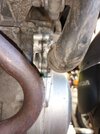
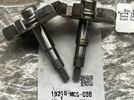
I had a minor leak of coolant from the water pump drain hole (round one). Here's a pic of the old vs new pump.
That was 5 years ago when I replaced it, and the mechanical seals. It's been good ever since.
In the middle of seal replacement myself. Glad I ordered a new impeller with the seals as the old one's shaft was scored. Probably would have damaged the new seals if not replaced.

tempImageKb1D9F.png
 
I have removed the bodywork from my pan to replace the Clutch smc on another thread.
I noticed green fluid had been leaking.
1000006070.jpg
I did some searching on this thread and started to trace the leak.
1000006068.jpg
It is leaking from the square hole, the water pump and seal and gaskets were replaced about 12 months ago.
One i have replace the clutch smc i will remove the radiator and airbox.
I have replaced smc and attended to some other items.
I started the bike and brought it up to temperature.. There was no signs of any leaks and the temperature stayed at three bars, with the fans kicking in occasionally.
20250727_151221.jpg20250727_151227.jpg
I have removed the radiator.
20250727_151221.jpg20250727_151227.jpg20250727_182516.jpg20250727_182519.jpg20250727_182525.jpg
 

Attachments

  • 20250727_182548.jpg
    20250727_182548.jpg
    165.4 KB · Views: 22
  • 20250727_182533.jpg
    20250727_182533.jpg
    170.8 KB · Views: 22
  • 20250727_182554.jpg
    20250727_182554.jpg
    144.4 KB · Views: 21
  • 20250727_182601.jpg
    20250727_182601.jpg
    131.5 KB · Views: 22
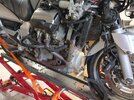
I had the occasion to start my bike up yesterday with all the right side plastics removed for some other maintenance.
(2007 ST-1300 with 52,000 miles).

I didn't think there was a problem with any coolant leak, but I got on the floor and watched the right side of the engine while it was idling and I saw pretty steady dripping coming out of my weep hole!

I didn't get a picture of it then, and that part of the engine was kind of dirty and grimy anyway. So I checked the coolant level and everything was good, so I did take the bike out yesterday for a two hour ride which only cover 35 miles because I live in suburbia and all the roads were rather congested .

I stopped the bike a couple of times during my ride to get down on the ground next to it and look at the engine again. I did not see anything dripping during those stops, even after the engine was good and hot.


Later I parked it in my garage and did not see any wet spots on the floor the next morning. .

Today I cleaned off the engine with engine degreaser, a rag, and some Q-tips.
The coolant was right up to the radiator cap today the same as it was yesterday before my ride. (if the level in the overflow bottle on the bike's left side changed any, I would not know because I cannot see any part of that bottle other than the neck at the top opening when the left side Tupperware is in place.)


I started the bike and let it idle up to 2 bars of coolant temperature.

No dripping at all --not one single drop.
Nothing coming from the little weep hole nor was anything coming from that larget square hole / molded in drain channel either.


Now, as to the question of why it would drip from the weep hole yesterday during the initial few minute warm-up time idling in my driveway but not today-- it didn't do the same thing 24 hours later under the same conditions --- perhaps the answer is that yesterday was the first time the bike has been run in eight weeks??

IMG_3846.jpegIMG_3845.jpeg

IMG_3847.jpeg
 
Last edited:
I have replaced smc and attended to some other items.
I started the bike and brought it up to temperature.. There was no signs of any leaks and the temperature stayed at three bars, with the fans kicking in occasionally.
20250727_151221.jpg20250727_151227.jpg
I have removed the radiator.
20250727_151221.jpg20250727_151227.jpg20250727_182516.jpg20250727_182519.jpg20250727_182525.jpg

I can see several signs of coolant leaks in your pictures.
The lower engine block on the right side
Next to several hoses and clamps.
All that green, or blue/green crap that stained around all the seams and fittings are coolant leaks.
Go out there at night and use a black light, you’ll be amazed at all the leaks.
And….just so you know, these bikes will almost never leave coolant on the ground unless a hose is leaking, the water pump weep hole is leaking, the plastic three way tee is cracked etc.
Instead coolant steams off the engine and never reaches the ground.
 
I had the occasion to start my bike up yesterday with all the right side plastics removed for some other maintenance.
(2007 ST-1300 with 52,000 miles).

I didn't think there was a problem with any coolant leak, but I got on the floor and watched the right side of the engine while it was idling and I saw pretty steady dripping coming out of my weep hole!

I didn't get a picture of it then, and that part of the engine was kind of dirty and grimy anyway. So I checked the coolant level and everything was good, so I did take the bike out yesterday for a two hour ride which only cover 35 miles because I live in suburbia and all the roads were rather congested .

I stopped the bike a couple of times during my ride to get down on the ground next to it and look at the engine again. I did not see anything dripping during those stops, even after the engine was good and hot.


Later I parked it in my garage and did not see any wet spots on the floor the next morning. .

Today I cleaned off the engine with engine degreaser, a rag, and some Q-tips.
The coolant was right up to the radiator cap today the same as it was yesterday before my ride. (if the level in the overflow bottle on the bike's left side changed any, I would not know because I cannot see any part of that bottle other than the neck at the top opening when the left side Tupperware is in place.)


I started the bike and let it idle up to 2 bars of coolant temperature.

No dripping at all --not one single drop.
Nothing coming from the little weep hole nor was anything coming from that larget square hole / molded in drain channel either.


Now, as to the question of why it would drip from the weep hole yesterday during the initial few minute warm-up time idling in my driveway but not today-- it didn't do the same thing 24 hours later under the same conditions --- perhaps the answer is that yesterday was the first time the bike has been run in eight weeks??

IMG_3846.jpegIMG_3845.jpeg

IMG_3847.jpeg

Was there a reason you left your over flow cap off the coolant tank in your pictures?
To answer your other question, maybe your leaking water pump mechanical seal pooled enough coolant in the housing and starting it up after that time pushed it out faster.
The weep holes can often clog up and prevent fluid/coolant from coming out until you get it full enough to blow through the clog after a while.
Think if it a different way, if you walk out and find a flat tire, and fill it up with air, and it seems to hold air while you look at it, does that mean in may not have a puncture?
But yet ever few weeks your tire keeps loosing pressure.
If the coolant came out Dripping, your mechanical seal has given up, coolant can’t make it past that seal unless it’s failing.
The manual for 07 and newer indicates that a slight bit of moisture at the end of the hose is normal.
Leaking is not.
If you see a nail in your tire, but it’s just a slow leak, so you just keep adding air, and riding on it without repairing it, that is a choice.
The same goes for your coolant leak.
You can deal with it and repair it, or just keep riding it that way until it damages other stuff.
Your bike, your choice.
 
Was there a reason you left your over flow cap off the coolant tank in your pictures?

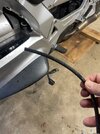
Yeah, I had been looking for a semi flexible thing to stuff down there to use as a dipstick --because I can't visually tell how high the coolant level is in that overflow bottle.
SUCCESS! I finally found a cut off section of air hose from a broken manual air pump that seems to work pretty well. (Of course I did clean it off first.)

And the level of coolant --when the bike was cold, at the time that photo was taken--was halfway.
I did't add any recently; I have not added any coolant in a few months and a couple thousand miles of riding.
But I will keep a close eye on it checking this bottle (cold) every day before I ride.
And as long as my right side fairings are off I will also manually check the radiator at the cap.

IMG_3851.jpeg
 
Think if it a different way, if you walk out and find a flat tire, and fill it up with air, and it seems to hold air while you look at it, does that mean in may not have a puncture?
But yet ever few weeks your tire keeps loosing pressure.
...
If you see a nail in your tire, but it’s just a slow leak, so you just keep adding air, and riding on it without repairing it, that is a choice.


Funny you give that as an example...
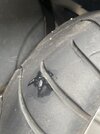
I found a nail in my rear tire while it was up on the table lift at ANIWACK's shop.

Pressure was still good, so I rode it home (45 miles).

Checked the tire pressure a few times since then as it sat in my garage. I seems to have lost 10 pounds of pressure from June until the end of September (42 down to 32 psi).
I rode it a couple days ago for 38 miles. Now I pumped it up to 40 lbs and rode it to two different Christian Motorcyclists' Association events today. Still holding air --or let's say the leak is so slow you can't measure it day by day; you can measure it with weekly checks.

I'll fix this tire when I get a round Tuit.

IMG_3856.jpeg
 
Funny you give that as an example...
I found a nail in my rear tire while it was up on the table lift at ANIWACK's shop.

Pressure was still good, so I rode it home (45 miles).

Checked the tire pressure a few times since then as it sat in my garage. I seems to have lost 10 pounds of pressure from June until the end of September (42 down to 32 psi).
I rode it a couple days ago for 38 miles. Now I pumped it up to 40 lbs and rode it to two different Christian Motorcyclists' Association events today. Still holding air --or let's say the leak is so slow you can't measure it day by day; you can measure it with weekly checks.

I'll fix this tire when I get a round Tuit.

IMG_3856.jpeg
Are you aware that continually running with a nail/screw in a tire usually makes the hole larger and pushed too far, it will usually spit out the offending object causing an almost instant flat? It is baffling why you wouldn't repair that right away. If you look on a map, "round tuit" is usually on the side of a road about a hundred miles from your home. Tell us you at least carry a repair kit on the bike for that inevitable roadside repair. Hopefully you dont crash when the tire suddenly deflates... Good luck
 
Hmmm... what you describe about a sudden flat on the road has actually never happened to me in 40 years of driving cars and light trucks, but it is possible.
Usually I find my flat tires after the bike or the car has been parked overnight. I've had them get soft during use, however, and needed to air them up in the middle of the day.

I do carry a tire repair kit featuring those gummy worms, plus an aerosol can of
Fix a Flat.
 
Back
Top Bottom